THE CLASSIC COLLECTION✦An outlaw’s diary: the CommuneCLASSIC FREE BOOKS
An outlaw’s diary: the Commune
Cécile Tormay
THE CLASSIC COLLECTION · 1906
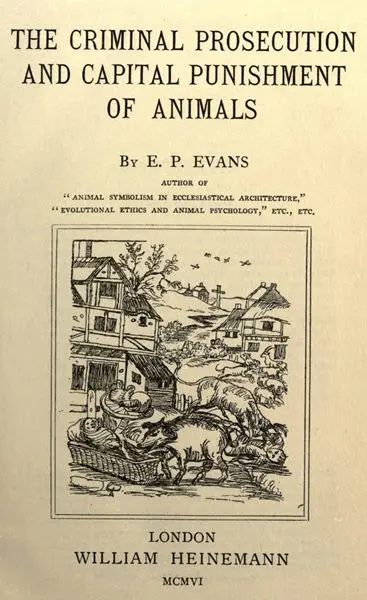
"The Criminal Prosecution and Capital Punishment of Animals" by E. P. Evans is a historical account written in the early 20th century. The book delves into the fascinating, if bizarre, legal practices of prosecuting animals for crimes in medieval and early modern Europe, exploring the absurdity and seriousness with which these cases were handled. It investigates the implications of these trials within the contexts of societal norms, religion, and the evolution of legal thought. The opening of the work outlines the origins of animal trials and the varying perspectives on their legality, notably the distinctions made between different types of prosecutions—those for domestic animals versus vermin. Evans introduces Bartholomew Chassenée, a jurist famous for defending rats charged with crop destruction, illustrating the lengths to which legal arguments were stretched to defend these creatures. He also discusses the interplay between secular and ecclesiastical courts in such cases, underscoring the peculiar belief that animals could be held accountable for their actions as if they were human actors in the legal system. Overall, this section sets the stage for a deeper exploration of the cultural and legal ramifications of treating animals as subjects of criminal law.
Introduction adapted from the source catalogue; source summaries may be automatically generated.
Free to read · English · 87,241 words · No account needed
MAKE TIME FOR A GOOD BOOK
On by default. Untick to stop anonymous reading totals. Each page counts after 10 seconds in view. How this works.
Anonymous counting is on unless you have switched it off.
Mediæval legislators were not restrained by any scruples of this sort; they regarded the criminal, both human and animal, as the sole author of the crime, ascribing it simply to his own wickedness and never looking beyond the mere actual deed to the social influences, psychical and physical characteristics and inherited qualities, that impelled him with irresistible force to do iniquitous things. This was doubtless a very narrow, superficial and utterly unphilosophical view of human action and responsibility; the danger now-a-days lies in the opposite extreme, in the tendency to pity the vicious individual as the passive product and commiserable victim of unfortunate conditions, and while engaged in the laudable attempt to improve these conditions by working out broad and benevolent plans of permanent relief and reformation for the future amelioration of society, to relax penalties and to fail in providing by sufficiently stringent measures for its present security. Tribunals have only to do with individual criminals as their conduct affects the general welfare. In what manner their characters have been formed by ancestral agencies and other predispositions may be an interesting study to the psychologist and the sociologist, but does not concern the judge or the jurist in the discharge of their official functions. The problem of crime is therefore a very simple one, so far as the criminal lawyer has to deal with the concrete case, but very complex, when we look beyond the overt act to its genesis in the life of the race. The proper administration of penal justice is weakened and defeated by mixing itself up with psycho-pathological inquiries wholly foreign to it.
It is a curious coincidence that the theory of evolution, in its application to man’s free agency, should arrive at essentially the same conclusion as the theology of Augustine and Calvin. Predestination, which the suffragan of Hippo and the Genevan divine attributed to the arbitrary decrees of God, evolution traces to the influences of heredity upon individuals, predetermining their bodily and mental constitutions. There is, however, a wide difference between these two doctrines in their workings. From the clutch of a deity “willing to show his wrath and to make his power known,” no man can by any effort of his own effect his escape. Against this imperious and general sentence of damnation no process of development, no upward striving, no individual initiative can be of any avail. Evolution, on the contrary, promises a gradual release from low ancestral conditions--the original sin of the theologians--and opens up to the race a way of redemption, not only through natural selection and spontaneous variations resulting in higher and nobler types of mankind, but also through the modification of inherited traits by careful breeding, thorough discipline and the conscious and constant endeavour of every human being to improve and perfect himself. Salvation through the “election of grace” is by no means identical with salvation through the “survival of the fittest.” The righteousness of those whom God has chosen as “the vessels of mercy whom he had afore prepared unto glory,” may be and probably is “as filthy rags”; evolutionary science, on the contrary, recognizes and appreciates redeemable qualities by selecting, strengthening and propagating them and by this means aims ultimately to redeem the world. It imposes upon each man the duty and necessity of working out his own salvation, not with fear and trembling at the prospect of meeting an angry deity, but with hope and cheerfulness, knowing that the beneficent forces of nature are working in him, as in all forms of organic life, in obedience to the laws of development, towards the goal of his highest possible perfection by gradually eliminating the heirloom of the beast and the savage, and letting the instincts of the tiger and the ape slowly die within him. “The best man,” said Socrates, “is he who seeks most earnestly to perfect himself, and the happiest man is he who has the fullest consciousness that he is perfecting himself.” This utterance of the Athenian sage expresses the fundamental principle of the ethics of evolution, according to which there can be no greater sin than the neglect of self-culture, holding, as it does, in the province of science a place corresponding in importance to that which the unpardonable sin against the Holy Ghost holds in the province of theology. No one is blamable for inheriting bad tendencies; but every one is blamable for not striving to eradicate them. If evil impulses prove to be irresistible, then society must step in and render them harmless by depriving of life or liberty the unfortunate victims of such propensities.
Your reading position is saved on this browser. Take it to another device with a library code. Reading pages adapt to text, rather than matching a printed edition.
BEHIND THE BOOK
This eBook is for the use of anyone anywhere in the United States and most other parts of the world at no cost and with almost no restrictions whatsoever. You may copy it, give it away or re-use it under the terms of the Project Gutenberg License included with this eBook or online at www.gutenberg.org. If you are not located in the United States, you will have to check the laws of the country where you are located before using this eBook. Read the source licence.
The original source file, including credits and licence, is retained by this library. Request an original-format copy at no charge. Please include the book title and Project Gutenberg identifier #43286.
KEEP YOUR CURIOSITY GOING
Cécile Tormay

Moritz Busch
John L. Ransom
Frances Wright
Cécile Tormay

Mabel Potter Daggett