THE CLASSIC COLLECTION✦An outlaw’s diary: the CommuneCLASSIC FREE BOOKS
An outlaw’s diary: the Commune
Cécile Tormay
THE CLASSIC COLLECTION · 1906
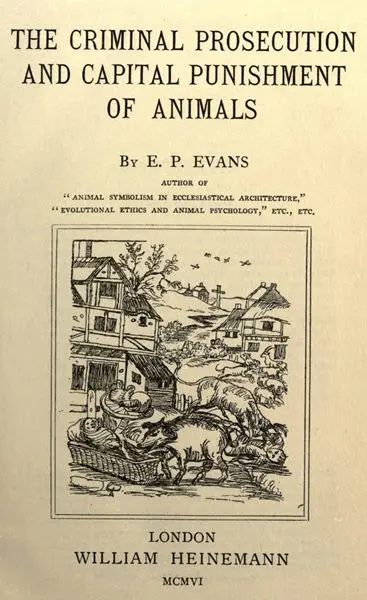
"The Criminal Prosecution and Capital Punishment of Animals" by E. P. Evans is a historical account written in the early 20th century. The book delves into the fascinating, if bizarre, legal practices of prosecuting animals for crimes in medieval and early modern Europe, exploring the absurdity and seriousness with which these cases were handled. It investigates the implications of these trials within the contexts of societal norms, religion, and the evolution of legal thought. The opening of the work outlines the origins of animal trials and the varying perspectives on their legality, notably the distinctions made between different types of prosecutions—those for domestic animals versus vermin. Evans introduces Bartholomew Chassenée, a jurist famous for defending rats charged with crop destruction, illustrating the lengths to which legal arguments were stretched to defend these creatures. He also discusses the interplay between secular and ecclesiastical courts in such cases, underscoring the peculiar belief that animals could be held accountable for their actions as if they were human actors in the legal system. Overall, this section sets the stage for a deeper exploration of the cultural and legal ramifications of treating animals as subjects of criminal law.
Introduction adapted from the source catalogue; source summaries may be automatically generated.
Free to read · English · 87,241 words · No account needed
MAKE TIME FOR A GOOD BOOK
On by default. Untick to stop anonymous reading totals. Each page counts after 10 seconds in view. How this works.
Anonymous counting is on unless you have switched it off.
Careful investigations would doubtless furnish additional examples of this comical application of the argumentum ad hominem in refutation of the notion that intellectual capacity is determined by the bulk of the brain or the shape of the skull. Ugo Foscolo, one of the most celebrated of modern Italian poets, had a cranium, which, according to this standard of appreciation, ought to have belonged to an idiot. On the other hand, the brain of the “Hottentot Venus,” examined by Gratiolet, far surpassed in the symmetry of both hemispheres and the perfection of its circumvolutions the normal brains of the Caucasian race. The same phenomenon has been observed, although in a less striking manner, occasionally in cretins and quite often in criminals. Character is the resultant of a multitude of combined forces, the great majority of which are still unknown and perhaps unknowable quantities. The impulse given by each must be exactly estimated in order to predetermine the joint effect. No factor which contributes to its formation must be overlooked, and the acceptance of any one of them, however important it may seem to be, as the basis on which to reform and reconstruct our penal legislation, would be premature and pernicious. This hobby-horsical tendency, which is the vice of every specialist, is now the besetting sin of criminal anthropologists, each of whom is firmly convinced that he can reach the goal only on his own garran.
“The more advanced criminalists,” says Professor Von Kirchenheim, “are becoming thoroughly convinced that the penal codes of to-day do not correspond to the criminal world of to-day. No science has remained so deeply rooted and grounded in scholasticism as jurisprudence; and this evil is most clearly perceptible in the province of criminal law. The necessity of a change in our penal legislation has already made itself widely felt. The contest with crime must now be carried on in a different manner from what it was when men waged war with bows and arrows; modern criminality must be fought, as it were, with repeating rifles.” In other words, we can never suppress crime by meeting it with bludgeons and boomerangs and other rude implements of barbarous warfare, but must encounter it with the finest and most effective weapons of precision, which the armoury of modern science can put into our hands. Society has outgrown the crude conception of punishment as mere retaliation or retribution incited by revenge. There is no doubt that even in the most enlightened countries, penology as a science is still in its infancy, and is only just beginning to feel the uncomfortable girding of its scanty swaddling-bands and blindly kicking itself free from them. That this first emancipatory effort should be somewhat clumsy, and occasionally attended by comical casualties and even serious disasters, lies in the very nature of the case. It is evident, too, that the antiquated and utterly irrational methods now employed for the suppression of crime tend directly to increase it. It is the aim of the positive, in distinction from the classical school of criminalists to discover the real causes of criminal actions, and thus to endeavour to eradicate or neutralize them. A casual criminal, for example, whom external conditions, accidental circumstances, sudden temptations or bad influences have led astray, should not be treated in the same manner, although guilty of the same overt act, as the habitual or constitutional criminal, whose wrong-doing arises from a diseased, ill-balanced or undeveloped mental or physical organization, and is therefore an inborn and perhaps irresistible proclivity. The latter is hardly responsible for his conduct, and the possibility of reforming him is slight. The only proper thing to do with such a culprit is to render him personally harmless to society either by death or perpetual incarceration, and to prevent him from propagating his kind. The law of the survival of the fittest through selection suggests as its necessary sequence the suppression of the unfittest through sterilization. Nature has her own effective and relentless method of attaining this desirable result; but man is constantly thwarting her beneficent purposes by all sorts of pernicious schemes originating in factitious sentimentalism and maudlin sympathy, which under the plea of philanthropy tend to foster and perpetuate moral monstrosities to the discomfort and detriment of civilized society and the permanent deterioration of the race. To sentence persons of this class to eight or ten years’ imprisonment and then to turn them loose again as a constant source of peril to mankind, is the greatest folly that any tribunal can possibly commit. It is a wrong done both to the criminal and to the community of which he is a member. The penalties imposed by the law should be determined not solely by the enormity of the crime, but chiefly by the character of the criminal. Paradoxical as such a conclusion may be, it is nevertheless a strictly logical deduction from the premises, that the more corrupt he is by his physical constitution and therefore the less culpable he is from a moral point of view, the more severe should be the sentence pronounced upon him. Where the vicious propensity is in the blood and beyond the reach of moral or penal purgations, the only safety is in the elimination of the individual, just as the only remedy for a gangrened limb is amputation. We ridicule ancient and mediæval courts of justice for prosecuting bugs and beasts, but future generations will condemn as equally absurd and outrageous our judicial treatment of human beings, who can no more help perpetrating deeds of violence, under given conditions, than locusts and caterpillars can help consuming crops to the injury of the husbandman, or wild beasts can help rending and devouring their prey. It is also interesting to know that in former times the animal was not punished capitally because it was supposed to have incurred guilt, but as a memorial of the occurrence, or in the language of canonical law: Non propter culpam sed propter memoriam facti pecus occiditur. It was put to death not because it was culpable, but because it was harmful; and this is the ground on which the radical wing of criminal anthropologists would repress and eliminate a vicious person without regard to his mental soundness or moral responsibility; to use Garofalo’s metaphor he is a microbe injurious to the social organism and must be destroyed.
Your reading position is saved on this browser. Take it to another device with a library code. Reading pages adapt to text, rather than matching a printed edition.
BEHIND THE BOOK
This eBook is for the use of anyone anywhere in the United States and most other parts of the world at no cost and with almost no restrictions whatsoever. You may copy it, give it away or re-use it under the terms of the Project Gutenberg License included with this eBook or online at www.gutenberg.org. If you are not located in the United States, you will have to check the laws of the country where you are located before using this eBook. Read the source licence.
The original source file, including credits and licence, is retained by this library. Request an original-format copy at no charge. Please include the book title and Project Gutenberg identifier #43286.
KEEP YOUR CURIOSITY GOING
Cécile Tormay

Moritz Busch
John L. Ransom
Frances Wright
Cécile Tormay

Mabel Potter Daggett