THE CLASSIC COLLECTION✦An outlaw’s diary: the CommuneCLASSIC FREE BOOKS
An outlaw’s diary: the Commune
Cécile Tormay
THE CLASSIC COLLECTION · 1851
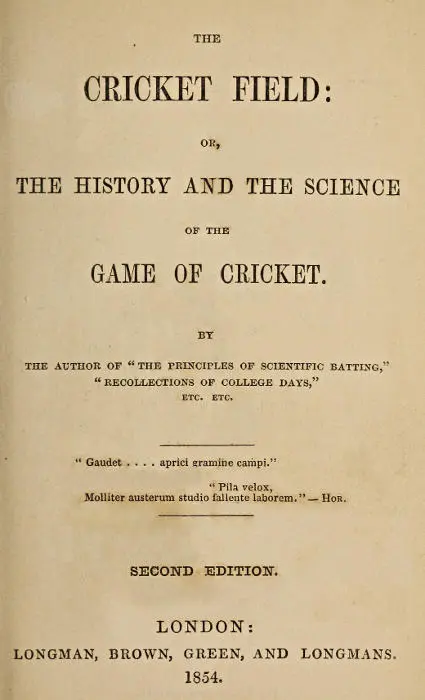
"The Cricket Field: Or, the History and Science of the Game of Cricket" by Pycroft is a historical account written in the mid-19th century. The book delves into the origins, development, and principles of cricket, exploring both its rich history and the scientific aspects of gameplay. This comprehensive analysis aims to serve as a definitive authoritative reference on the national game of England. At the start of the book, the author presents a prelude that sets the stage for exploring the evolution of cricket from its early forms to its establishment as a national pastime. Pycroft reflects on the historical significance of cricket, presenting evidence of its existence dating back to the 13th century while addressing the challenges of documenting its early history. The preface also emphasizes the importance of understanding the science behind the game, suggesting that widespread knowledge of the principles of cricket can enhance both the enjoyment and proficiency of players. By compiling insights from historical sources and his own experiences, Pycroft aims to provide readers with a thorough appreciation of this beloved sport.
Introduction adapted from the source catalogue; source summaries may be automatically generated.
Free to read · English · 62,670 words · No account needed
MAKE TIME FOR A GOOD BOOK
On by default. Untick to stop anonymous reading totals. Each page counts after 10 seconds in view. How this works.
Anonymous counting is on unless you have switched it off.
One artifice of Clarke, and of all good slow bowlers, is this: to begin with a ball or two which may easily be played back; then, with a much higher toss and slower pace, as in the diagram, he pitches a little short of the usual spot. If the batsman’s eye is deceived as to the distance, he at once plays forward to a length which is at all times dangerous; and, as it rises higher, the play becomes more dangerous still.
The difficulty of “going in” to such bowling as Clarke’s, depends on
this:--
The bat is only four inches and a quarter wide: call half that width two inches of wood. Then, you can only have two inches to spare for the deviation of your hit; therefore, if a ball turns about two inches, while you are in the act of hitting, the truest hitter possible must miss.
The obvious conclusion from these facts is,--
1st. That you can safely go in to such balls only as are straight, otherwise you cannot present a full bat; and, only when you can step right up to the pitch of the ball, otherwise, by a twist it will escape you; and slow balls turn more than fast in a given space. 2ndly. You can only go in to such lengths as you can easily and steadily command: a very long step, or any unusual hurry, will hardly be safe with only the said two inches of wood to spare.
Now the question is, with what lengths, against such bowling as Clarke’s, can you step in steadily and safely, both as far as the pitch, and with full command of hand and eye? Remember, you cannot begin your step till you have judged the length; and this, with the curved line of a slow dropping ball, you cannot judge till within a little of its grounding; so, the critical time for decision and action is very brief, and, in that brief space, how far can you step secure of all optical illusions, for, Clarke can deceive you by varying both the pace and the curve of his ball?--Go and try. Again, when you have stepped in, where will you hit? On the ground, of course, and straight. And where are the men placed? Besides, are you aware of the difficulty of interchanging the steady game with right foot in your ground, with that springy and spasmodic impulse which characterises this “going in?” At a match at Lord’s in 1849, I saw Brockwell score some forty runs with many hits off Clarke: he said to me, when he came out, “Clarke cannot bowl his best to me; for, sometimes, I go in to the pitch of the ball, when pitched well up, and hit her away; at other times, I make a feint, and then stand back, and so Clarke gets off his bowling.” He added, “the difficulty is to keep your temper and not to go in with a wrong ball.” This, I believe, is indeed a difficulty,--a much greater difficulty than is commonly imagined. My advice to all players who have not made a study of the art of going in, and have not fully succeeded on practising days, is, by no means to attempt it in a match. It is not so easy as it appears. You will find Clarke, or any good slow bowler, too much for you.--“But, supposing I should stand out of my ground, or start before the ball is out of the bowler’s hand?” Why, with an unpractised bowler, especially if in the constrained attitude of the overhand delivery, this manœuvre has succeeded in producing threes and fours in rapid succession. But Clarke would pitch over your head, or send in a quick underhand ball a little wide, and you would be stumped; and Wisden would probably send a fast toss about the height of your shoulder, and, being prepared to play perfectly straight at the pitch, you would hardly raise your bat in time to keep a swift toss out of the wicket-keeper’s hands.
Your reading position is saved on this browser. Take it to another device with a library code. Reading pages adapt to text, rather than matching a printed edition.
BEHIND THE BOOK
This eBook is for the use of anyone anywhere in the United States and most other parts of the world at no cost and with almost no restrictions whatsoever. You may copy it, give it away or re-use it under the terms of the Project Gutenberg License included with this eBook or online at www.gutenberg.org. If you are not located in the United States, you will have to check the laws of the country where you are located before using this eBook. Read the source licence.
The original source file, including credits and licence, is retained by this library. Request an original-format copy at no charge. Please include the book title and Project Gutenberg identifier #52022.
KEEP YOUR CURIOSITY GOING
Cécile Tormay

Moritz Busch
John L. Ransom
Frances Wright
Cécile Tormay

Mabel Potter Daggett