THE CLASSIC COLLECTION✦An outlaw’s diary: the CommuneCLASSIC FREE BOOKS
An outlaw’s diary: the Commune
Cécile Tormay
THE CLASSIC COLLECTION · 1851
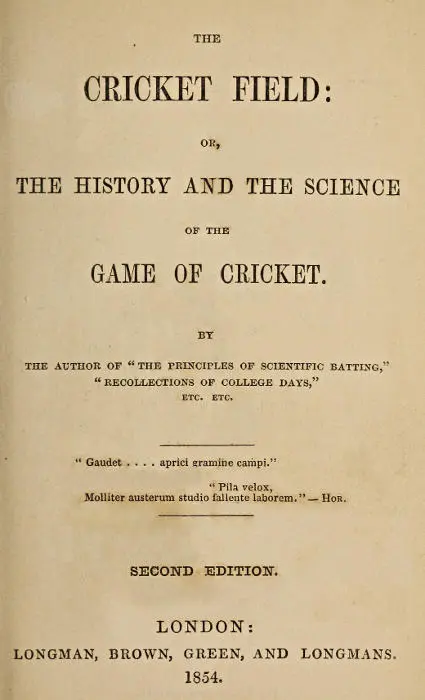
"The Cricket Field: Or, the History and Science of the Game of Cricket" by Pycroft is a historical account written in the mid-19th century. The book delves into the origins, development, and principles of cricket, exploring both its rich history and the scientific aspects of gameplay. This comprehensive analysis aims to serve as a definitive authoritative reference on the national game of England. At the start of the book, the author presents a prelude that sets the stage for exploring the evolution of cricket from its early forms to its establishment as a national pastime. Pycroft reflects on the historical significance of cricket, presenting evidence of its existence dating back to the 13th century while addressing the challenges of documenting its early history. The preface also emphasizes the importance of understanding the science behind the game, suggesting that widespread knowledge of the principles of cricket can enhance both the enjoyment and proficiency of players. By compiling insights from historical sources and his own experiences, Pycroft aims to provide readers with a thorough appreciation of this beloved sport.
Introduction adapted from the source catalogue; source summaries may be automatically generated.
Free to read · English · 62,670 words · No account needed
MAKE TIME FOR A GOOD BOOK
On by default. Untick to stop anonymous reading totals. Each page counts after 10 seconds in view. How this works.
Anonymous counting is on unless you have switched it off.
VI. The great John Locke wrote in 1679, “The sports of England for a curious stranger to see, are horse-racing, hawking, hunting, and Bowling: at Marebone and Putney he may see several persons of quality bowling two or three times a week: also, wrestling in Lincoln’s Inn Fields every evening; bear and bull-baiting at the bear garden; shooting with the long bow, and stob-ball, in Tothill Fields; and cudgel playing in the country, and hurling in Cornwall.” Here again we have no Cricket. Stob-ball is a different game.
Nevertheless we have a catalogue of games of about 1700, in Stow’s “Survey of London,” and there Cricket is mentioned; but, remarkably enough, it is particularised as one of the amusements of “the lower classes.” The whole passage is curious:--
“The modern sports of the citizens, besides drinking(!), are cock-fighting, bowling upon greens, backgammon, cards, dice, billiards, also musical entertainments, dancing, masks, balls, stage-plays, and club-meetings in the evening; they sometimes ride out on horseback, and hunt with the lord mayor’s pack of dogs, when the common hunt goes on. The lower classes divert themselves at foot-ball, wrestling, cudgels, nine-pins, shovel-board, cricket, stow-ball, ringing of bells, quoits, pitching the bar, bull and bear baitings, throwing at cocks, and lying at ale-houses.”(!)
The lawyers have a rule that to specify one thing is to ignore the other; and this rule of evidence can never be more applicable than where a sport is omitted from six distinct catalogues; therefore, the conclusion that Cricket was unknown when those lists were made would indeed appear utterly irresistible, only--audi semper alteram partem--in this case the argument would prove too much; for it would equally prove that Club-ball and Trap-ball were undiscovered too, whereas both these games are confessedly as old as the thirteenth century!
The conclusion of all this is, that the oft-repeated assertions that Cricket is a game no older than the eighteenth century is erroneous: for, first, the thing itself may be much older than its name; and, secondly, the “silence of antiquity” is no conclusive evidence that even the name of Cricket was really unknown.
Thus do we refute those who assert a negative as to the antiquity of cricket: and now for our affirmative; and we are prepared to show--
First, that a single-wicket game was played as early as the thirteenth century, under the name of Club-ball.
Secondly, that it might have been identical with a sport of the same date called “Handyn and Handoute.”
Thirdly, that a genuine double-wicket game was played in Scotland about 1700, under the name of “Cat and Dog.”
Your reading position is saved on this browser. Take it to another device with a library code. Reading pages adapt to text, rather than matching a printed edition.
BEHIND THE BOOK
This eBook is for the use of anyone anywhere in the United States and most other parts of the world at no cost and with almost no restrictions whatsoever. You may copy it, give it away or re-use it under the terms of the Project Gutenberg License included with this eBook or online at www.gutenberg.org. If you are not located in the United States, you will have to check the laws of the country where you are located before using this eBook. Read the source licence.
The original source file, including credits and licence, is retained by this library. Request an original-format copy at no charge. Please include the book title and Project Gutenberg identifier #52022.
KEEP YOUR CURIOSITY GOING
Cécile Tormay

Moritz Busch
John L. Ransom
Frances Wright
Cécile Tormay

Mabel Potter Daggett