THE CLASSIC COLLECTION✦An outlaw’s diary: the CommuneCLASSIC FREE BOOKS
An outlaw’s diary: the Commune
Cécile Tormay
THE CLASSIC COLLECTION · 1851
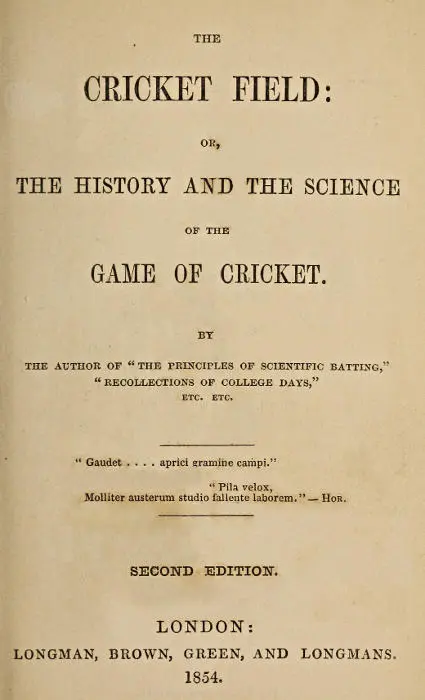
"The Cricket Field: Or, the History and Science of the Game of Cricket" by Pycroft is a historical account written in the mid-19th century. The book delves into the origins, development, and principles of cricket, exploring both its rich history and the scientific aspects of gameplay. This comprehensive analysis aims to serve as a definitive authoritative reference on the national game of England. At the start of the book, the author presents a prelude that sets the stage for exploring the evolution of cricket from its early forms to its establishment as a national pastime. Pycroft reflects on the historical significance of cricket, presenting evidence of its existence dating back to the 13th century while addressing the challenges of documenting its early history. The preface also emphasizes the importance of understanding the science behind the game, suggesting that widespread knowledge of the principles of cricket can enhance both the enjoyment and proficiency of players. By compiling insights from historical sources and his own experiences, Pycroft aims to provide readers with a thorough appreciation of this beloved sport.
Introduction adapted from the source catalogue; source summaries may be automatically generated.
Free to read · English · 62,670 words · No account needed
MAKE TIME FOR A GOOD BOOK
On by default. Untick to stop anonymous reading totals. Each page counts after 10 seconds in view. How this works.
Anonymous counting is on unless you have switched it off.
Byron mentions in his letters that he played in the eleven of Harrow against Eton in 1805. The score is given in Lillywhite’s Public-School Matches.
The excellent William Wilberforce was fond of cricket, and was laid up by a severe blow on the leg at Rothley while playing with his sons: he says the doctor told him a little more would have broken the bone.
Cricket, we have shown, was originally classed among the games of the lower orders; so we find the yeomen infinitely superior to the gentlemen even before cricket had become by any means so much of a profession as it is now. Tom Walker, Beldham, John Wells, Fennex, Hammond, Robinson, Lambert, Sparkes, H. Bentley, Bennett, Freemantle, were the best professionals of the day. For it was seven or eight years later that Mr. E. H. Budd, and his unequal rival, Mr. Brand, and his sporting friend, Osbaldeston, as also that fine player, E. Parry, Esq., severally appeared; and later still, that Mr. Ward, Howard, Beagley, Thumwood, Caldecourt, Slater, Flavel, Ashby, Searle, and Saunders, successively showed every resource of bias bowling to shorten the scores, and of fine hitting to lengthen them. By the end of these twenty years, all these distinguished players had taught a game in which the batting beat the bowling. “Cricket,” said Mr. Ward, “unlike hunting, shooting, fishing, or even yachting, was a sport that lasted three days;” the wicket had been twice enlarged, once about 1814, and again in 1817; old Lord had tried his third, the present, ground; the Legs had taught the wisdom of playing rather for love than money; slow coaches had given way to fast, long whist to short; and ultimately Lambert, John Wells, Howard, and Powell, handed over the ball to Broadbridge and Lillywhite.
Such is the scene, the characters, and the performance. “Matches in those days were more numerously attended than now,” said Mr. Ward: the old game was more attractive to spectators, because more busy, than the new. Tom Lord’s flag was the well known telegraph that brought him in from three to four thousand sixpences at a match. John Goldham, the octogenarian inspector of Billingsgate, has seen the Duke of York and his adversary, the Honourable Colonel Lennox, in the same game, and had the honour of playing with both, and the Prince Regent, too, in the White Conduit Fields, on which spot Mr. Goldham built his present house. For the Prince was a great lover of the game, and caused the “Prince’s Cricket Ground” to be formed at Brighton. The late Lord Barrymore, killed by the accidental discharge of a blunderbuss in his phaeton, was an enthusiastic cricketer. The Duke of Richmond, when Colonel Lennox, a nobleman whose life and spirits and genial generous nature made him beloved by all, exulted in this as in all athletic sports: the bite of a fox killed him. Then, as you drive through Russell Square, behold the statue of another patron, the noble-born and noble-minded Duke of Bedford; and in Dorset Square, the site of old Lord’s Ground, you may muse and fancy you see, where now is some “modest mansion,” the identical mark called the “Duke’s strike,” which long recorded a hit, 132 yards in the air, from the once famous bat of Alexander, late Duke of Hamilton. Great matches in those days, as in these, cost money. Six guineas if they won and four if they lost, was the player’s fee; or, five and three if they lived in town. So, as every match cost some seventy pounds, over the fire-place at Lord’s you would see a Subscription List for Surrey against England, or for England against Kent, as the case might be, and find notices of each interesting match at Brookes’s and other clubs.
Your reading position is saved on this browser. Take it to another device with a library code. Reading pages adapt to text, rather than matching a printed edition.
BEHIND THE BOOK
This eBook is for the use of anyone anywhere in the United States and most other parts of the world at no cost and with almost no restrictions whatsoever. You may copy it, give it away or re-use it under the terms of the Project Gutenberg License included with this eBook or online at www.gutenberg.org. If you are not located in the United States, you will have to check the laws of the country where you are located before using this eBook. Read the source licence.
The original source file, including credits and licence, is retained by this library. Request an original-format copy at no charge. Please include the book title and Project Gutenberg identifier #52022.
KEEP YOUR CURIOSITY GOING
Cécile Tormay

Moritz Busch
John L. Ransom
Frances Wright
Cécile Tormay

Mabel Potter Daggett