THE CLASSIC COLLECTION✦An outlaw’s diary: the CommuneCLASSIC FREE BOOKS
An outlaw’s diary: the Commune
Cécile Tormay
THE CLASSIC COLLECTION · 1851
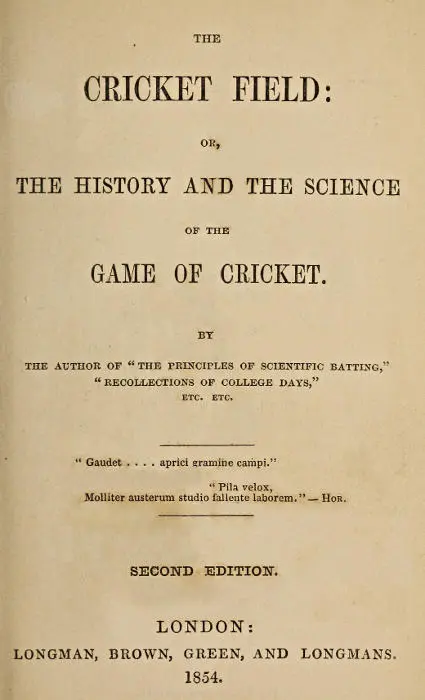
"The Cricket Field: Or, the History and Science of the Game of Cricket" by Pycroft is a historical account written in the mid-19th century. The book delves into the origins, development, and principles of cricket, exploring both its rich history and the scientific aspects of gameplay. This comprehensive analysis aims to serve as a definitive authoritative reference on the national game of England. At the start of the book, the author presents a prelude that sets the stage for exploring the evolution of cricket from its early forms to its establishment as a national pastime. Pycroft reflects on the historical significance of cricket, presenting evidence of its existence dating back to the 13th century while addressing the challenges of documenting its early history. The preface also emphasizes the importance of understanding the science behind the game, suggesting that widespread knowledge of the principles of cricket can enhance both the enjoyment and proficiency of players. By compiling insights from historical sources and his own experiences, Pycroft aims to provide readers with a thorough appreciation of this beloved sport.
Introduction adapted from the source catalogue; source summaries may be automatically generated.
Free to read · English · 62,670 words · No account needed
MAKE TIME FOR A GOOD BOOK
On by default. Untick to stop anonymous reading totals. Each page counts after 10 seconds in view. How this works.
Anonymous counting is on unless you have switched it off.
Middlesex also, exclusively of the Marylebone Club, had its Eleven in these days; or, we should say, its twenty-two, for that was the number then required to stand the disciplined forces of Hampshire, Kent, or England. And this reminds us of an “Uxbridge ground,” where Middlesex played and lost; also, of “Hornchurch, Essex,” where Essex, in 1791, was sufficiently advanced to win against Marylebone, an occasion memorable, because Lord Frederick Beauclerk there played nearly his first recorded match, making scarce any runs, but bowling four wickets. Lord Frederick’s first match was at Lord’s, 2nd June, 1791. “There was also,” writes the Hon. R. Grimston, “‘the Bowling-green’ at Harrow-on-the-Hill, where the school played: Richardson, who subsequently became Mr. Justice Richardson, was the captain of the School Eleven in 1782.”
Already, in 1790, the game was spreading northwards, or, rather, proofs exist that it had long before struck far and wide its roots and branches in northern latitudes; and also that it was a game as popular with the men of labour as the men of leisure, and therefore incontestably of home growth: no mere exotic, or importation of the favoured few, can cricket be, if, like its namesake, it is found “a household word” with those whom Burns aptly calls “the many-aproned sons of mechanical life.”
In 1791 Eton, that is, the old Etonians, played Marylebone, four players given on either side; and all true Etonians will thank us for informing them, not only that the seven Etonians were more than a match for their adversaries, but also that this match proves that Eton had, at that early date, the honour of sending forth the most distinguished amateurs of the day; for Lord Winchelsea, Hon. H. Fitzroy, Earl Darnley, Hon. E. Bligh, C. Anguish, Assheton Smith--good men and true--were Etonians all. This match was played in Burley Park, Rutlandshire. On the following day, June 25th, 1791, the Marylebone played eleven yeomen and artisans of Leicester; and though the Leicestrians cut a sorry figure, still the fact that the Midland Counties practised cricket sixty years ago is worth recording. Peter Heward, of Leicester, a famous wicket-keeper, of twenty years since, told me of a trial match in which he saw his father, quite an old man, with another veteran of his own standing, quickly put out with the old-fashioned slow bowling a really good Eleven for some twenty runs--good, that is, against the modern style of bowling; and cricket was not a new game in this old man’s early days (say 1780) about Leicester and Nottingham, as the score in page 41 alone would prove; for such a game as cricket, evidently of gradual development, must have been played in some primitive form many a long year before the date of 1775, in which it had excited sufficient interest, and was itself sufficiently matured in form, to show the two Elevens of Sheffield and of Nottingham. Add to this, what we have already mentioned, a rude form of cricket as far north as Angus and Lothian in 1700, and we can hardly doubt that cricket was known as early in the Midland as in the Southern Counties. The men of Nottingham--land of Clarke, Barker, and Redgate--next month, in the same year (1791) threw down the gauntlet, and shared the same fate; and next day the Marylebone, “adding,” in a cricketing sense, “insult unto injury,” played twenty-two of them, and won by thirteen runs.
Your reading position is saved on this browser. Take it to another device with a library code. Reading pages adapt to text, rather than matching a printed edition.
BEHIND THE BOOK
This eBook is for the use of anyone anywhere in the United States and most other parts of the world at no cost and with almost no restrictions whatsoever. You may copy it, give it away or re-use it under the terms of the Project Gutenberg License included with this eBook or online at www.gutenberg.org. If you are not located in the United States, you will have to check the laws of the country where you are located before using this eBook. Read the source licence.
The original source file, including credits and licence, is retained by this library. Request an original-format copy at no charge. Please include the book title and Project Gutenberg identifier #52022.
KEEP YOUR CURIOSITY GOING
Cécile Tormay

Moritz Busch
John L. Ransom
Frances Wright
Cécile Tormay

Mabel Potter Daggett