THE CLASSIC COLLECTION✦An outlaw’s diary: the CommuneCLASSIC FREE BOOKS
An outlaw’s diary: the Commune
Cécile Tormay
THE CLASSIC COLLECTION · 1851
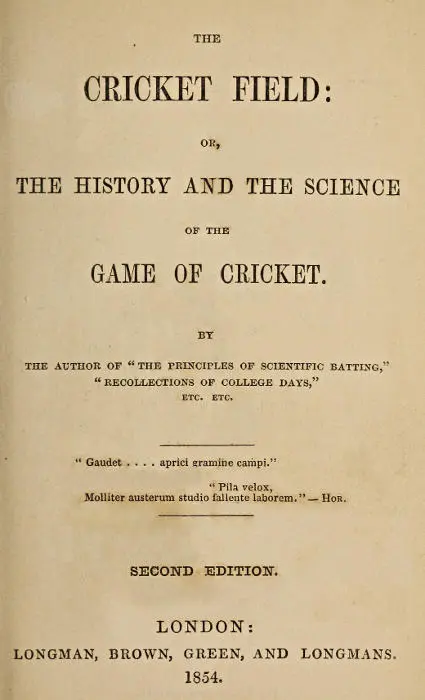
"The Cricket Field: Or, the History and Science of the Game of Cricket" by Pycroft is a historical account written in the mid-19th century. The book delves into the origins, development, and principles of cricket, exploring both its rich history and the scientific aspects of gameplay. This comprehensive analysis aims to serve as a definitive authoritative reference on the national game of England. At the start of the book, the author presents a prelude that sets the stage for exploring the evolution of cricket from its early forms to its establishment as a national pastime. Pycroft reflects on the historical significance of cricket, presenting evidence of its existence dating back to the 13th century while addressing the challenges of documenting its early history. The preface also emphasizes the importance of understanding the science behind the game, suggesting that widespread knowledge of the principles of cricket can enhance both the enjoyment and proficiency of players. By compiling insights from historical sources and his own experiences, Pycroft aims to provide readers with a thorough appreciation of this beloved sport.
Introduction adapted from the source catalogue; source summaries may be automatically generated.
Free to read · English · 62,670 words · No account needed
MAKE TIME FOR A GOOD BOOK
On by default. Untick to stop anonymous reading totals. Each page counts after 10 seconds in view. How this works.
Anonymous counting is on unless you have switched it off.
The game of cricket, philosophically considered, is a standing panegyric on the English character: none but an orderly and sensible race of people would so amuse themselves. It calls into requisition all the cardinal virtues, some moralist would say. As with the Grecian games of old, the player must be sober and temperate. Patience, fortitude, and self-denial, the various bumps of order, obedience, and good-humour, with an unruffled temper, are indispensable. For intellectual virtues we want judgment, decision, and the organ of concentrativeness--every faculty in the free use of all its limbs--and every idea in constant air and exercise. Poor, rickety, and stunted wits will never serve: the widest shoulders are of little use without a head upon them: the cricketer wants wits down to his fingers’ ends. As to physical qualifications, we require not only the volatile spirits of the Irishman Rampant, nor the phlegmatic caution of the Scotchman Couchant, but we want the English combination of the two; though, with good generalship, cricket is a game for Britons generally: the three nations would mix not better in a regiment than in an eleven; especially if the Hibernian were trained in London, and taught to enjoy something better than what Father Prout terms his supreme felicity, “Otium cum dig-gin-taties.”
It was from the southern and south-eastern counties of England that the game of Cricket spread--not a little owing to the Propaganda of the metropolitan clubs, which played chiefly first at the Artillery Ground, then at White Conduit Fields, and thirdly at Thomas Lord’s Grounds, (of which there were two before the present “Lord’s,”) as well as latterly at the Oval, Kennington, and on all sides of London--through all the southern half of England; and during these last twenty years the northern counties, and even Edinburgh, have sent forth distinguished players. But considering that the complement of the game is twenty-two men, besides two Umpires and two Scorers; and considering also that cricket, unlike every other manly contest, by flood or field, occupies commonly more than one day; the railways, as might be expected, have tended wonderfully to the diffusion of cricket,--giving rise to clubs depending on a circle of some thirty or forty miles, as also to that club in particular under the canonised saint, John Zingari, into whom are supposed to have migrated all the erratic spirits of the gipsy tribe. The Zingari are a race of ubiquitous cricketers, exclusively gentlemen-players; for cricket affords to a race of professionals a merry and abundant, though rather a laborious livelihood, from the time the first May-fly is up to the time the first pheasant is down. Neither must we forget the All England and United Elevens, who, under the generalship of Clarke or Wisden, play numbers varying from fourteen to twenty-two in almost every county in England. So proud are provincial clubs of this honour that, besides a subscription of some 70l., and part or all of the money at the field-gate being willingly accorded for their services, much hospitality is exercised wherever they go. This tends to a healthy circulation of the life’s blood of cricket, vaccinating and inoculating every wondering rustic with the principles of the national game. Our soldiers, we said, by order of the Horse Guards, are provided with cricket-grounds adjoining their barracks; and all of her Majesty’s ships have bats and balls to astonish the cockroaches at sea, and the crabs and turtles ashore. Hence it has come to pass that, wherever her Majesty’s servants have “carried their victorious arms” and legs, wind and weather permitting, cricket has been played. Still the game is essentially Anglo-Saxon. Foreigners have rarely, very rarely, imitated us. The English settlers and residents everywhere play; but of no single cricket club have we ever heard dieted either with frogs, sour crout, or macaroni. But how remarkable that cricket is not naturalised in Ireland! the fact is very striking that it follows the course rather of ale than whiskey. Witness Kent, the land of hops, and the annual antagonists of “All England.” Secondly, Farnham, which, as we shall presently show, with its adjoining parishes, nurtured the finest of the old players, as well as the finest hops,--cunabula Trojæ, the infant school of cricketers. Witness also the Burton Clubs, assisted by our excellent friend next akin to bitter ale. Witness again Alton ale, on which old Beagley throve so well, and the Scotch ale of Edinburgh, on which John Sparkes, though commencing with the last generation, has carried on his instructions, in which we ourselves once rejoiced, into the middle of the present century. The mountain mists and “mountain dew” suit better with deer-stalking than with cricket: our game disdains the Dutch courage of ardent spirits. The brain must glow with Nature’s fire, and not depend upon a spirit lamp. Mens sana in corpore sano: feed the body, but do not cloud the mind. You, sir, with the hectic flush, the fire of your eyes burnt low in their sockets, with beak as sharp as a woodcock’s from living upon suction, with pallid face and shaky hand,--our game disdains such ghostlike votaries. Rise with the lark and scent the morning air, and drink from the bubbling rill, and then, when your veins are no longer fevered with alcohol, nor puffed with tobacco smoke,--when you have rectified your illicit spirits and clarified your unsettled judgment,--“come again and devour up my discourse.” And you, sir, with the figure of Falstaff and the nose of Bardolph,--not Christianly eating that you may live, but living that you may eat,--one of the nati consumere fruges, the devouring caterpillar and grub of human kind--our noble game has no sympathy with gluttony, still less with the habitual “diner out,” on whom outraged nature has taken vengeance, by emblazoning what was his face (nimium ne crede colori), encasing each limb in fat, and condemning him to be his own porter to the end of his days. “Then I am your man--and I--and I,” cry a crowd of self-satisfied youths: “sound are we in wind and limb, and none have quicker hand or eye.” Gently, my friends, so far well; good hands and eyes are instruments indispensable, but only instruments. There is a wide difference between a good workman and a bag of tools, however sharp. We must have heads as well as hands. You may be big enough and strong enough, but the question is whether, as Virgil says,
Your reading position is saved on this browser. Take it to another device with a library code. Reading pages adapt to text, rather than matching a printed edition.
BEHIND THE BOOK
This eBook is for the use of anyone anywhere in the United States and most other parts of the world at no cost and with almost no restrictions whatsoever. You may copy it, give it away or re-use it under the terms of the Project Gutenberg License included with this eBook or online at www.gutenberg.org. If you are not located in the United States, you will have to check the laws of the country where you are located before using this eBook. Read the source licence.
The original source file, including credits and licence, is retained by this library. Request an original-format copy at no charge. Please include the book title and Project Gutenberg identifier #52022.
KEEP YOUR CURIOSITY GOING
Cécile Tormay

Moritz Busch
John L. Ransom
Frances Wright
Cécile Tormay

Mabel Potter Daggett