THE CLASSIC COLLECTION✦An outlaw’s diary: the CommuneCLASSIC FREE BOOKS
An outlaw’s diary: the Commune
Cécile Tormay
THE CLASSIC COLLECTION · 1851
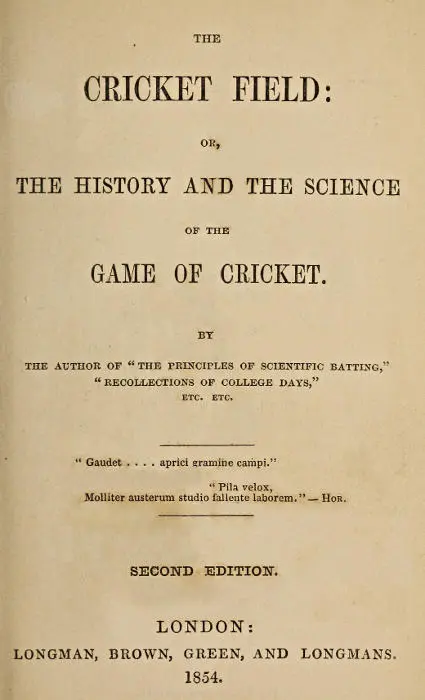
"The Cricket Field: Or, the History and Science of the Game of Cricket" by Pycroft is a historical account written in the mid-19th century. The book delves into the origins, development, and principles of cricket, exploring both its rich history and the scientific aspects of gameplay. This comprehensive analysis aims to serve as a definitive authoritative reference on the national game of England. At the start of the book, the author presents a prelude that sets the stage for exploring the evolution of cricket from its early forms to its establishment as a national pastime. Pycroft reflects on the historical significance of cricket, presenting evidence of its existence dating back to the 13th century while addressing the challenges of documenting its early history. The preface also emphasizes the importance of understanding the science behind the game, suggesting that widespread knowledge of the principles of cricket can enhance both the enjoyment and proficiency of players. By compiling insights from historical sources and his own experiences, Pycroft aims to provide readers with a thorough appreciation of this beloved sport.
Introduction adapted from the source catalogue; source summaries may be automatically generated.
Free to read · English · 62,670 words · No account needed
MAKE TIME FOR A GOOD BOOK
On by default. Untick to stop anonymous reading totals. Each page counts after 10 seconds in view. How this works.
Anonymous counting is on unless you have switched it off.
The great thing in Wicket-keeping is, for hand and eye to go together, just as with batting, and what is exercise for the former, assists the latter. Any exercise in which the hand habitually tries to obey the eye, is useful for cricket; fielding improves batting, and batting improves fielding.
Twelve of the principal wicket-keepers of the last fifty years were all efficient Batsmen; namely, Hammond, Searle, Box, Wenman, Dorrington, C. Brown, Chatterton, Lockyer, with Messrs. Jenner, Anson, Nicholson, and Ridding.
“How would you explain, sir,” said Cobbett, “that the player’s batting keeps pace with the gentleman’s, when we never take a bat except in a game?”--Because you are constantly following the ball with hand and eye together, which forms a valuable practice for judging pace, and time, and distance: not enough certainly to teach batting, but enough to keep it up. Besides, if you practise too little, most gentlemen practise too much, ending in a kind of experimental and speculative play, which proves--like gentleman’s farming--more scientific than profitable. Amateurs often try at too much, mix different styles, and, worse than all, form conflicting habits. The game, for an average, is the player’s game; because, less ambitious, with less excitement about favourite hits, of a simple style, with fewer things to think of, and a game in which, though limited, they are better grounded.
Amateurs are apt to try a bigger game than they could safely play with twice their practice. Many a man, for instance, whose talent lies in defence, tries free hitting, and, between the two, proves good for nothing. Others, perhaps, can play straight and fairly Off;--and, should not they learn to hit On also? Certainly: but while in a transition state, they are not fit for a county match; and some men are always in this transition state. Horace had good cricket ideas, for, said he,
“Aut famam sequere, aut sibi convenientia finge.”
Either play for show off, and “that’s villanous,” says Hamlet, “and shows a most pitiful ambition in the fool that uses it;” or, adopt a style you can put well together--and sumite materiam--æquam viribus, adopt a style that suits your capabilities; cui lecta potenter erit res; try at no more than you can do--nec deseret hunc,--and that’s the game to carry you through.
Your reading position is saved on this browser. Take it to another device with a library code. Reading pages adapt to text, rather than matching a printed edition.
BEHIND THE BOOK
This eBook is for the use of anyone anywhere in the United States and most other parts of the world at no cost and with almost no restrictions whatsoever. You may copy it, give it away or re-use it under the terms of the Project Gutenberg License included with this eBook or online at www.gutenberg.org. If you are not located in the United States, you will have to check the laws of the country where you are located before using this eBook. Read the source licence.
The original source file, including credits and licence, is retained by this library. Request an original-format copy at no charge. Please include the book title and Project Gutenberg identifier #52022.
KEEP YOUR CURIOSITY GOING
Cécile Tormay

Moritz Busch
John L. Ransom
Frances Wright
Cécile Tormay

Mabel Potter Daggett