THE CLASSIC COLLECTION✦An outlaw’s diary: the CommuneCLASSIC FREE BOOKS
An outlaw’s diary: the Commune
Cécile Tormay
THE CLASSIC COLLECTION · 1851
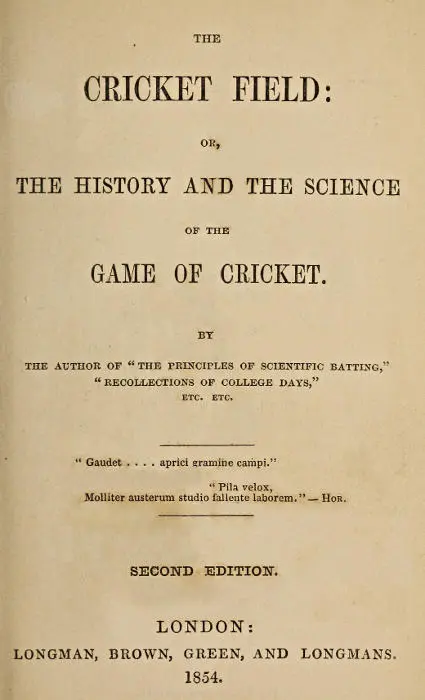
"The Cricket Field: Or, the History and Science of the Game of Cricket" by Pycroft is a historical account written in the mid-19th century. The book delves into the origins, development, and principles of cricket, exploring both its rich history and the scientific aspects of gameplay. This comprehensive analysis aims to serve as a definitive authoritative reference on the national game of England. At the start of the book, the author presents a prelude that sets the stage for exploring the evolution of cricket from its early forms to its establishment as a national pastime. Pycroft reflects on the historical significance of cricket, presenting evidence of its existence dating back to the 13th century while addressing the challenges of documenting its early history. The preface also emphasizes the importance of understanding the science behind the game, suggesting that widespread knowledge of the principles of cricket can enhance both the enjoyment and proficiency of players. By compiling insights from historical sources and his own experiences, Pycroft aims to provide readers with a thorough appreciation of this beloved sport.
Introduction adapted from the source catalogue; source summaries may be automatically generated.
Free to read · English · 62,670 words · No account needed
MAKE TIME FOR A GOOD BOOK
On by default. Untick to stop anonymous reading totals. Each page counts after 10 seconds in view. How this works.
Anonymous counting is on unless you have switched it off.
Great men have the same ideas, or Clarke would seem to have borrowed
from Horace
“Qui studet optatam cursu contingere metam Multa tulit fecitque puer, sudavit et alsit.”
A good innings disdains a sleeping partner. Be alive and moving; and--instead of saying, “Well played!” “Famous hit!” &c.; or, as we sometimes hear in the way of encouragement, “How near!” “What a close shave!” “Pray, take care, Smith!”--think of the runs, and say “run” or “stop” as the case may be. Thus, you may avoid the ludicrous scene of two big men rushing from their wickets, pausing, turning back, starting again, and having a small talk together at the eleventh yard, and finding, one or the other, a prostrate wicket, while apologies and recrimination are the only solace.
Old players need keep up a habit of throwing and of active movements. For, the redundant spirit and buoyancy of youthful activity soon evaporates. Many a zealous cricketer loses his once-famed quickness from mere disuse--Sic omnia fatis, in pejus ruere. Instead of always batting, and practising poor Hillyer and Wisden till their dodges are dodges no more, and it is little credit to score from them, go to your neighbour’s wicket and practise fielding for an hour, or else, next match, you may find your throwing at fault.
Fielding, I fear, is retrograding: a good general player, famed for that quick return which runs the adversary out, one who is, at the same time, a useful change in bowling, a safe judge of a run, and respectable at every point of the game--this is becoming a scarce character, and Batting is a word supposed coextensive with Cricket,--a sad mistake.
SPARE THE BOWLER.--One reason for returning the ball not to bowler, but to wicket-keeper, who should advance quietly, like Box, and return a catch. A swift throw, or any exertion in the field which hurts the bowler’s hand, or sets it shaking, may lose a game. If a bowler has half-volleys returned to him, by stretching and stooping after them, he gets out of his swing. Now, this same swing is a great point with a bowler. Watch him after he has got his footsteps firm for his feet, and when in his regular stride, and see the increased precision of his performance. Then comes the time when your great gun tumbles down his men: and that is the time that some sure, judicious batsman, whose eminence is little seen amidst the loose hitting of a scratch match, comes calmly and composedly to the wicket and makes a stand; and, as he disposes of maiden Overs, and steals ones and twos, he breaks the spell that bound his men, and makes the dead-straight bowling good for Cuts and leg-hits. In no game or sport do I ever witness half the satisfaction of the bowler who can thus bowl maiden Overs and defy a score; or of the batsman who takes the edge off the same, runs up the telegraph to even betting, and gives easier work and greater confidence to those who follow. A wicket-keeper, too, may dart off and save a bowler from fielding a three or four; and, whenever he leaves his wicket, slip must take wicket-keeper’s place. “How stale,” “true; but,--instantly’s the word,”--from neglect of which, we have seen dreadful mistakes made even in good matches.
Your reading position is saved on this browser. Take it to another device with a library code. Reading pages adapt to text, rather than matching a printed edition.
BEHIND THE BOOK
This eBook is for the use of anyone anywhere in the United States and most other parts of the world at no cost and with almost no restrictions whatsoever. You may copy it, give it away or re-use it under the terms of the Project Gutenberg License included with this eBook or online at www.gutenberg.org. If you are not located in the United States, you will have to check the laws of the country where you are located before using this eBook. Read the source licence.
The original source file, including credits and licence, is retained by this library. Request an original-format copy at no charge. Please include the book title and Project Gutenberg identifier #52022.
KEEP YOUR CURIOSITY GOING
Cécile Tormay

Moritz Busch
John L. Ransom
Frances Wright
Cécile Tormay

Mabel Potter Daggett