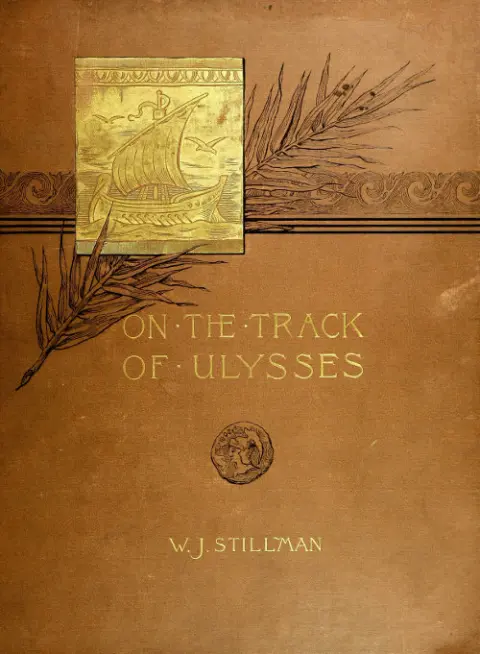
On the track of Ulysses; Together with an excursion in quest of the so-called Venus of Melos Two studies in archaeology, made during a cruise among the Greek islands
William James Stillman

THE CLASSIC COLLECTION · 1874
"The Cretan Insurrection of 1866-7-8" by William J. Stillman is a historical account written in the late 19th century. The book delves into the events surrounding the Cretan revolt against Ottoman rule during the years mentioned, providing insights into the complexities of political influences and the cultural heritage of the Cretan people. It explores the socio-political dynamics of the time, focusing on the Cretans’ struggle for autonomy and the various powers that intervened in their affairs. The opening of the text introduces readers to the context preceding the insurrection, notably Stillman’s personal involvement as the U.S. Consul in Crete. He reflects on the historical background of the island, illuminating its unique character and the grievances that led to heightened tensions. Through various interactions with local officials and the unfolding political landscape marked by oppression, he sets the stage for the subsequent assembly of Cretan leaders, which becomes a catalyst for revolt. The narrative highlights the significant “Assembly” at Omalo, showcasing both the democratic aspirations of the Cretans and the volatile political environment that ultimately leads to conflict.
Introduction adapted from the source catalogue; source summaries may be automatically generated.
Free to read · English · 55,299 words · No account needed
MAKE TIME FOR A GOOD BOOK
On by default. Untick to stop anonymous reading totals. Each page counts after 10 seconds in view. How this works.
Anonymous counting is on unless you have switched it off.
On this day the insurgent force had augmented to 2,000 men, and the plan of operation was a slight variation only of that of the day before, the feint being on the left, but, unfortunately for it, the order to the commander who should have made the real attack was kept in the pocket of the officer who carried it until an hour after the time at which the assault was ordered to be made, so that though the diversion of Coroneos was very well carried out, and the Sphakiotes under him penetrated to an abattis which had been constructed around the principal position of the Turkish army on a conical hill called Avgon (the egg), the expected flank attack was not delivered, and the troops who had held the positions on the right had time to concentrate against Coroneos, and he was driven back. Preparations were, however, made for the third day, with forces still increasing, when the news that Reschid had arrived at Gaiduropolis, and consequently menaced their rear, demoralized the Cretans, compelling Coroneos with his volunteers to fall back on Askyfó.
Mehmet Pasha, once more attacking Askyfó by Krapi, while Omar's troops and Reschid with his bashi-bazouks passed by the mountains from Kallikrati to Asfendu, and so into Askyfó, had been opposed by Zimbrakaki, Soliotis, and the Sphakiote chiefs for three days, when, finding the defence concentrated at the head of the gorge, he climbed the hills at his right, passed over into Askyfó, took possession of Kares, on the edge of the plain, barricading himself there without attempting to advance further. Coroneos, on his retreat to Askyfó, threw a force of several hundred Sphakiotes and volunteers behind him, and for several days his communications with Canéa and his base at Vryses were cut off, when Reschid succeeded in getting into Askyfó and supplying him with provisions, of which he stood much in need, having left Vryses with six days' rations, and now been twelve days out without further supplies. Zimbrakaki had retired to the heights between Askyfó and Anopolis, followed by Omar's forces, while Reschid occupied the southeastern part of Askyfó, Mehmet being in the northeastern. The indefatigable Coroneos took position at Muri with about 800 men, and thence menaced the communications between the latter chiefs, and so effectually that Mehmet was obliged to evacuate Askyfó, and get back to Vryses, when, falling on the rear of Reschid, Coroneos compelled him to fall back to Kallikrati. The Greek chief then placed himself between Omar and his auxiliaries, and watched both, ready to attack either when the development of their plans should tell him what to do. Omar pushed on to Anopolis, and thence to Aradena, where he was gallantly opposed by a small force of Greek volunteers under Smolenski and Nicolaïdes. The Greeks, attacked in front and on both flanks, while Zimbrakaki, at an hour's journey, remained idle, and Petropoulaki, a league away, guarded an unattacked pass, were forced to fall back, and leave Aradena to the Turkish troops, after a display of courage which called forth the praises of their enemies. But here the defences of nature stopped the invaders. The great stronghold of Sphakia, Samaria, was impregnable from the side of Aradena, the mountains hardly giving place for undisputed passage to pedestrians. The troops were accordingly withdrawn to the sea-side, and as the shore gives no passage, a detachment was carried by ships to the entrance of the gorge of Agios Roumeli. An energetic assault penetrated as far as the village which gives name to this valley, a distance of half a mile, but here the Cretans, concentrating in numbers, and aided by the masses of rock and torrents, stopped all further advance, and the troops were withdrawn; and, their passage through Sphakia to Canéa being barred, they were sent round by sea, leaving the country as hostile as they had found it, but desolated and ravaged as the "paese guasta" never had been before. The losses of the army in this campaign had been frightful. The sun of July, beating on those bare rocks with southern slopes, with rare and unhealthy wells, fatigues of climbing and battle, merciless driving and pushing to enable Omar to telegraph to the Sultan at Paris the conquest of Sphakia, had been a hundredfold more fatal to the Turks than Cretan bullets. Sunstrokes and dysenteries carried off hundreds. Amongst the deaths was that of Geissler, Omar's chief of artillery, in whose journal the writer read after his death these words: "Who could have believed that I could ever have assisted in the subjugation of these unhappy Christians!" He had done his utmost at the beginning of the campaign to check the barbarities by which it was sought to terrify the Cretans into submission, and having remonstrated with Omar for one case of peculiar and repulsive atrocity, a coolness arose between them, which continued until Geissler's death.
Your reading position is saved on this browser. Take it to another device with a library code. Reading pages adapt to text, rather than matching a printed edition.
BEHIND THE BOOK
This eBook is for the use of anyone anywhere in the United States and most other parts of the world at no cost and with almost no restrictions whatsoever. You may copy it, give it away or re-use it under the terms of the Project Gutenberg License included with this eBook or online at www.gutenberg.org. If you are not located in the United States, you will have to check the laws of the country where you are located before using this eBook. Read the source licence.
The original source file, including credits and licence, is retained by this library. Request an original-format copy at no charge. Please include the book title and Project Gutenberg identifier #49956.
KEEP YOUR CURIOSITY GOING
Cécile Tormay

Moritz Busch
John L. Ransom
Frances Wright
Cécile Tormay

Mabel Potter Daggett