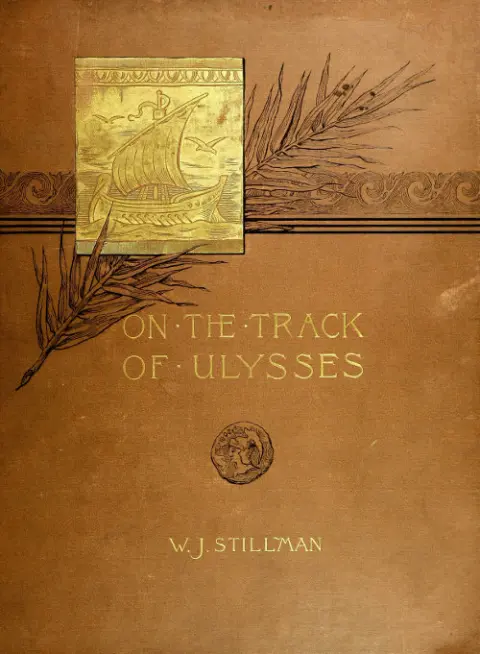
On the track of Ulysses; Together with an excursion in quest of the so-called Venus of Melos Two studies in archaeology, made during a cruise among the Greek islands
William James Stillman

THE CLASSIC COLLECTION · 1874
"The Cretan Insurrection of 1866-7-8" by William J. Stillman is a historical account written in the late 19th century. The book delves into the events surrounding the Cretan revolt against Ottoman rule during the years mentioned, providing insights into the complexities of political influences and the cultural heritage of the Cretan people. It explores the socio-political dynamics of the time, focusing on the Cretans’ struggle for autonomy and the various powers that intervened in their affairs. The opening of the text introduces readers to the context preceding the insurrection, notably Stillman’s personal involvement as the U.S. Consul in Crete. He reflects on the historical background of the island, illuminating its unique character and the grievances that led to heightened tensions. Through various interactions with local officials and the unfolding political landscape marked by oppression, he sets the stage for the subsequent assembly of Cretan leaders, which becomes a catalyst for revolt. The narrative highlights the significant “Assembly” at Omalo, showcasing both the democratic aspirations of the Cretans and the volatile political environment that ultimately leads to conflict.
Introduction adapted from the source catalogue; source summaries may be automatically generated.
Free to read · English · 55,299 words · No account needed
MAKE TIME FOR A GOOD BOOK
On by default. Untick to stop anonymous reading totals. Each page counts after 10 seconds in view. How this works.
Anonymous counting is on unless you have switched it off.
The Cretans possess, in common with all the Greeks, the avidity for instruction and quickness of intellect which make of this race the dominant element in the Levant. They are tenaciously devoted to their religion and to their traditions, which have kept them up and preserved the national character against such a continuation of hostile influences as probably no other people ever lived through. The history of Crete is a series of obstinate rebellions and barbarous repressions, since the first conquest by the Saracens in A.D. 820, a conquest which was followed by an almost complete apostasy from Christianity--sword-conversion, and by persistent attempts on the part of the Byzantine emperors to reconquer it, until 961, when Nikephoras Phocas succeeded in driving the Saracens out. They seem to have made no considerable addition to the Cretan stock, since the population rapidly returned to Christianity, to which, judging from the known and more recent past, they had always probably remained devoted at heart. At the division of the Byzantine empire, Crete passed to Boniface, Duke of Montserrat, and from him was purchased by the Venetian Republic, 1204, from which time till its conquest by the Turks, completed in 1669, the Cretans were under a yoke that would probably have depopulated any other section of the Old World. The cruelties and misgovernment of the governors sent from Venice would be incredible if not recorded by Venetian historians and official records. The Venetians seem to have regarded the Cretans much in the same light as the English colonists of America did the Indians, and, when their wretched state came to the knowledge of the Senate, they sent commissioners to examine into it, from whose reports I translate some extracts (quoted in Italian by Pashley), who took them from the original documents in the public library of Venice. Basadonna, the first of these officers whose reports remain, says (1566): "The tax-gatherers and others dependent on them use against these unhappy people, in one way and another, strange and horrible tyrannies. It would be a matter worthy of your clemency immediately to abolish so odious and barbarous exactions, since to maintain them is to abandon these wretched men to most cruel serpents, who lacerate and devour them entirely, or oblige the few of them who remain to escape into Turkey, following the footsteps of innumerable others who, from time to time, have gone away from this cause." Then from Garzoni (1586): "In all the villages in which I have been, I have seen the houses of the inhabitants, in the greater part of which there is not be seen any article for the uses of dress or table; and for food, they are without bread or corn; they have no wine; their women are despoiled, their children naked, the men slightly covered, and the house emptied of everything, without any sign of human habitation. And this wretched people ('quella meschinità de' huomini') is compelled by established custom to give to the cavaliers two 'angarie' [twelve days' work] each per annum, and is obliged also by ancient regulation to work as much more as the cavalier may need for the pay of eight soldini a day, which amounts to a 'gazetta' [two Venetian soldi, or about one penny] and a fifteenth, introduced by them two hundred years ago, and not since increased. They are obliged to keep chickens and hens according to the number of doors [I do not feel sure of having properly translated this expression, obscure in the original], their masters having applied the term of doors to houses, which are built by the peasants themselves, and have no kind of use of doors, because the Cavaliers, industrious for their own advantage, make doors as frequently as possible to increase the number of royalties. The beasts of labor, called donnegals, are obliged to plough a certain quantity of land, for which, planted or not, the peasant must pay the third. The donnegals are also obliged to work two angarie per annum. Mules and other beasts of transport must make two voyages to the city for the master. Animals of pasture the tenth, and a thousand other inventions to absorb all the productions of the land. If the peasant has a vineyard planted (the ground always belonging to the Cavaliers) and trained by him, although on land before wild, he must pay to the master, before marking the division for the royalty (which by ancient regulation gives one-third to the Cavalier and two to the peasant), five measures, called mistaches, for each vineyard, under pretext that he has eaten part before the vintage, for the use of the pattichier [in Crete, even now, an open shallow kind of vat built in the fields, of flat stones, and cemented, in which the grapes are trampled], and under other most dishonest inventions. And to increase still more the royalty, they divide the vineyard into so many parts that few return more than fifteen mistaches, in such a way that with fraud founded on force they take two-thirds for themselves and give one to the peasant.
Your reading position is saved on this browser. Take it to another device with a library code. Reading pages adapt to text, rather than matching a printed edition.
BEHIND THE BOOK
This eBook is for the use of anyone anywhere in the United States and most other parts of the world at no cost and with almost no restrictions whatsoever. You may copy it, give it away or re-use it under the terms of the Project Gutenberg License included with this eBook or online at www.gutenberg.org. If you are not located in the United States, you will have to check the laws of the country where you are located before using this eBook. Read the source licence.
The original source file, including credits and licence, is retained by this library. Request an original-format copy at no charge. Please include the book title and Project Gutenberg identifier #49956.
KEEP YOUR CURIOSITY GOING
Cécile Tormay

Moritz Busch
John L. Ransom
Frances Wright
Cécile Tormay

Mabel Potter Daggett