THE CLASSIC COLLECTION✦Birds in Legend, Fable and FolkloreCLASSIC FREE BOOKS
Birds in Legend, Fable and Folklore
Ernest Ingersoll
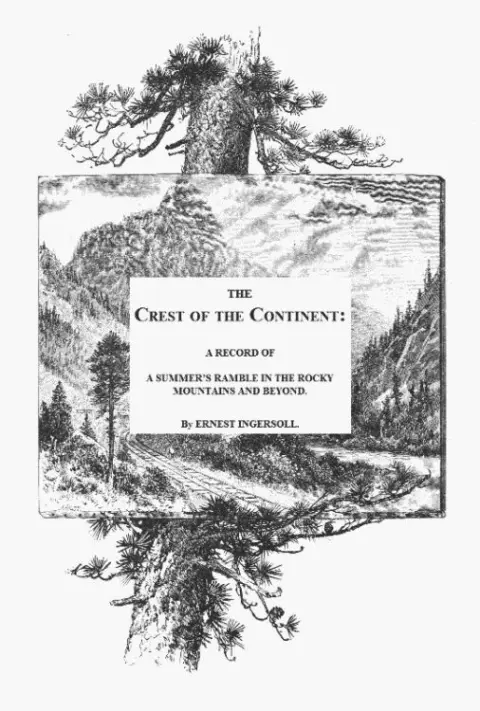
THE CLASSIC COLLECTION · 1885
"The Crest of the Continent: A Summer's Ramble in the Rocky Mountains and Beyond" by Ernest Ingersoll is a travel narrative written in the late 19th century. The book captures the author's personal experiences and observations during an adventurous journey through the Rocky Mountains, offering a vivid portrayal of the scenery, wildlife, and human interactions in the region. Through its delightful prose, the work touches on themes of exploration, nature, and the quest for solace beyond the confines of civilization. At the start of this lively account, the author expresses a sense of awe and excitement as he first glimpses the majestic Rocky Mountains, describing their ethereal appearance against the skyline. The narrative introduces a group of friends and companions, including a musician, artist, and a photographer, who have charismatically banded together to embark on a memorable expedition in a specially chartered train. The opening sets the stage for an exploration of Denver and its surroundings, detailing aspects of the city that underline its rapid development and rich resources, while fostering an atmosphere of camaraderie and adventure as the group prepares to delve deeper into the mountainous beauty that lies ahead.
Introduction adapted from the source catalogue; source summaries may be automatically generated.
Free to read · English · 134,359 words · No account needed
MAKE TIME FOR A GOOD BOOK
On by default. Untick to stop anonymous reading totals. Each page counts after 10 seconds in view. How this works.
Anonymous counting is on unless you have switched it off.
A still clearer idea of the great value of its interests to the State, and of its local works to Pueblo may be obtained from the report of the productions of the Colorado Coal and Iron company for the year 1882 which, briefly summarized, aggregates as follows: Coal, 511,239 tons; coke, 92,770 tons; iron ores, 53,425 tons; merchant iron, mine rails, etc., 3,883 tons; castings, 2,752 tons; pig-iron, 24,303 tons; muck bar, in four months, 1,253 tons; steel ingots, eight months, 20,919 tons; steel blooms, eight months, 18,068 tons; steel rails, eight months, 16,139 tons; nails, four months, 16,158 kegs; and spikes, six months, 5,022 kegs.
The economy of location, and the successful results attending the establishment here of the great enterprises referred to, are attracting many others. During the past season one of Leadville's largest smelters, having been destroyed by fire, has been rebuilt at Pueblo, and more will naturally follow.
The mercantile part of the community, however, while admitting all the claims of the steel works and the smelter to their great and beneficent influence upon the destiny of the new town, puts forward its own claim to the credit of commencing the progressive movement. When, by the extensions of the railway into the back country of Colorado, merchants began to perceive that at Pueblo they could buy goods of precisely such grades as they desired a trifle more cheaply, and get them home a trifle more expeditiously, than by going to Denver or Kansas City, Pueblo began to feel the impulse of new commercial vigor. When it came to reckoning upon a whole year's purchases, the slight advantage gained in freight over Denver, to all southern and middle interior points, amounted to a very considerable sum. Here, far more than in the Eastern States, the freight charges must be taken into account by the country merchant; particularly in the provision business, where the staples are the heaviest articles, as a rule, and, at the same time, those on which the least profit accrues. This consideration, impressing itself more and more upon the good judgment of the mountain dealers, is bringing a larger and larger trade to Pueblo, until now she is beginning to boast herself mistress of all southern and middle Colorado and of northern New Mexico. She can not hope to compete with Denver for the northern half of the State, but she does not intend to lose her grip upon the great, rapidly-developing, money-producing San Juan, Gunnison and Rio Grande regions. And as the visitor sees the railway yards crowded with loaded freight trains destined for every point of the compass; notes the throng of laden carts in the furrowed streets; observes how every warehouse is plethoric with constantly changing merchandise, often stacked on the curbstone under the cover of a canvas sheet because room within doors can not be found; witnesses the temporary nature of so many scores of buildings for business and for domiciles, and learns how most of their owners are putting up permanent houses, multitudes of which are rising substantially on every side;--when he has caught the meaning of all this, he finds that Pueblo has an idea that her opportunities are great, and that she does not propose to neglect them in the least particular. There is much wealth there now, and more is being introduced by Eastern investors, or accumulated on the spot, not only in trade, but in the very extensive herds of cattle and sheep that center there. Yet this seems to be but the incipience of her prosperity,--a prosperity which rests on solid foundations, existing not alone in the industries I have catalogued and the trade which has centered there, but in the fact that values are not inflated and that the real property of the city is mortgaged to a remarkably small degree.
Your reading position is saved on this browser. Take it to another device with a library code. Reading pages adapt to text, rather than matching a printed edition.
Ernest Ingersoll
Ernest Ingersoll
Ernest Ingersoll
Ernest Ingersoll
BEHIND THE BOOK
This eBook is for the use of anyone anywhere in the United States and most other parts of the world at no cost and with almost no restrictions whatsoever. You may copy it, give it away or re-use it under the terms of the Project Gutenberg License included with this eBook or online at www.gutenberg.org. If you are not located in the United States, you will have to check the laws of the country where you are located before using this eBook. Read the source licence.
The original source file, including credits and licence, is retained by this library. Request an original-format copy at no charge. Please include the book title and Project Gutenberg identifier #43020.
KEEP YOUR CURIOSITY GOING
Wilfrid Scawen Blunt
Wilfrid Scawen Blunt

E. W. (Edgar Watson) Howe
Francis Greenleaf Allinson & Anne C. E. (Anne Crosby Emery) Allinson
Cyrenus Cole

John Martineau