THE CLASSIC COLLECTION✦Birds in Legend, Fable and FolkloreCLASSIC FREE BOOKS
Birds in Legend, Fable and Folklore
Ernest Ingersoll
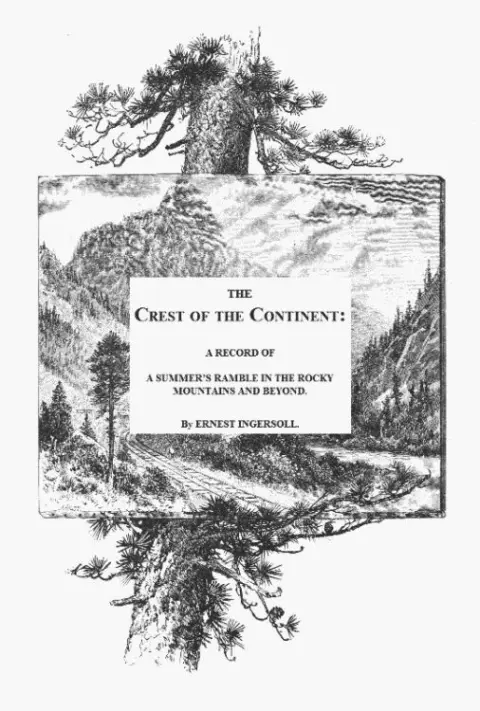
THE CLASSIC COLLECTION · 1885
"The Crest of the Continent: A Summer's Ramble in the Rocky Mountains and Beyond" by Ernest Ingersoll is a travel narrative written in the late 19th century. The book captures the author's personal experiences and observations during an adventurous journey through the Rocky Mountains, offering a vivid portrayal of the scenery, wildlife, and human interactions in the region. Through its delightful prose, the work touches on themes of exploration, nature, and the quest for solace beyond the confines of civilization. At the start of this lively account, the author expresses a sense of awe and excitement as he first glimpses the majestic Rocky Mountains, describing their ethereal appearance against the skyline. The narrative introduces a group of friends and companions, including a musician, artist, and a photographer, who have charismatically banded together to embark on a memorable expedition in a specially chartered train. The opening sets the stage for an exploration of Denver and its surroundings, detailing aspects of the city that underline its rapid development and rich resources, while fostering an atmosphere of camaraderie and adventure as the group prepares to delve deeper into the mountainous beauty that lies ahead.
Introduction adapted from the source catalogue; source summaries may be automatically generated.
Free to read · English · 134,359 words · No account needed
MAKE TIME FOR A GOOD BOOK
On by default. Untick to stop anonymous reading totals. Each page counts after 10 seconds in view. How this works.
Anonymous counting is on unless you have switched it off.
"Clear and cool, clear and cool,
By laughing shallow and dreaming pool,
Cool and clear, cool and clear,
By shining shingle and foaming weir."
Listen again below, where it rushes triumphant from the adamantine gates that sought to imprison it:--
"Strong and free, strong and free, The flood gates are open away to the sea; Free and strong, free and strong, Claiming my streams as I hurry along, To the golden sands and the leaping bar And the taintless tide that awaits me afar."
Almost in the very springs of the river, where an amphitheatre of gray quartzite peaks stand like stiffened silver-gray curtains between the Atlantic and the Pacific, we curl round a perfect shepherd's crook of a curve, and then climb its straight staff to the summit of Fremont's,--the highest railway pass in the world. The pathway is so hidden in great woods, and the grim giants of the Mosquito range are still so inaccessibly far above you, even when you have reached the sterile oberland, above the trees, that you hardly realize the fact that you are 11,540 feet--considerably over two vertical miles--above the sea.
Once more on the Pacific slope, with the crossing of this range, we see the first trickling of Ten-Mile creek, and enter the edge of one of the famous mining districts of the state, catching a sidelong glimpse of the Holy Cross as we descend.
"Although its now well-known silver mines," says a recent historical account, "are of recent date, the district is not a new one, having been run over by gold hunters in the 'flush times' of California gulch, Buckskin Joe and other famous gold-camps of early days. Gold was found in the bed of Ten-Mile creek, and in the connecting gulches, ... among them McNulty's gulch, said to have yielded more gold in proportion to its size than any other workings in the state, and many fine nuggets of unusual size were taken from it.... The discovery in 1878, of the famous Robinson group of mines, followed, by the White Quail and Wheel of Fortune discoveries, attracted large numbers of prospectors to the new camp, and in spite of the ten feet of snow that covered the ground during the winter of 1878-'79 locations were made, and shafts and tunnels begun in every direction. During the winter the town of Carbonateville was settled, and for a time promised to become a thriving camp. On the 8th of February, the town of Kokomo, which, with its younger rival, Robinson, is now a prosperous and growing mining camp, with two smelters in operation, was located. In the spring of 1880 Robinson's camp began to build up rapidly, under the support of the great Robinson mines, and the fostering care of the late Lieutenant Governor Robinson, and soon became a formidable rival to Kokomo. The many discoveries made during the spring and summer of 1880, brought the district into a prominence second only to that of Leadville, and a large amount of capital was invested in the development of its many promising mines and prospects. Two smelters were erected at Kokomo, and one near the old town of Carbonateville, while extensive works, consisting of furnaces, roasters, etc., were put up at Robinson to work the ores of the Robinson mine. A railroad to connect the district with Leadville on the south and Georgetown on the east, was projected, and partially graded during the summer, but was finally absorbed by the enterprising managers of the Denver and Rio Grande Company, who, with a watchful eye for the future, began the construction, under the name of Blue River extension of the Denver and Rio Grande, of a road, which in spite of the many and great difficulties encountered, was completed to Robinson on the 1st of January, 1881. Much of the grading and most of the track-laying were done under a heavy fall of snow, the range being crossed in midwinter, affording a striking instance of the energy and contempt of obstacles characteristic of Western railroad builders."
Your reading position is saved on this browser. Take it to another device with a library code. Reading pages adapt to text, rather than matching a printed edition.
Ernest Ingersoll
Ernest Ingersoll
Ernest Ingersoll
Ernest Ingersoll
BEHIND THE BOOK
This eBook is for the use of anyone anywhere in the United States and most other parts of the world at no cost and with almost no restrictions whatsoever. You may copy it, give it away or re-use it under the terms of the Project Gutenberg License included with this eBook or online at www.gutenberg.org. If you are not located in the United States, you will have to check the laws of the country where you are located before using this eBook. Read the source licence.
The original source file, including credits and licence, is retained by this library. Request an original-format copy at no charge. Please include the book title and Project Gutenberg identifier #43020.
KEEP YOUR CURIOSITY GOING
Wilfrid Scawen Blunt
Wilfrid Scawen Blunt

E. W. (Edgar Watson) Howe
Francis Greenleaf Allinson & Anne C. E. (Anne Crosby Emery) Allinson
Cyrenus Cole

John Martineau