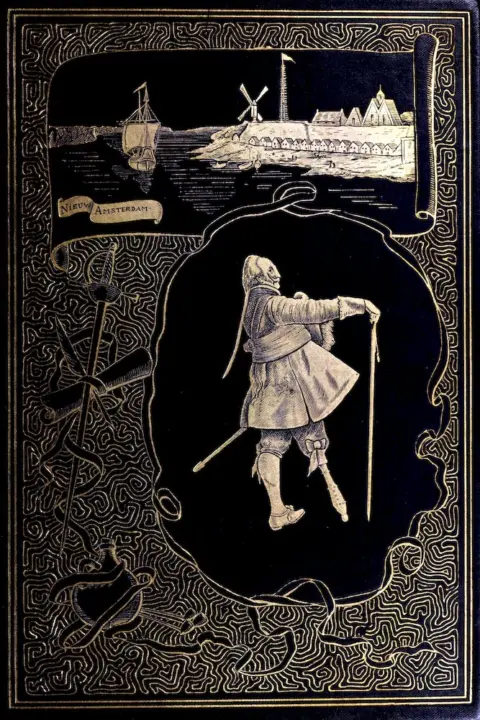
Knickerbocker’s history of New York, vol. 2 (of 2)
Washington Irving
THE CLASSIC COLLECTION · 1800
"The Crayon Papers" by Washington Irving is a collection of literary sketches written during the early 19th century. The work features the character Geoffrey Crayon, who serves as the narrator and commentator on various subjects, including personal reflections, social observations, and tales of adventure. The stories are infused with a romantic spirit and are set against a backdrop of picturesque landscapes, offering a blend of nostalgia and humor that characterizes Irving's style. At the start of "The Crayon Papers," the opening section titled "Mountjoy" introduces us to the narrator's idyllic childhood, steeped in imagination and wonder. We learn about his upbringing in a rural setting near the Hudson River, influenced by his lazy yet affectionate father and his imaginative sisters. The young narrator recalls the enchanting tales he was captivated by, which nurtured his adventurous spirit. He spends his days in nature, exploring the woods and engaging in flights of fancy, foreshadowing the romantic idealism that will characterize his life. The section captures the essence of youthful exploration and the deeply ingrained yearning for beauty and adventure, setting a foundation for the tales that follow in the collection.
Introduction adapted from the source catalogue; source summaries may be automatically generated.
Free to read · English · 83,344 words · No account needed
MAKE TIME FOR A GOOD BOOK
On by default. Untick to stop anonymous reading totals. Each page counts after 10 seconds in view. How this works.
Anonymous counting is on unless you have switched it off.
"One cold stormy evening I was seated, in dumpish mood, in the bar-room of the inn, looking into the fire, and turning over uncomfortable thoughts, when I was accosted by some one who had entered the room without my perceiving it. I looked up, and saw before me a tall and, as I thought, pompous-looking man, arrayed in small clothes and knee-buckles, with powdered head, and shoes nicely blacked and polished; a style of dress unparalleled in those days, in that rough country. I took a pique against him from the very portliness of his appearance, and stateliness of his manner, and bristled up as he accosted me. He demanded if my name was not Ringwood.
"I was startled, for I supposed myself perfectly incog.; but I answered in
the affirmative.
"'Your family, I believe, lives in Richmond?'
"My gorge began to rise. 'Yes, sir,' replied I sulkily, 'my family does
live in Richmond.'
"'And what, may I ask, has brought you into this part of the country?'
"'Zounds, sir!' cried I, starting on my feet, 'what business is it of yours? How dare you to question me in this manner?'
"The entrance of some persons prevented a reply; but I walked up and down the bar-room, fuming with conscious independence and insulted dignity, while the pompous-looking personage, who had thus trespassed upon my spleen, retired without proffering another word.
"The next day, while seated in my room, some one tapped at the door, and, on being bid to enter, the stranger in the powdered head, small-clothes, and shining shoes and buckles, walked in with ceremonious courtesy.
"My boyish pride was again in arms; but he subdued me. He was formal, but kind and friendly. He knew my family and understood my situation, and the dogged struggle I was making. A little conversation, when my jealous pride was once put to rest, drew everything from me. He was a lawyer of experience and of extensive practice, and offered at once to take me with him, and direct my studies. The offer was too advantageous and gratifying not to be immediately accepted. From that time I began to look up. I was put into a proper track, and was enabled to study to a proper purpose. I made acquaintance, too, with some of the young men of the place, who were in the same pursuit, and was encouraged at finding that I could 'hold my own' in argument with them. We instituted a debating club, in which I soon became prominent and popular. Men of talents, engaged in other pursuits, joined it, and this diversified our subjects and put me on various tracks of inquiry. Ladies, too, attended some of our discussions, and this gave them a polite tone, and had an influence on the manners of the debaters. My legal patron also may have had a favorable effect in correcting any roughness contracted in my hunter's life. He was calculated to bend me in an opposite direction, for he was of the old school; quoted Chesterfield on all occasions, and talked of Sir Charles Grandison, who was his beau ideal. It was Sir Charles Grandison, however, Kentuckyized.
Your reading position is saved on this browser. Take it to another device with a library code. Reading pages adapt to text, rather than matching a printed edition.
Washington Irving
William Irving & Washington Irving & James Kirke Paulding
Washington Irving
Washington Irving
BEHIND THE BOOK
This eBook is for the use of anyone anywhere in the United States and most other parts of the world at no cost and with almost no restrictions whatsoever. You may copy it, give it away or re-use it under the terms of the Project Gutenberg License included with this eBook or online at www.gutenberg.org. If you are not located in the United States, you will have to check the laws of the country where you are located before using this eBook. Read the source licence.
The original source file, including credits and licence, is retained by this library. Request an original-format copy at no charge. Please include the book title and Project Gutenberg identifier #7994.
KEEP YOUR CURIOSITY GOING
Coulson Kernahan

Maurice Baring
Frances Wright
Cécile Tormay

Frederic Jesup Stimson

W. H. P. (William Henry Pope) Jarvis