THE CLASSIC COLLECTION✦Hawthorne (English Men of Letters Series)CLASSIC FREE BOOKS
Hawthorne (English Men of Letters Series)
Henry James
THE CLASSIC COLLECTION · 1915
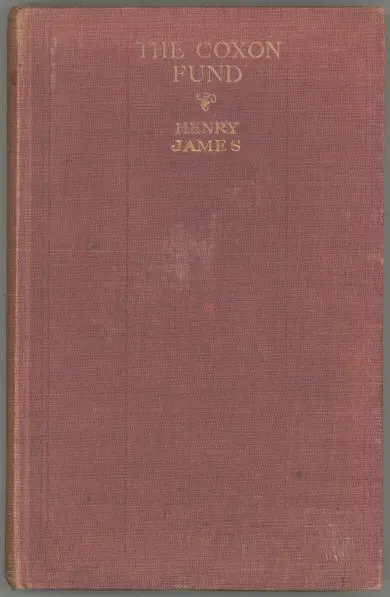
"The Coxon Fund" by Henry James is a short story published in 1894. Frank Saltram possesses a brilliant mind that dazzles in conversation but produces nothing tangible. He lives off others' generosity while recognizing no obligations. When a substantial inheritance meant for a deserving intellectual becomes available, a moral dilemma emerges: should the unreliable but captivating Saltram receive it? The decision threatens an engagement and forces those around him to weigh genius against character, potential against performance.
Introduction adapted from the source catalogue; source summaries may be automatically generated.
Free to read · English · 23,385 words · No account needed
MAKE TIME FOR A GOOD BOOK
On by default. Untick to stop anonymous reading totals. Each page counts after 10 seconds in view. How this works.
Anonymous counting is on unless you have switched it off.
“So you came to see where the fascination resides? Well, you’ve seen!”
My young lady raised fine eyebrows. “Do you mean in his bad faith?”
“In the extraordinary effects of it; his possession, that is, of some quality or other that condemns us in advance to forgive him the humiliation, as I may call it, to which he has subjected us.”
“The humiliation?”
“Why mine, for instance, as one of his guarantors, before you as the
purchaser of a ticket.”
She let her charming gay eyes rest on me. “You don’t look humiliated a bit, and if you did I should let you off, disappointed as I am; for the mysterious quality you speak of is just the quality I came to see.”
“Oh, you can’t ‘see’ it!” I cried.
“How then do you get at it?”
“You don’t! You mustn’t suppose he’s good-looking,” I added.
“Why his wife says he’s lovely!”
My hilarity may have struck her as excessive, but I confess it broke out afresh. Had she acted only in obedience to this singular plea, so characteristic, on Mrs. Saltram’s part, of what was irritating in the narrowness of that lady’s point of view? “Mrs. Saltram,” I explained, “undervalues him where he’s strongest, so that, to make up for it perhaps, she overpraises him where he’s weak. He’s not, assuredly, superficially attractive; he’s middle-aged, fat, featureless save for his great eyes.”
“Yes, his great eyes,” said my young lady attentively. She had evidently heard all about his great eyes—the beaux yeux for which alone we had really done it all.
“They’re tragic and splendid—lights on a dangerous coast. But he moves badly and dresses worse, and altogether he’s anything but smart.”
My companion, who appeared to reflect on this, after a moment appealed. “Do you call him a real gentleman?”
I started slightly at the question, for I had a sense of recognising it: George Gravener, years before, that first flushed night, had put me face to face with it. It had embarrassed me then, but it didn’t embarrass me now, for I had lived with it and overcome it and disposed of it. “A real gentleman? Emphatically not!”
My promptitude surprised her a little, but I quickly felt how little it was to Gravener I was now talking. “Do you say that because he’s—what do you call it in England?—of humble extraction?”
“Not a bit. His father was a country school-master and his mother the widow of a sexton, but that has nothing to do with it. I say it simply because I know him well.”
Your reading position is saved on this browser. Take it to another device with a library code. Reading pages adapt to text, rather than matching a printed edition.
Henry James
Henry James
Henry James

Henry James
BEHIND THE BOOK
This eBook is for the use of anyone anywhere in the United States and most other parts of the world at no cost and with almost no restrictions whatsoever. You may copy it, give it away or re-use it under the terms of the Project Gutenberg License included with this eBook or online at www.gutenberg.org. If you are not located in the United States, you will have to check the laws of the country where you are located before using this eBook. Read the source licence.
The original source file, including credits and licence, is retained by this library. Request an original-format copy at no charge. Please include the book title and Project Gutenberg identifier #1193.
KEEP YOUR CURIOSITY GOING
Coulson Kernahan

Maurice Baring
Frances Wright
Cécile Tormay

Frederic Jesup Stimson

W. H. P. (William Henry Pope) Jarvis