THE CLASSIC COLLECTION✦Hawthorne (English Men of Letters Series)CLASSIC FREE BOOKS
Hawthorne (English Men of Letters Series)
Henry James
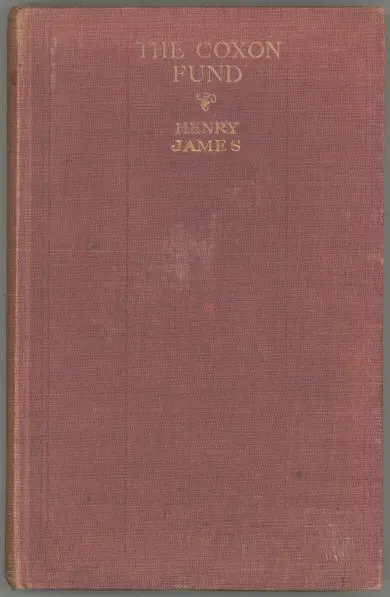
THE CLASSIC COLLECTION · 1915
"The Coxon Fund" by Henry James is a short story published in 1894. Frank Saltram possesses a brilliant mind that dazzles in conversation but produces nothing tangible. He lives off others' generosity while recognizing no obligations. When a substantial inheritance meant for a deserving intellectual becomes available, a moral dilemma emerges: should the unreliable but captivating Saltram receive it? The decision threatens an engagement and forces those around him to weigh genius against character, potential against performance.
Introduction adapted from the source catalogue; source summaries may be automatically generated.
Free to read · English · 23,385 words · No account needed
MAKE TIME FOR A GOOD BOOK
On by default. Untick to stop anonymous reading totals. Each page counts after 10 seconds in view. How this works.
Anonymous counting is on unless you have switched it off.
“Oh yes, but there are some new ones.”
“None for me. Ah novelty would be pleasant!”
“Doesn’t it appear that of late he has been particularly horrid?”
“His fluctuations don’t matter”, I returned, “for at night all cats are grey. You saw the shade of this one the night we waited for him together. What will you have? He has no dignity.”
Miss Anvoy, who had been introducing with her American distinctness, looked encouragingly round at some of the combinations she had risked. “It’s too bad I can’t see him.”
“You mean Gravener won’t let you?”
“I haven’t asked him. He lets me do everything.”
“But you know he knows him and wonders what some of us see in him.”
“We haven’t happened to talk of him,” the girl said.
“Get him to take you some day out to see the Mulvilles.”
“I thought Mr. Saltram had thrown the Mulvilles over.”
“Utterly. But that won’t prevent his being planted there again, to bloom like a rose, within a month or two.”
Miss Anvoy thought a moment. Then, “I should like to see them,” she said with her fostering smile.
“They’re tremendously worth it. You mustn’t miss them.”
“I’ll make George take me,” she went on as Mrs. Saltram came up to interrupt us. She sniffed at this unfortunate as kindly as she had smiled at me and, addressing the question to her, continued: “But the chance of a lecture—one of the wonderful lectures? Isn’t there another course announced?”
“Another? There are about thirty!” I exclaimed, turning away and feeling Mrs. Saltram’s little eyes in my back. A few days after this I heard that Gravener’s marriage was near at hand—was settled for Whitsuntide; but as no invitation had reached me I had my doubts, and there presently came to me in fact the report of a postponement. Something was the matter; what was the matter was supposed to be that Lady Coxon was now critically ill. I had called on her after my dinner in the Regent’s Park, but I had neither seen her nor seen Miss Anvoy. I forget to-day the exact order in which, at this period, sundry incidents occurred and the particular stage at which it suddenly struck me, making me catch my breath a little, that the progression, the acceleration, was for all the world that of fine drama. This was probably rather late in the day, and the exact order doesn’t signify. What had already occurred was some accident determining a more patient wait. George Gravener, whom I met again, in fact told me as much, but without signs of perturbation. Lady Coxon had to be constantly attended to, and there were other good reasons as well. Lady Coxon had to be so constantly attended to that on the occasion of a second attempt in the Regent’s Park I equally failed to obtain a sight of her niece. I judged it discreet in all the conditions not to make a third; but this didn’t matter, for it was through Adelaide Mulville that the side-wind of the comedy, though I was at first unwitting, began to reach me. I went to Wimbledon at times because Saltram was there, and I went at others because he wasn’t. The Pudneys, who had taken him to Birmingham, had already got rid of him, and we had a horrible consciousness of his wandering roofless, in dishonour, about the smoky Midlands, almost as the injured Lear wandered on the storm-lashed heath. His room, upstairs, had been lately done up (I could hear the crackle of the new chintz) and the difference only made his smirches and bruises, his splendid tainted genius, the more tragic. If he wasn’t barefoot in the mire he was sure to be unconventionally shod. These were the things Adelaide and I, who were old enough friends to stare at each other in silence, talked about when we didn’t speak. When we spoke it was only about the brilliant girl George Gravener was to marry and whom he had brought out the other Sunday. I could see that this presentation had been happy, for Mrs. Mulville commemorated it after her sole fashion of showing confidence in a new relation. “She likes me—she likes me”: her native humility exulted in that measure of success. We all knew for ourselves how she liked those who liked her, and as regards Ruth Anvoy she was more easily won over than Lady Maddock.
Your reading position is saved on this browser. Take it to another device with a library code. Reading pages adapt to text, rather than matching a printed edition.
Henry James
Henry James
Henry James

Henry James
BEHIND THE BOOK
This eBook is for the use of anyone anywhere in the United States and most other parts of the world at no cost and with almost no restrictions whatsoever. You may copy it, give it away or re-use it under the terms of the Project Gutenberg License included with this eBook or online at www.gutenberg.org. If you are not located in the United States, you will have to check the laws of the country where you are located before using this eBook. Read the source licence.
The original source file, including credits and licence, is retained by this library. Request an original-format copy at no charge. Please include the book title and Project Gutenberg identifier #1193.
KEEP YOUR CURIOSITY GOING
Coulson Kernahan

Maurice Baring
Frances Wright
Cécile Tormay

Frederic Jesup Stimson

W. H. P. (William Henry Pope) Jarvis