READ · DISCOVER · ENJOYClassic literature · Always free
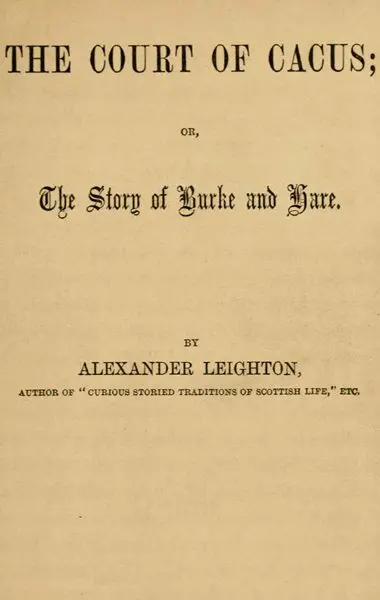
The Court of Cacus; Or, The Story of Burke and Hare — digital edition cover

THE CLASSIC COLLECTION · 1861

The Court of Cacus; Or, The Story of Burke and Hare

"The Court of Cacus; Or, The Story of Burke and Hare" by Alexander Leighton is a historical account written in the mid-19th century. The book illuminates the notorious tales of body snatching and medical malpractice in 19th-century Scotland, with a focus on the infamous pair, William Burke and William Hare, who became known for their grisly deeds. Through its vivid narrative, the work explores themes of morality, depravity, and the darker facets of human nature in pursuit of scientific advancement. At the start of the narrative, the atmosphere is set in Surgeon’s Square in Edinburgh during the autumn of 1827. The approach of a new and timid body-snatcher, who turns out to be William Burke, is detailed, as he encounters a student from Dr. Knox's class. This chance meeting foreshadows Burke's entry into the macabre trade of selling cadavers, a practice that thrived due to the growing demand in medical schools. The reader is introduced to the grim reality of body snatching, as Burke and the students engage in conversation about the value of human remains, and the narrative hints at the moral decay and desperate motivations that characterize the characters involved in this dark chapter of medical history.

Introduction adapted from the source catalogue; source summaries may be automatically generated.

Start reading ↓

Free to read · English · 77,505 words · No account needed

MAKE TIME FOR A GOOD BOOK

The Court of Cacus; Or, The Story of Burke and Hare

On by default. Untick to stop anonymous reading totals. Each page counts after 10 seconds in view. How this works.

Anonymous counting is on unless you have switched it off.

The Court of Cacus; Or, The Story of Burke and Hare

We wonder how nature so often leaves us in the dark. We cannot understand that she has so much to do that she is for ever in a hurry, so that we only see at times the skirt of her cloak. Then we are ourselves so restless and impatient for knowledge, that we snuff the candle of our inquiry so often that we can see nothing. Perhaps all this is intended for the purpose of giving us a wider world of imagination, and more ardour in peopling it with all its strange beings, spectral images, protean forms, wild movements--for what further end we know not, but we work our privilege in these days of fiction very well. The veil is often an exaggerator, but in this act of our drama it seems hard to fill up the unknown recesses with possibilities equal to the realities. Just try to supply the required minutiæ to the few words said to have been uttered by Helen M'Dougal. After many months of fruitless inquiry, met with a denial that any one in Log's lodgings had seen the young cousin, the mother and sister, probably under suspicion of some foul play, went to the house of Constantine Burke, the brother of our man. Helen M'Dougal happened to be present, and to the request again made to know what had become of the girl, the woman, who must have been under the influence of drink, for at this time the explosion had not taken place, answered, "Oh, you need not trouble yourselves about Jessy. She was murdered, and sold long ago."

Among the cases of mere outline and shadowy traces, suspected to have been more in number, as including more waifs than admitted, we may place another. It seems to have been a bargain between the two principal actors that their work should be conjunct in action as well as in payment. On one occasion, Burke, having now plenty of money, went to the country on a pleasure jaunt. Yes; pleasure. Amidst all our philosophy and inquiry into causes and motives, would we not save ourselves a deal of trouble by attributing nine-tenths of the actions of men, not excepting murder, to a desire for pleasure? All swallow the love-apple bait presented by some wicked genius of the devil, who sports with the affections of mankind. The beguiler laughs as he angles. Some victims afford him fine "rises," and look shy, only to come again to bite in earnest. Some swallow and enjoy the sweet morsel, until the hook approaches the pylorus of their reason. Some disgorge it, to seek it again; others break the line and run away with the hook, to die in secret places under a crag. Some are caught by a fin, and carry the mark of the forbidden pleasure only to excite them to another trial; others are held on till they reach the bank, where they writhe in agony amidst sunbeams, wild thyme, and gaudy flowers, with the laugh of the tempter sounding in their ears. And some, on being swung ashore, get entangled in a tree, and hang there by the neck. How few can nibble off cunningly the cibum præfixum ære, and avoid the snare! Burke had gone on a pleasure jaunt--not to be hooked yet. On his return he found Log's lodgings as he left them; nor did he suspect that any of the unholy work had been performed in his absence. If the old orgies had been continued,--and how could they now be renounced when the increasing weight of all those deeds must have been pressing more and more on their hearts, however they might try to conceal it, and required the old art of buoyancy as a counter-agent?--there had been plenty of money to supply the means, so that Burke thought that no march had been stolen upon him by his cunning colleague. It happened, however, that he had occasion soon after his return to call at the hall in Surgeon's Square--perhaps to get the price, or part of it, of the last burden. He was there told by one of the assistants that his friend had been there shortly before with a box, not empty, and had been paid for it. He even got the day of the month and the hour of the evening, from which he saw that his co-actor had been secretly, as he said, working during his absence "on his own hook." Enraged at this want of honour, he repaired to the house, where he found his friend, and taxed him with the fraud. Hare stoutly denied the charge. The women were appealed to, but neither of them would admit anything; for we are to remember that both of them were not only in fear of their respective lords, but of those of each other. Nay, we have seen Hare using as much liberty of punishing M'Dougal when his friend was present, as Burke had of thrashing Mrs Hare, which it is certain he often did. Nay, the women even had their battles royal, and the men were, as well, often engaged in fierce conflict. The present subject was a delicate one. It touched the honour of contractors, the purse of sordidness, and the faith of friendship. Well, we verily believe that even Burke was fit for these heroics, and he was fit for something else. He fell upon his friend with fury, and Hare, ever ready for battle with all and sundry, not excepting his wife, retaliated. They fought long and desperately, the women looking on with only that concern which might find its account in so being revenged for some prior cruelty exercised toward them by one or the other, perhaps both. This was one of those riots which so much disturbed the neighbours. A crowd, as usual, collected at the door, but even the exasperation of the parties could not force out the secret of their quarrel. It would have been strange indeed if it had! and we say this even in the midst of daily examples of anger roused to a pitch of opening the floodgates of very dark things, even to the confusion and ruin of the angry, and so far involuntary, confessor. How little did that crowd of spectators know what these men were fighting about!

Your reading position is saved on this browser. Take it to another device with a library code. Reading pages adapt to text, rather than matching a printed edition.

BEHIND THE WORDS

About Alexander Leighton

Alexander Leighton (1800–1874). Explore The Court of Cacus; Or, The Story of Burke and Hare in this collection. These books span history.

Explore this author’s books →

THE READERS’ VERDICT

How did this story stay with you?

Not rated yet
Your rating for The Court of Cacus; Or, The Story of Burke and Hare

Be the first to share your verdict.

One rating per browser, which you can change or remove. A necessary browser identifier remembers your vote. How ratings work

A GOOD STORY DESERVES COMPANY

Pass this book along.

A great read is even better when it’s shared.

SEND A LITTLE INSPIRATION

Share this book

BEHIND THE BOOK

Edition & source details.

Title
The Court of Cacus; Or, The Story of Burke and Hare
Author
Alexander Leighton
First publication (Open Library catalogue match)
1861
Digital edition publisher
Project Gutenberg
Gutenberg release date
2012-12-17
Language
English
Source edition imprint
Not stated in source catalogue
Source identifier
Project Gutenberg #41642
Contributors
No additional named contributors in source metadata

Public-domain source & licence

This eBook is for the use of anyone anywhere in the United States and most other parts of the world at no cost and with almost no restrictions whatsoever. You may copy it, give it away or re-use it under the terms of the Project Gutenberg License included with this eBook or online at www.gutenberg.org. If you are not located in the United States, you will have to check the laws of the country where you are located before using this eBook. Read the source licence.

Full source licence and obtaining an original copy

The original source file, including credits and licence, is retained by this library. Request an original-format copy at no charge. Please include the book title and Project Gutenberg identifier #41642.

the full Project Gutenberg License must appear
prominently whenever any copy of a Project Gutenberg work (any work
on which the phrase “Project Gutenberg” appears, or with which the
phrase “Project Gutenberg” is associated) is accessed, displayed,
performed, viewed, copied or distributed:

This eBook is for the use of anyone anywhere in the United States and most
other parts of the world at no cost and with almost no restrictions
whatsoever. You may copy it, give it away or re-use it under the terms
of the Project Gutenberg™ License included with this eBook or online
at www.gutenberg.org. If you
are not located in the United States, you will have to check the laws
of the country where you are located before using this eBook.

1.E.2. If an individual Project Gutenberg electronic work is
derived from texts not protected by U.S. copyright law (does not
contain a notice indicating that it is posted with permission of the
copyright holder), the work can be copied and distributed to anyone in
the United States without paying any fees or charges. If you are
redistributing or providing access to a work with the phrase “Project
Gutenberg” associated with or appearing on the work, you must comply
either with the requirements of paragraphs 1.E.1 through 1.E.7 or
obtain permission for the use of the work and the Project Gutenberg
trademark as set forth in paragraphs 1.E.8 or 1.E.9.

1.E.3. If an individual Project Gutenberg electronic work is posted
with the permission of the copyright holder, your use and distribution
must comply with both paragraphs 1.E.1 through 1.E.7 and any
additional terms imposed by the copyright holder. Additional terms
will be linked to the Project Gutenberg License for all works
posted with the permission of the copyright holder found at the
beginning of this work.

1.E.4. Do not unlink or detach or remove the full Project Gutenberg
License terms from this work, or any files containing a part of this
work or any other work associated with Project Gutenberg.

1.E.5. Do not copy, display, perform, distribute or redistribute this
electronic work, or any part of this electronic work, without
prominently displaying the sentence set forth in paragraph 1.E.1 with
active links or immediate access to the full terms of the Project
Gutenberg License.

1.E.6. You may convert to and distribute this work in any binary,
compressed, marked up, nonproprietary or proprietary form, including
any word processing or hypertext form. However, if you provide access
to or distribute copies of a Project Gutenberg work in a format
other than “Plain Vanilla ASCII” or other format used in the official
version posted on the official Project Gutenberg website
(www.gutenberg.org), you must, at no additional cost, fee or expense
to the user, provide a copy, a means of exporting a copy, or a means
of obtaining a copy upon request, of the work in its original “Plain
Vanilla ASCII” or other form. Any alternate format must include the
full Project Gutenberg License as specified in paragraph 1.E.1.

1.E.7. Do not charge a fee for access to, viewing, displaying,
performing, copying or distributing any Project Gutenberg works
unless you comply with paragraph 1.E.8 or 1.E.9.

1.E.8. You may charge a reasonable fee for copies of or providing
access to or distributing Project Gutenberg electronic works
provided that:

• You pay a royalty fee of 20% of the gross profits you derive from
the use of Project Gutenberg works calculated using the method
you already use to calculate your applicable taxes. The fee is owed
to the owner of the Project Gutenberg trademark, but he has
agreed to donate royalties under this paragraph to the Project
Gutenberg Literary Archive Foundation. Royalty payments must be paid
within 60 days following each date on which you prepare (or are
legally required to prepare) your periodic tax returns. Royalty
payments should be clearly marked as such and sent to the Project
Gutenberg Literary Archive Foundation at the address specified in
Section 4, “Information about donations to the Project Gutenberg
Literary Archive Foundation.”

• You provide a full refund of any money paid by a user who notifies
you in writing (or by e-mail) within 30 days of receipt that s/he
does not agree to the terms of the full Project Gutenberg™
License. You must require such a user to return or destroy all
copies of the works possessed in a physical medium and discontinue
all use of and all access to other copies of Project Gutenberg™
works.

• You provide, in accordance with paragraph 1.F.3, a full refund of
any money paid for a work or a replacement copy, if a defect in the
electronic work is discovered and reported to you within 90 days of
receipt of the work.

• You comply with all other terms of this agreement for free
distribution of Project Gutenberg™ works.


1.E.9. If you wish to charge a fee or distribute a Project
Gutenberg™ electronic work or group of works on different terms than
are set forth in this agreement, you must obtain permission in writing
from the Project Gutenberg Literary Archive Foundation, the manager of
the Project Gutenberg™ trademark. Contact the Foundation as set
forth in Section 3 below.

1.F.

1.F.1. Project Gutenberg volunteers and employees expend considerable
effort to identify, do copyright research on, transcribe and proofread
works not protected by U.S. copyright law in creating the Project
Gutenberg™ collection. Despite these efforts, Project Gutenberg™
electronic works, and the medium on which they may be stored, may
contain “Defects,” such as, but not limited to, incomplete, inaccurate
or corrupt data, transcription errors, a copyright or other
intellectual property infringement, a defective or damaged disk or
other medium, a computer virus, or computer codes that damage or
cannot be read by your equipment.

1.F.2. LIMITED WARRANTY, DISCLAIMER OF DAMAGES - Except for the “Right
of Replacement or Refund” described in paragraph 1.F.3, the Project
Gutenberg Literary Archive Foundation, the owner of the Project
Gutenberg™ trademark, and any other party distributing a Project
Gutenberg™ electronic work under this agreement, disclaim all
liability to you for damages, costs and expenses, including legal
fees. YOU AGREE THAT YOU HAVE NO REMEDIES FOR NEGLIGENCE, STRICT
LIABILITY, BREACH OF WARRANTY OR BREACH OF CONTRACT EXCEPT THOSE
PROVIDED IN PARAGRAPH 1.F.3. YOU AGREE THAT THE FOUNDATION, THE
TRADEMARK OWNER, AND ANY DISTRIBUTOR UNDER THIS AGREEMENT WILL NOT BE
LIABLE TO YOU FOR ACTUAL, DIRECT, INDIRECT, CONSEQUENTIAL, PUNITIVE OR
INCIDENTAL DAMAGES EVEN IF YOU GIVE NOTICE OF THE POSSIBILITY OF SUCH
DAMAGE.

1.F.3. LIMITED RIGHT OF REPLACEMENT OR REFUND - If you discover a
defect in this electronic work within 90 days of receiving it, you can
receive a refund of the money (if any) you paid for it by sending a
written explanation to the person you received the work from. If you
received the work on a physical medium, you must return the medium
with your written explanation. The person or entity that provided you
with the defective work may elect to provide a replacement copy in
lieu of a refund. If you received the work electronically, the person
or entity providing it to you may choose to give you a second
opportunity to receive the work electronically in lieu of a refund. If
the second copy is also defective, you may demand a refund in writing
without further opportunities to fix the problem.

1.F.4. Except for the limited right of replacement or refund set forth
in paragraph 1.F.3, this work is provided to you ‘AS-IS’, WITH NO
OTHER WARRANTIES OF ANY KIND, EXPRESS OR IMPLIED, INCLUDING BUT NOT
LIMITED TO WARRANTIES OF MERCHANTABILITY OR FITNESS FOR ANY PURPOSE.

1.F.5. Some states do not allow disclaimers of certain implied
warranties or the exclusion or limitation of certain types of
damages. If any disclaimer or limitation set forth in this agreement
violates the law of the state applicable to this agreement, the
agreement shall be interpreted to make the maximum disclaimer or
limitation permitted by the applicable state law. The invalidity or
unenforceability of any provision of this agreement shall not void the
remaining provisions.

1.F.6. INDEMNITY - You agree to indemnify and hold the Foundation, the
trademark owner, any agent or employee of the Foundation, anyone
providing copies of Project Gutenberg™ electronic works in
accordance with this agreement, and any volunteers associated with the
production, promotion and distribution of Project Gutenberg™
electronic works, harmless from all liability, costs and expenses,
including legal fees, that arise directly or indirectly from any of
the following which you do or cause to occur: (a) distribution of this
or any Project Gutenberg work, (b) alteration, modification, or
additions or deletions to any Project Gutenberg work, and (c) any
Defect you cause.

Section 2. Information about the Mission of Project Gutenberg

Project Gutenberg is synonymous with the free distribution of
electronic works in formats readable by the widest variety of
computers including obsolete, old, middle-aged and new computers. It
exists because of the efforts of hundreds of volunteers and donations
from people in all walks of life.

Volunteers and financial support to provide volunteers with the
assistance they need are critical to reaching Project Gutenberg’s
goals and ensuring that the Project Gutenberg collection will
remain freely available for generations to come. In 2001, the Project
Gutenberg Literary Archive Foundation was created to provide a secure
and permanent future for Project Gutenberg and future
generations. To learn more about the Project Gutenberg Literary
Archive Foundation and how your efforts and donations can help, see
Sections 3 and 4 and the Foundation information page at www.gutenberg.org.

Section 3. Information about the Project Gutenberg Literary Archive Foundation

The Project Gutenberg Literary Archive Foundation is a non-profit
501(c)(3) educational corporation organized under the laws of the
state of Mississippi and granted tax exempt status by the Internal
Revenue Service. The Foundation’s EIN or federal tax identification
number is 64-6221541. Contributions to the Project Gutenberg Literary
Archive Foundation are tax deductible to the full extent permitted by
U.S. federal laws and your state’s laws.

The Foundation’s business office is located at 41 Watchung Plaza #516,
Montclair NJ 07042, USA, +1 (862) 621-9288. Email contact links and up
to date contact information can be found at the Foundation’s website
and official page at www.gutenberg.org/contact

Section 4. Information about Donations to the Project Gutenberg
Literary Archive Foundation

Project Gutenberg™ depends upon and cannot survive without widespread
public support and donations to carry out its mission of
increasing the number of public domain and licensed works that can be
freely distributed in machine-readable form accessible by the widest
array of equipment including outdated equipment. Many small donations
($1 to $5,000) are particularly important to maintaining tax exempt
status with the IRS.

The Foundation is committed to complying with the laws regulating
charities and charitable donations in all 50 states of the United
States. Compliance requirements are not uniform and it takes a
considerable effort, much paperwork and many fees to meet and keep up
with these requirements. We do not solicit donations in locations
where we have not received written confirmation of compliance. To SEND
DONATIONS or determine the status of compliance for any particular state
visit www.gutenberg.org/donate.

While we cannot and do not solicit contributions from states where we
have not met the solicitation requirements, we know of no prohibition
against accepting unsolicited donations from donors in such states who
approach us with offers to donate.

International donations are gratefully accepted, but we cannot make
any statements concerning tax treatment of donations received from
outside the United States. U.S. laws alone swamp our small staff.

Please check the Project Gutenberg web pages for current donation
methods and addresses. Donations are accepted in a number of other
ways including checks, online payments and credit card donations. To
donate, please visit: www.gutenberg.org/donate.

Section 5. General Information About Project Gutenberg electronic works

Professor Michael S. Hart was the originator of the Project
Gutenberg concept of a library of electronic works that could be
freely shared with anyone. For forty years, he produced and
distributed Project Gutenberg eBooks with only a loose network of
volunteer support.

Project Gutenberg eBooks are often created from several printed
editions, all of which are confirmed as not protected by copyright in
the U.S. unless a copyright notice is included. Thus, we do not
necessarily keep eBooks in compliance with any particular paper
edition.

Most people start at our website which has the main PG search
facility: www.gutenberg.org.

This website includes information about Project Gutenberg,
including how to make donations to the Project Gutenberg Literary
Archive Foundation, how to help produce our new eBooks, and how to
subscribe to our email newsletter to hear about new eBooks.


KEEP YOUR CURIOSITY GOING

Your next chapter awaits.

Your privacy choices

Reading is always free. You can change these settings at any time.

Book banners link to our books on simonward.net. They do not use advertising cookies or tracking.

Privacy & cookie policy · Reading data and privacy controls