THE CLASSIC COLLECTION✦An outlaw’s diary: the CommuneCLASSIC FREE BOOKS
An outlaw’s diary: the Commune
Cécile Tormay
THE CLASSIC COLLECTION · 1861
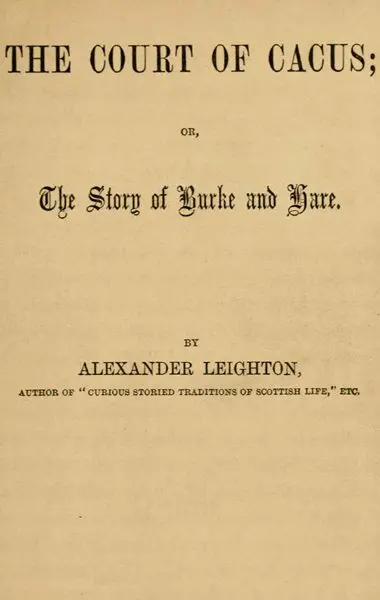
"The Court of Cacus; Or, The Story of Burke and Hare" by Alexander Leighton is a historical account written in the mid-19th century. The book illuminates the notorious tales of body snatching and medical malpractice in 19th-century Scotland, with a focus on the infamous pair, William Burke and William Hare, who became known for their grisly deeds. Through its vivid narrative, the work explores themes of morality, depravity, and the darker facets of human nature in pursuit of scientific advancement. At the start of the narrative, the atmosphere is set in Surgeon’s Square in Edinburgh during the autumn of 1827. The approach of a new and timid body-snatcher, who turns out to be William Burke, is detailed, as he encounters a student from Dr. Knox's class. This chance meeting foreshadows Burke's entry into the macabre trade of selling cadavers, a practice that thrived due to the growing demand in medical schools. The reader is introduced to the grim reality of body snatching, as Burke and the students engage in conversation about the value of human remains, and the narrative hints at the moral decay and desperate motivations that characterize the characters involved in this dark chapter of medical history.
Introduction adapted from the source catalogue; source summaries may be automatically generated.
Free to read · English · 77,505 words · No account needed
MAKE TIME FOR A GOOD BOOK
On by default. Untick to stop anonymous reading totals. Each page counts after 10 seconds in view. How this works.
Anonymous counting is on unless you have switched it off.
This suspicion very soon passed away, for not only was there no sign of that puckering up of the lank muscles, not deserving the name of a look of vivacity, which preceded his lugubrious personation in the hospital, but the day passed without any aid being asked from the others to help to carry, or rather run, with the white coffin. The methodist "Spune" was the first to divine the real cause of the chief's melancholy; and whether it was, as was said,--for we are not certain of the fact,--that the two had had a quarrel some time before about the division of spoil, it was certain that the worsted competitor began to entertain some very dark thoughts about a visit to Penicuik church-yard, whereby he could not only remunerate himself in the shape of money, but achieve one of the most curious revenges that ever were enjoyed since Nemesis began to have her fiery eyes. So, taking Mowat to a side of the Square, the "Spune" began to look mysteriously into his face--a most unnecessary process, where there never was any change of expression since first nature squeezed the clay into solidity.
"I suspect Merrylees' sister's dead at last," said he; "isn't she as good
as another?"
"Nae difference," was the answer, without any surprise.
"Yes, ye fule, some; and you're so stupid you don't see it."
"I can see nane,--a' is alike to me; ae worm's as gude's anither to the
'Moudiewart.'"
"Ay, but if a worm had bitten ye, man, wouldn't you squeeze it the
harder?"
"Maybe."
"And have you forgotten the ten shillings in Blackfriars' Wynd?"
"I'll tak it oot o' his blude," was the surly reply.
"And why not out of his sister's?" said the "Spune," with another dark look as unnecessary as the former.
"Just as sune,--a' ane."
"And," continued the tempter, where no temptation was necessary, "I know where she lies, just in the southeast angle, where he told me his father was laid."
"Why no him?" replied Mowat; "a' ane."
"Rotten ten years ago, you idiot," said the other, getting impatient.
"Weel, the fresh ane then."
"Now you are sensible," continued the friendly counsellor; "we might have her here in the morning, with five pounds each in our pockets, and a laugh in our sleeves at Merrylees."
"I never saw you laugh," said Mowat, in perfect innocence.
"No more you did, nor any other person, 'cause its always in the sleeve. Doesn't do to laugh about these things--they're scientific."
"Umph! dinna understand that; but I'm ready when you like."
Your reading position is saved on this browser. Take it to another device with a library code. Reading pages adapt to text, rather than matching a printed edition.
BEHIND THE BOOK
This eBook is for the use of anyone anywhere in the United States and most other parts of the world at no cost and with almost no restrictions whatsoever. You may copy it, give it away or re-use it under the terms of the Project Gutenberg License included with this eBook or online at www.gutenberg.org. If you are not located in the United States, you will have to check the laws of the country where you are located before using this eBook. Read the source licence.
The original source file, including credits and licence, is retained by this library. Request an original-format copy at no charge. Please include the book title and Project Gutenberg identifier #41642.
KEEP YOUR CURIOSITY GOING
Cécile Tormay

Moritz Busch
John L. Ransom
Frances Wright
Cécile Tormay

Mabel Potter Daggett