THE CLASSIC COLLECTION✦An outlaw’s diary: the CommuneCLASSIC FREE BOOKS
An outlaw’s diary: the Commune
Cécile Tormay
THE CLASSIC COLLECTION · 1861
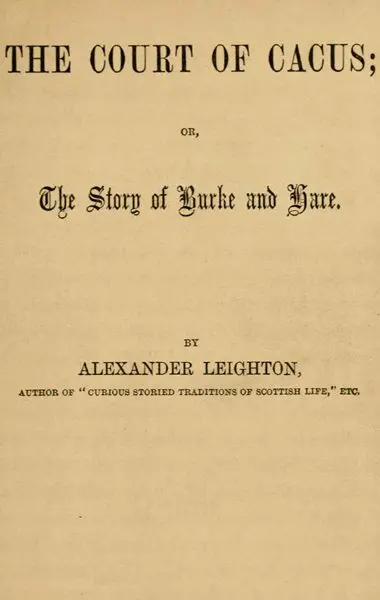
"The Court of Cacus; Or, The Story of Burke and Hare" by Alexander Leighton is a historical account written in the mid-19th century. The book illuminates the notorious tales of body snatching and medical malpractice in 19th-century Scotland, with a focus on the infamous pair, William Burke and William Hare, who became known for their grisly deeds. Through its vivid narrative, the work explores themes of morality, depravity, and the darker facets of human nature in pursuit of scientific advancement. At the start of the narrative, the atmosphere is set in Surgeon’s Square in Edinburgh during the autumn of 1827. The approach of a new and timid body-snatcher, who turns out to be William Burke, is detailed, as he encounters a student from Dr. Knox's class. This chance meeting foreshadows Burke's entry into the macabre trade of selling cadavers, a practice that thrived due to the growing demand in medical schools. The reader is introduced to the grim reality of body snatching, as Burke and the students engage in conversation about the value of human remains, and the narrative hints at the moral decay and desperate motivations that characterize the characters involved in this dark chapter of medical history.
Introduction adapted from the source catalogue; source summaries may be automatically generated.
Free to read · English · 77,505 words · No account needed
MAKE TIME FOR A GOOD BOOK
On by default. Untick to stop anonymous reading totals. Each page counts after 10 seconds in view. How this works.
Anonymous counting is on unless you have switched it off.
"Were you looking for any one?" said he, as he peered into the down-looking face, where there never had been a blush.
"'Mph!--are you Dr Knox?"
"No; but I am one of his students," was the reply of the young man, who was now nearly satisfied of the intention of the stranger.
"And, sure, I'm not far wrong thin, afther all."
"And I may suit your purpose as well, perhaps."
"Perhaps."
"Well, speak out; don't be afraid. Have you got 'the thing?'"
"Doun't know what you mean."
"Ah! not an old hand, I perceive. You were never here before?"
"No."
"And don't know what to say?"
"No."
And the bashful man again turned his gloomy eyes to the ground, and didn't know what to do with those hands of his, which were not made for kid--perhaps for skin of another kind. And shouldn't this hardened student have been sorry for a man in such confusion; but he wasn't--nay, he had no sympathy with his refinement.
"Why, man, don't you speak out?" he said impatiently.
"There's some one coming through the Square there," was the reply, as the man looked furtively to a side.
"Come in here, then," said the student, as he pulled him into a large room where there were three young men who acted as Knox's assistants.
And there they were in the midst of a great number of coarse tables, with one large one in the middle, whereon were deposited--each having its portion--masses or lumps of some matter which could not be seen by reason of all of them being covered with pieces of cloth--once white, but now dirty gray, as if they had been soiled with clammy hands for weeks or months. Nor were these signs, though unmistakeable to even the neophyte, all that there spoke with a terrible eloquence of man's lowly destiny upon earth; ay, and of man's pride too, even that pride of science which makes such a fool of him in the very midst of the evidences of his corruption; for although the windows were opened a little way, the choking air, thick with gases which, in other circumstances, the free wind carries off to dissipate and purify in the storm, pressed heavily upon the lungs, so that even the uninitiated shrank with unfeigned feeling, as if he shuddered under an awe that was perfectly foreign to his rough nature.
"Sure, and I'm among the dead," said the man, whom the reader will have discovered to be an Irishman; "and I have something ov that kind to----"
"Sell," added one assistant sharply, as, in his scientific ardour, he
anticipated the merchant.
"Yes."
Your reading position is saved on this browser. Take it to another device with a library code. Reading pages adapt to text, rather than matching a printed edition.
BEHIND THE BOOK
This eBook is for the use of anyone anywhere in the United States and most other parts of the world at no cost and with almost no restrictions whatsoever. You may copy it, give it away or re-use it under the terms of the Project Gutenberg License included with this eBook or online at www.gutenberg.org. If you are not located in the United States, you will have to check the laws of the country where you are located before using this eBook. Read the source licence.
The original source file, including credits and licence, is retained by this library. Request an original-format copy at no charge. Please include the book title and Project Gutenberg identifier #41642.
KEEP YOUR CURIOSITY GOING
Cécile Tormay

Moritz Busch
John L. Ransom
Frances Wright
Cécile Tormay

Mabel Potter Daggett