THE CLASSIC COLLECTION✦An outlaw’s diary: the CommuneCLASSIC FREE BOOKS
An outlaw’s diary: the Commune
Cécile Tormay
THE CLASSIC COLLECTION · 1861
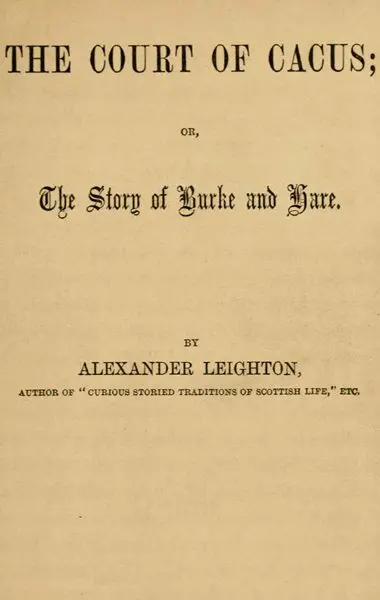
"The Court of Cacus; Or, The Story of Burke and Hare" by Alexander Leighton is a historical account written in the mid-19th century. The book illuminates the notorious tales of body snatching and medical malpractice in 19th-century Scotland, with a focus on the infamous pair, William Burke and William Hare, who became known for their grisly deeds. Through its vivid narrative, the work explores themes of morality, depravity, and the darker facets of human nature in pursuit of scientific advancement. At the start of the narrative, the atmosphere is set in Surgeon’s Square in Edinburgh during the autumn of 1827. The approach of a new and timid body-snatcher, who turns out to be William Burke, is detailed, as he encounters a student from Dr. Knox's class. This chance meeting foreshadows Burke's entry into the macabre trade of selling cadavers, a practice that thrived due to the growing demand in medical schools. The reader is introduced to the grim reality of body snatching, as Burke and the students engage in conversation about the value of human remains, and the narrative hints at the moral decay and desperate motivations that characterize the characters involved in this dark chapter of medical history.
Introduction adapted from the source catalogue; source summaries may be automatically generated.
Free to read · English · 77,505 words · No account needed
MAKE TIME FOR A GOOD BOOK
On by default. Untick to stop anonymous reading totals. Each page counts after 10 seconds in view. How this works.
Anonymous counting is on unless you have switched it off.
There was no loss in that case; but another which was current among the classes not long after was less fortunate, though not less true, as indeed may be verified by the brother, still living, of the young student who figured in it. Somewhere about Gilmerton or Liberton, we are uncertain which, a small farmer who had lost his wife went out one morning very early, probably because he could not rest in his bed for the dreary blank that was there,--that negative so much more appalling to love than the dead positive. On going along the Edinburgh road, he observed some white figure lying close by the footpath, and making up to see what it was, he came upon the corpse of a woman, dressed in her scolloped dead-clothes, and lying extended upon her back, with the "starr eyes" open, glazed, and fixed. On looking more narrowly, he discovered that it was his own wife, and, all dismayed and wild as he became, he could still have the power to think that she had come back to life after having been buried and lain in the grave for three days, and had thus far struggled to get to her beloved home. Frenzy knows nothing of logic, and was he to think how she could have thrown off a ton of earth and got up again to the light of the sun? The idea took him by force, and, throwing himself upon the body, he looked into the dead orbs, and watched the cold stiff lips, and listened for a breath. Vain heart, with all its hopes and tumults! no sign in return for all this madness. Yet he persevered, and gave up, and resumed, and, as the hope died to come back again, he writhed his strong body in an agony tenfold more acute than his first grief; nor would he in all probability have renounced the insane hope for a much longer time, if the Penicuik carrier had not come up, and, hearing the wonderful tale, hinted the explanation of an interrupted body-snatching. The light flashed upon him in an instant, and, in pursuance of a desire to keep the occurrence secret for the sake of her friends, he prevailed upon the man to take the body in the cart and remove it to his house. It was buried again privately on the following night, and few ever heard of the occurrence. And now comes the explanation of a story which may seem altogether incredible. A young student of the name of F----y, belonging to Monro's class, entered with two others into an adventure of body-snatching, in imitation of those whose exploits had produced in them an enthusiasm untempered by prudence, and not directed by experience. They fixed upon their ground, and hired a gig, and the hour was regulated by an obituary. Away accordingly they set, with no more knowledge of the secrets of the art than what they could get from the regular purveyors of the class, but provided with the necessary instrument. They soon got to their destination, and, leaving the gig in the charge of one of them, the two others got over the low wall, and, by the aid of the moon, discovered the last laid turf. Going to work vigorously, they succeeded in raising the body of a woman, but not having brought from the gig the indispensable sack, and, being fluttered and hurried, they bethought themselves of carrying the object to the side of the road, just as it was with the dead-clothes, and then running along by the side of the hedge to where their companion waited. F----y accordingly, with the aid of his friend, got the white burden hoisted on his back, holding it as firmly as he could by the linen. So far all was well, and they were fortunate, moreover, in getting out by a gate which they could open; but just as F----y got to the road, along which he had to go a considerable space, the grasp he had of the shroud began to give way, perhaps almost unknown to himself, the effect of which was that the body slipped so far down that the feet touched the ground. The consequence was altogether peculiar; as F----y bent and dodged in the hurry of getting forward, the feet of the corpse, coming always to the ground, resiled again with something like elasticity, so that it appeared to him as if it trotted or leaped behind him. Fear is the mother of suspicion, and the idea took hold of him that the body was alive. He uttered a roar,--threw his burden off, and crying out to his friend, "By G----, she's alive!" jumped into the gig. His friend was taken by the same terror, and away they galloped, leaving the corpse in the place where it was found next morning by the husband.
Your reading position is saved on this browser. Take it to another device with a library code. Reading pages adapt to text, rather than matching a printed edition.
BEHIND THE BOOK
This eBook is for the use of anyone anywhere in the United States and most other parts of the world at no cost and with almost no restrictions whatsoever. You may copy it, give it away or re-use it under the terms of the Project Gutenberg License included with this eBook or online at www.gutenberg.org. If you are not located in the United States, you will have to check the laws of the country where you are located before using this eBook. Read the source licence.
The original source file, including credits and licence, is retained by this library. Request an original-format copy at no charge. Please include the book title and Project Gutenberg identifier #41642.
KEEP YOUR CURIOSITY GOING
Cécile Tormay

Moritz Busch
John L. Ransom
Frances Wright
Cécile Tormay

Mabel Potter Daggett