THE CLASSIC COLLECTION✦An outlaw’s diary: the CommuneCLASSIC FREE BOOKS
An outlaw’s diary: the Commune
Cécile Tormay
THE CLASSIC COLLECTION · 1861
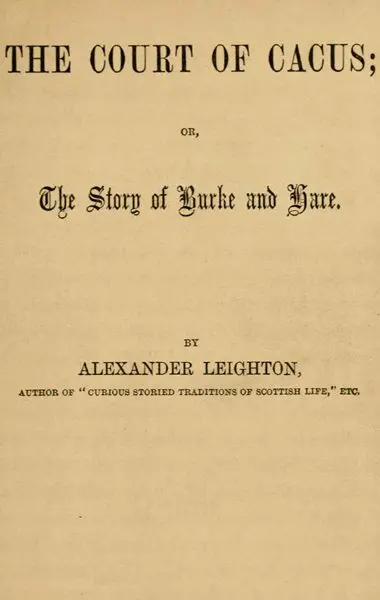
"The Court of Cacus; Or, The Story of Burke and Hare" by Alexander Leighton is a historical account written in the mid-19th century. The book illuminates the notorious tales of body snatching and medical malpractice in 19th-century Scotland, with a focus on the infamous pair, William Burke and William Hare, who became known for their grisly deeds. Through its vivid narrative, the work explores themes of morality, depravity, and the darker facets of human nature in pursuit of scientific advancement. At the start of the narrative, the atmosphere is set in Surgeon’s Square in Edinburgh during the autumn of 1827. The approach of a new and timid body-snatcher, who turns out to be William Burke, is detailed, as he encounters a student from Dr. Knox's class. This chance meeting foreshadows Burke's entry into the macabre trade of selling cadavers, a practice that thrived due to the growing demand in medical schools. The reader is introduced to the grim reality of body snatching, as Burke and the students engage in conversation about the value of human remains, and the narrative hints at the moral decay and desperate motivations that characterize the characters involved in this dark chapter of medical history.
Introduction adapted from the source catalogue; source summaries may be automatically generated.
Free to read · English · 77,505 words · No account needed
MAKE TIME FOR A GOOD BOOK
On by default. Untick to stop anonymous reading totals. Each page counts after 10 seconds in view. How this works.
Anonymous counting is on unless you have switched it off.
This proposition was brought to bear by an application presented to the Sheriff on the part of the Wilsons, praying for liberty to precognosce witnesses with a view to the prosecution of Hare; on the deliverance upon which progress was being rapidly made in the examination of several persons, when immediately there was presented to his lordship a petition for Hare, craving to be set at liberty. On the 21st of January, the Sheriff pronounced an interlocutor refusing the prayer of Hare's petition, on the ground that there was no decision finding that the right of the private party to prosecute is barred by any guarantee or promise of indemnity given by the public prosecutor; but, in consequence of the novelty of the case, he superseded further progress with the precognitions, in order that Hare might have an opportunity of applying to the Court of Justiciary.
This judgment was accordingly brought under review of the High Court by what is technically called a bill of advocation, suspension, and liberation--the meaning of which is simply that Hare tried another chance for freedom by applying to the highest tribunal. The Lord Justice-Clerk, who saw at once that the question was so far new, and of the first importance, not only in its merits, but viewed in relation to the state of the public mind, wished to have it judged of by all the Lords, and he therefore called upon the public prosecutor to answer the request of Hare. The Lord Advocate, who, no doubt, felt himself placed in a delicate position, but still determined to stand by the law and the dignity of the Crown, accordingly presented his answer; and long pleadings, called informations, having been lodged, the case came to be tried before the Court on the 2d February. The celebrated Jeffrey appeared for Mrs Wilson, and Duncan M'Neill for Hare. It was maintained on the part of Hare, said Mr Jeffrey, that the public prosecutor was entitled to make a compact, to which compact their Lordships were bound to give effect; that their Lordships had no discretion, but that it rested entirely with the Lord Advocate to enter into such compact, and to extend immunity to any number of cases, without the control of the judge; in short, that the Lord Advocate possessed the uncontrolled power of exercising the royal prerogative. And this he might do, not merely in respect of the particular crime as to which a socius criminis was to be used as a witness, but might, if he chose, extend it to all other crimes of which he might have been guilty. Whenever the Lord Advocate stipulated an immunity, it seemed to be maintained, on the other side, that a sufferer by housebreaking, fire-raising, and other crimes, was to be deprived of his right, as a private party, to prosecute the guilty perpetrator of the wrong, and that the Lord Advocate had a power to enter into a compact by which he could grant immunity for offences, past or future, known or unknown. Such a prerogative would be to invest the public prosecutor with a power of pardon which only belonged to the Crown, and this, too, without a tittle of authority, amounting to an assumption of the authority of Parliament; and so forth. But all the eloquence of Jeffrey would not do. The judges had, long before this day of judgment, been down in the deep wells of authority, and, as one of the enraged people said, came up drunk with law, and kicked sober justice out of court. Certainly, if such a profane expression could be used, these learned men might have been in that state, for seldom had they appeared so surcharged with authorities. They seem to have rummaged every corner of the Advocates' Library and the Register-Office to find out the origin of the law of king's evidence, and to have hunted out every decision bearing upon the case, so that, it would seem, Hare should be rendered as famous for settling a great and hitherto doubtful point of law, as Burke was destined to be for putting an end to a science. After all, the judges who decided for Hare were found to be right; and, indeed, any one looking at the subject, could not fail to see that, as the Lord Advocate represented the king, and the king, as the great public protector of his subjects and prosecutor of their wrongs, represented his people, and Mrs Janet Wilson and her daughter among the rest, the immunity promised by his lordship to Hare really included an immunity implied as given by Mrs Wilson and her daughter.
Your reading position is saved on this browser. Take it to another device with a library code. Reading pages adapt to text, rather than matching a printed edition.
BEHIND THE BOOK
This eBook is for the use of anyone anywhere in the United States and most other parts of the world at no cost and with almost no restrictions whatsoever. You may copy it, give it away or re-use it under the terms of the Project Gutenberg License included with this eBook or online at www.gutenberg.org. If you are not located in the United States, you will have to check the laws of the country where you are located before using this eBook. Read the source licence.
The original source file, including credits and licence, is retained by this library. Request an original-format copy at no charge. Please include the book title and Project Gutenberg identifier #41642.
KEEP YOUR CURIOSITY GOING
Cécile Tormay

Moritz Busch
John L. Ransom
Frances Wright
Cécile Tormay

Mabel Potter Daggett