THE CLASSIC COLLECTION✦An outlaw’s diary: the CommuneCLASSIC FREE BOOKS
An outlaw’s diary: the Commune
Cécile Tormay
THE CLASSIC COLLECTION · 1861
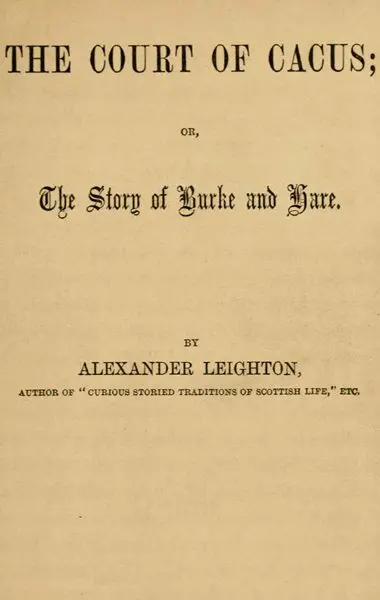
"The Court of Cacus; Or, The Story of Burke and Hare" by Alexander Leighton is a historical account written in the mid-19th century. The book illuminates the notorious tales of body snatching and medical malpractice in 19th-century Scotland, with a focus on the infamous pair, William Burke and William Hare, who became known for their grisly deeds. Through its vivid narrative, the work explores themes of morality, depravity, and the darker facets of human nature in pursuit of scientific advancement. At the start of the narrative, the atmosphere is set in Surgeon’s Square in Edinburgh during the autumn of 1827. The approach of a new and timid body-snatcher, who turns out to be William Burke, is detailed, as he encounters a student from Dr. Knox's class. This chance meeting foreshadows Burke's entry into the macabre trade of selling cadavers, a practice that thrived due to the growing demand in medical schools. The reader is introduced to the grim reality of body snatching, as Burke and the students engage in conversation about the value of human remains, and the narrative hints at the moral decay and desperate motivations that characterize the characters involved in this dark chapter of medical history.
Introduction adapted from the source catalogue; source summaries may be automatically generated.
Free to read · English · 77,505 words · No account needed
MAKE TIME FOR A GOOD BOOK
On by default. Untick to stop anonymous reading totals. Each page counts after 10 seconds in view. How this works.
Anonymous counting is on unless you have switched it off.
Precisely at the hour Burke was on his feet, eager to be dead, and the procession moved. He was supported by the two Catholic priests, more from the difficulty he experienced in walking with his arms so closely pinioned, than from any weakness or faltering of step. In the progress towards and up Liberton's Wynd he shewed even increased coolness and self-possession, turning from side to side in conversation, and at one part, where the ground was wet, carefully picking his steps; but at the head of the entry, where he was to get a view of the crowd, he winced, and half-closing his eyes, hurried on, as if more eager still to be out of the roar of that terrible assemblage. Nor was that roar long delayed. Upon Bailies Crichton and Small issuing from the wynd, the shout was raised in one long-continued yell, and when Burke himself was seen ascending the stair, the roar was repeated with double intensity, mixed with articulated execrations,--"Burke him!" "Choke him!" "No mercy, hangie!" Yet amidst all, Burke walked with steady step, and stood coolly below the apparatus of death. If he was much moved at all, it was to cast a look at the crowd of fierce and desperate defiance, as if he could have felt it in his heart to repeat upon every one of them his old experiment, and we suspect that he would have done it if he had had the liberty and the power.
Having taken his station in front of the drop, he kneeled with his back towards the spectators, his confessor on his right hand, and the other Catholic clergyman on the left, and repeated a form of prayer dictated by one of these reverend gentlemen. Mr Marshall, meanwhile, offered up a supplication on his behalf, the bailies and other officials joining in the devotions, with the exception of the executioner (Williams) and his assistant, who stood at the back of the drop. During all this time there was silence. On rising from his kneeling posture, Burke was observed to lift a silk handkerchief, on which his knees had rested, and put it into his pocket. There was now some hesitation in his manner, as if loath to mount; and one of the persons who assisted him to ascend, having, perhaps inadvertently, pushed him somewhat roughly to a side, that he might be placed exactly on the spot, he looked round with a withering scowl. He then ran up the steps, as if he hurried to death, to get beyond the reach of these terrible howls. Some further delay took place, from the circumstance of Williams, who stood behind him, endeavouring to loose his handkerchief, in which he found some difficulty. "The knot is behind," said Burke,--the only words not devotional uttered by him on the scaffold. When Williams succeeded in removing the neckcloth, he proceeded to fasten the rope round his neck, pulling it tightly, and, after adjusting and fixing it, he put upon his head a white cotton night-cap, but without pulling it over his face. While this was going on, the yells became fiercer and fiercer, mixed with the ejaculations, "Where's Hare? Hang him, too." "Don't waste rope on him." "You ----, you will see Daft Jamie in a minute." The Rev. Mr Reid then advanced, and conversed with him shortly, but earnestly, and directed him to say the Creed, which he did. As he muttered the words, his face was pale and livid, but he was still composed, unflinching, and motionless. The next act was the advance of Williams to draw the cap over his face. He manifested a repugnance to this, as if he would brave the yelling crowd even to the last extremity, and it was with some difficulty this was accomplished. Everything is now ready. He utters an ejaculation to his Maker, imploring mercy, and throws away the handkerchief with a jerk of impatience, the bolt is drawn, and Burke swings in the air amidst the deafening roar of thirty thousand people.[16] But Burke was not yet dead. He must be dead before that crowd is satisfied. From the limited length of the fall, there had been no dislocation; and for five minutes the body hung motionless, except from the impetus given by the fall, when a convulsive motion of the feet, and a general heaving, indicated a still lingering vitality. Upon observing this, the crowd raised another cheer. Twice these motions were renewed, and twice again rose the shout.
Your reading position is saved on this browser. Take it to another device with a library code. Reading pages adapt to text, rather than matching a printed edition.
BEHIND THE BOOK
This eBook is for the use of anyone anywhere in the United States and most other parts of the world at no cost and with almost no restrictions whatsoever. You may copy it, give it away or re-use it under the terms of the Project Gutenberg License included with this eBook or online at www.gutenberg.org. If you are not located in the United States, you will have to check the laws of the country where you are located before using this eBook. Read the source licence.
The original source file, including credits and licence, is retained by this library. Request an original-format copy at no charge. Please include the book title and Project Gutenberg identifier #41642.
KEEP YOUR CURIOSITY GOING
Cécile Tormay

Moritz Busch
John L. Ransom
Frances Wright
Cécile Tormay

Mabel Potter Daggett