THE CLASSIC COLLECTION✦An outlaw’s diary: the CommuneCLASSIC FREE BOOKS
An outlaw’s diary: the Commune
Cécile Tormay
THE CLASSIC COLLECTION · 1861
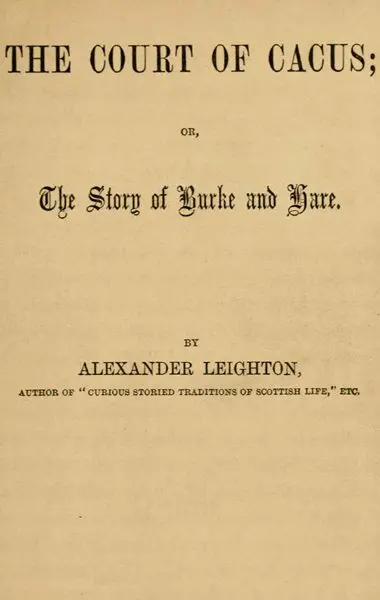
"The Court of Cacus; Or, The Story of Burke and Hare" by Alexander Leighton is a historical account written in the mid-19th century. The book illuminates the notorious tales of body snatching and medical malpractice in 19th-century Scotland, with a focus on the infamous pair, William Burke and William Hare, who became known for their grisly deeds. Through its vivid narrative, the work explores themes of morality, depravity, and the darker facets of human nature in pursuit of scientific advancement. At the start of the narrative, the atmosphere is set in Surgeon’s Square in Edinburgh during the autumn of 1827. The approach of a new and timid body-snatcher, who turns out to be William Burke, is detailed, as he encounters a student from Dr. Knox's class. This chance meeting foreshadows Burke's entry into the macabre trade of selling cadavers, a practice that thrived due to the growing demand in medical schools. The reader is introduced to the grim reality of body snatching, as Burke and the students engage in conversation about the value of human remains, and the narrative hints at the moral decay and desperate motivations that characterize the characters involved in this dark chapter of medical history.
Introduction adapted from the source catalogue; source summaries may be automatically generated.
Free to read · English · 77,505 words · No account needed
MAKE TIME FOR A GOOD BOOK
On by default. Untick to stop anonymous reading totals. Each page counts after 10 seconds in view. How this works.
Anonymous counting is on unless you have switched it off.
The Trial.
In November 1828, a citation was served upon William Burke and Helen M'Dougal to appear before the High Court of Justiciary to be held at Edinburgh, the 24th day of December, at 10 o'clock forenoon, to underlie the law in the crime of murder, on three separate indictments. The first comprehended the case of Mary Paterson, as having occurred in the preceding month of April in the house of Constantine Burke; the second--that of James Wilson, or Daft Jamie--in October of the same year in Log's house, situated in Tanner's Close; and the third--that of Madgy, Marjory, or Mary M'Gonegal or Duffie, or Campbell, or Docherty--in November, in Burke's house, Portsburgh. The libel contained also a list of a great number of articles of dress worn by the victims, and identified, and, among others, Mrs Docherty's gown, and Daft Jamie's brass snuff-box and spoon.
The presiding judge of the Court at that time was the Lord Justice-Clerk Boyle; the other judges, Lords Pitmilly, Meadowbank, and M'Kenzie; and the prosecutor, Sir William Rae, Lord Advocate. The leading counsel for Burke was the Dean of Faculty, that for M'Dougal, Henry Cockburn, James Tytler being the Crown agent. The witnesses were fifty-five in number--the two principal, Hare and his wife, received as king's evidence in the characters of socii criminis. The panels having taken their places at the bar in the midst of a crowded court, filled long before the opening of the doors by people who had the privilege of influence, and whose numbers were only as a trifle in comparison of the mass outside, Mr Patrick Robertson, one of Burke's junior counsel, made a technical objection to the reading of the indictment, which was overruled. A defence was then lodged for Burke, and supported by the same counsel, on the ground that it was contrary to the law of Scotland to combine in one libel so many charges and two separate panels. The argument, which was a long one, involving points of law and practice, was followed up by the Dean of Faculty, and answered by the Lord Advocate, with this result, that the judges, with the consent of the public prosecutor, agreed to limit the charge to the case of Docherty, and thus limited, the proceedings went on. The various witnesses, forming, however, a very small portion of the whole fifty-five cited, appeared in succession to give their evidence. Every word uttered by every one was caught by ears strung to the highest pitch of sensibility; and throughout the entire day, the deep silence, more like that of a death-chamber than a court, was as much the expression of curiosity as of awe--reminding one, too, of the stillness of an audience where the feelings are claimed by oppressed virtue with the encircling meshes in which innocence is to be involved by death getting closer and closer as the scenes succeed. The interest lay in the gradual development, while the heart was affected by all the different passions which, changing from pity for the victims to hatred of the murderers, were kept in continual agitation. Over all, there was the oppressive awe inspired by the presence of the fearful men and women, as if they had been demons of monstrous forms and powers placed there under restraining bonds. At several times,--and especially when Hare described the screigh of the little old woman which preceded that ten minutes' agony in which she lay under the pressure of Burke--Hare being all the while, according to his lie, sitting coolly looking on,--you might have heard deep sighs escaping from strong hearts, in spite of resolutions to restrain them. Even then the grateful creature, who seemed to have trusted Burke alone, and defended him in the preceding sham fight, was only "dead a wee," and the process was to be resumed. But even this effect was transcended, if possible, by the very manner in which the witness stated how the victim was presently stripped, and after being bound neck and heel, was cast, mangled and bloody, among the straw in the angle between the bed and the wall. The dominant idea seemed to bring into light all the surrounding objects--the table pushed aside, the old chairs, the squalid bed marked with the blood of prior victims, the women listening with expectation in the long dark passage, the two men panting after the struggle, and bringing forth on the top of their long-drawn breath ribald jokes, and even accomplishing a laugh,--all followed by the rush in of the women, and the resumption of the drink, the song, and the dance.
Your reading position is saved on this browser. Take it to another device with a library code. Reading pages adapt to text, rather than matching a printed edition.
BEHIND THE BOOK
This eBook is for the use of anyone anywhere in the United States and most other parts of the world at no cost and with almost no restrictions whatsoever. You may copy it, give it away or re-use it under the terms of the Project Gutenberg License included with this eBook or online at www.gutenberg.org. If you are not located in the United States, you will have to check the laws of the country where you are located before using this eBook. Read the source licence.
The original source file, including credits and licence, is retained by this library. Request an original-format copy at no charge. Please include the book title and Project Gutenberg identifier #41642.
KEEP YOUR CURIOSITY GOING
Cécile Tormay

Moritz Busch
John L. Ransom
Frances Wright
Cécile Tormay

Mabel Potter Daggett