THE CLASSIC COLLECTION✦An outlaw’s diary: the CommuneCLASSIC FREE BOOKS
An outlaw’s diary: the Commune
Cécile Tormay
THE CLASSIC COLLECTION · 1861
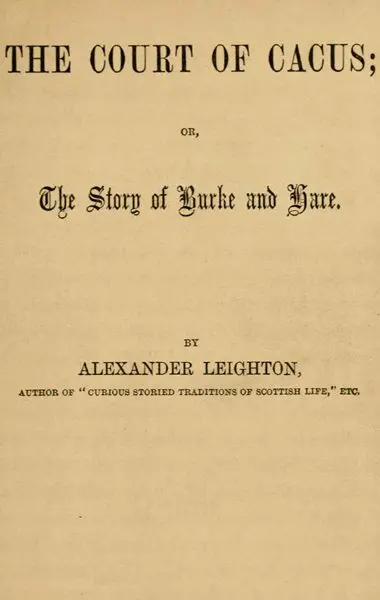
"The Court of Cacus; Or, The Story of Burke and Hare" by Alexander Leighton is a historical account written in the mid-19th century. The book illuminates the notorious tales of body snatching and medical malpractice in 19th-century Scotland, with a focus on the infamous pair, William Burke and William Hare, who became known for their grisly deeds. Through its vivid narrative, the work explores themes of morality, depravity, and the darker facets of human nature in pursuit of scientific advancement. At the start of the narrative, the atmosphere is set in Surgeon’s Square in Edinburgh during the autumn of 1827. The approach of a new and timid body-snatcher, who turns out to be William Burke, is detailed, as he encounters a student from Dr. Knox's class. This chance meeting foreshadows Burke's entry into the macabre trade of selling cadavers, a practice that thrived due to the growing demand in medical schools. The reader is introduced to the grim reality of body snatching, as Burke and the students engage in conversation about the value of human remains, and the narrative hints at the moral decay and desperate motivations that characterize the characters involved in this dark chapter of medical history.
Introduction adapted from the source catalogue; source summaries may be automatically generated.
Free to read · English · 77,505 words · No account needed
MAKE TIME FOR A GOOD BOOK
On by default. Untick to stop anonymous reading totals. Each page counts after 10 seconds in view. How this works.
Anonymous counting is on unless you have switched it off.
In addition to this preparation of the mind, as it may be called, to look suspiciously on introductions coming out of the regular way, with the admission made that they had not been exhumed, and with the inevitable traces of violence which could not be blinked, there was the peculiarity on which, perhaps, the greatest stress was laid, that in one of the cases, at least, there was a recognition of the individual by one of the students as having been seen and conversed with by him, in terms of more than ordinary intimacy, only the night before, or at least a very short period, countable by hours. We allude to Mary Paterson, "the study for the artist," who, though naked, was said to have made her appearance on the table en papillote--not to be believed--but who, for certain, attracted so much observation, yea, admiration, that the recognition by the youth could not have fallen as an idle brag. The case of Daft Jamie, the collegians' favourite of almost every day's fun, was so much stronger, that there seemed no mode of accounting for the pure innocence of Surgeon's Square, except upon the supposition that all the students had, in the course of a day, been merged in some Lethe. No great wonder that the most zealous defenders of the craft were here contented with a simple shaking of the head, for, to be sure, even the devil's advocate has not an interminable tether.
These charges are very practical, and even to us, at this distant period, who would be regulated by reason and truth, and cannot be under the influence of passion, are hard bones. Independently of our estimate of youths--putting Knox out of the question,--of good birth and parentage, whose generous hearts would revolt from the thought of a guilty cognisance,--some of these assistants who came in contact with Burke, "and no questions asked," have risen to rank in their profession, and bear a high character for honesty and humanity. "They ken their ain ken;" but their negative defence leaves their friends to the slough of mere metaphysics. We all know that mysterious attractiveness and repulsiveness of the mind which makes such fools of even the most practical of mankind. The man would not look through Galileo's telescope, because he knew beforehand that there was nothing to be seen; but he did no more than every man does every day he lives. We all know that we may look, and not see, hear, and not understand; yea, though the image of the outer thing may be in black and white on the back of the eye, and the words play their intellectual tune on the drum of the ear, you may neither see the one nor hear the other. The bird-lime of acceptance is not present, and there is even more--an absolute recusancy in proportion to some reigning wish in the form of what we call a prejudice. All this is alphabetic, and we might go deeper and get lost, but there is no occasion. The truth is, that these medical students had a strong wish for subjects. This rose out of another wish, that for knowledge, and this again came out of one behind, a wish to shine or make money,--the benefit to mankind being only that thing which we all understand when we hear people getting philanthropical in recommending their leather, as contributing to the good of the eternal sons of God. Then the next truth is, that they did suspect, and becoming the paradoxes which so many unconsciously become, did not know, in the sense of an apprehension, that they suspected. When the thought sought entrance to the mind, always under the cogency of the repulse of unwillingness, it was either thrown out or dissolved; to all which the authority of their leader or lecturer contributed, and not less the generosity of their own hearts, naturally seeking uniformity, and averse to think so ill of human nature, as was required to be implied in an atrocity never before heard of in the world. If the thought had ever come so strong upon them as to have amounted to an active conviction, why, then they must have glided into the crime of winking toleration, and to that, we verily believe, they never came. There were only three of these young men who took an active charge. If there had been a score, we might have conceded that one, perhaps two, might have been found among them capable, by the predisposition of an evil nature, to have quietly succumbed to the force of such startling appearances; but judging of the proportions according to what we find among men, we require a large number for the successful selection of the devil's own. In short, they were very much in the position of resetters, who, standing in great need of the article, take refuge from a suspicion which would injure them in the fallacious eloquence of the naturally selfish heart, and casting up behind them intervening obstructions to the light--a kind of weakness into which all mankind are less or more liable to fall, and against which they are ready to recoil when the passion of possession decays. It requires only superficial looking to bring us to the conclusion, that the world is a great collection of "wee pawns," every man resetting some thought or feeling, false in itself, and improperly come by, and wrongfully retained. The difference here lies in the fact, that we have not yet come to hold this a crime, nor are we likely to do so till regeneration comes wrapt up in the world-wide cloak of the millennium.
Your reading position is saved on this browser. Take it to another device with a library code. Reading pages adapt to text, rather than matching a printed edition.
BEHIND THE BOOK
This eBook is for the use of anyone anywhere in the United States and most other parts of the world at no cost and with almost no restrictions whatsoever. You may copy it, give it away or re-use it under the terms of the Project Gutenberg License included with this eBook or online at www.gutenberg.org. If you are not located in the United States, you will have to check the laws of the country where you are located before using this eBook. Read the source licence.
The original source file, including credits and licence, is retained by this library. Request an original-format copy at no charge. Please include the book title and Project Gutenberg identifier #41642.
KEEP YOUR CURIOSITY GOING
Cécile Tormay

Moritz Busch
John L. Ransom
Frances Wright
Cécile Tormay

Mabel Potter Daggett