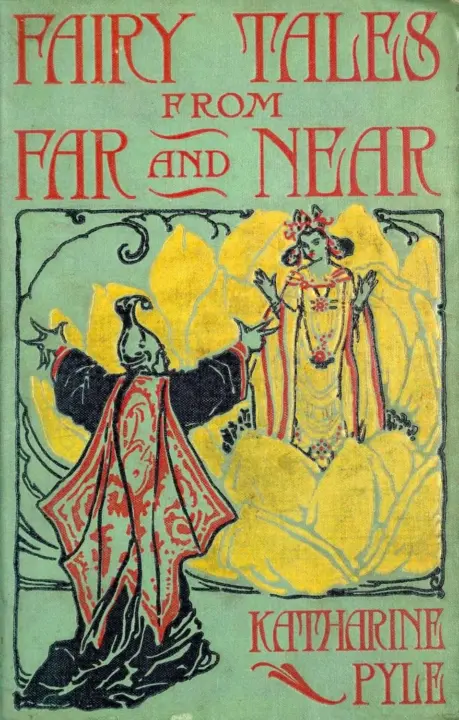
Fairy tales from far and near
Katharine Pyle
THE CLASSIC COLLECTION · 1898
"The Counterpane Fairy" by Katharine Pyle is a children's fantasy story likely written in the late 19th century. The narrative centers around a young boy named Teddy who is confined to bed due to illness. During this time, he encounters the whimsical Counterpane Fairy, who offers to transport him into magical stories that unfold from the squares of his counterpane quilt. The book explores themes of imagination, bravery, and coping with loneliness through Teddy's enchanting adventures. At the start of this enchanting tale, Teddy is feeling lonely and under the supervision of his mother while he recovers from an illness. As he gazes out the window, a fairy appears, introducing herself as the Counterpane Fairy. She explains that she is here to show Teddy a magical story, prompting him to choose a square on his quilt. Teddy selects a yellow square, and with the fairy's guidance, he finds himself in a golden garden where he learns he is a hero destined to rescue an enchanted princess. The narrative engages the reader with vivid imagery and a sense of wonder, as Teddy embarks on his quest, overcoming obstacles and facing challenges with the guidance of the fairy. This opening portion sets the stage for a series of adventures that explore Teddy's courage and the magic of storytelling.
Introduction adapted from the source catalogue; source summaries may be automatically generated.
Free to read · English · 28,304 words · No account needed
MAKE TIME FOR A GOOD BOOK
On by default. Untick to stop anonymous reading totals. Each page counts after 10 seconds in view. How this works.
Anonymous counting is on unless you have switched it off.
Then he turned and walked quietly down the hall and into another. He went on and on, but he did not run and jump now, for he was thinking. After a while, when he turned into another hall he once more saw Silverling at play with his silver ball.
“Did you find her?” cried Silverling, eagerly.
“Yes,” said Teddy, “I found her, and she sent you a dove for your very own; but, Silverling, I think this. I think the only way for us ever to find her together is for us to set the dove free, and to follow it when it flies back to her.”
“But we couldn’t follow it,” said Silverling. “It would fly so fast that it would be out of sight in a minute.”
“I know,” said Teddy, “but we could tie something to it.”
“What could we fasten to it?” asked Silverling.
The two little boys stood looking about them and wondering what they could use. Suddenly Teddy clapped his hands so the dove in his tunic started. “We’ll fasten the end of your golden chain to it,” he cried.
No sooner said than done. In a moment Silverling had taken the chain from his neck and unfastened the ends. It was so long that it had been twisted several times around his neck. Very gently they took the dove and fastened the chain to its leg, and then they let it go.
It fluttered up over their heads and circled about them once or twice, and then it flew on down the hall with the little boys following it.
They turned many a corner and went through many a door, and at last they came into a hall and there —there was Starlein waiting for them with her doves about her.
“Oh, Starlein!” cried Silverling.
“Oh, Silverling!” cried Starlein.
They ran to each other and threw their arms about each other’s necks and kissed, while the white doves flew circling about them. Then they told each other how sorry they were that they had quarrelled, and that they would never do it any more, and then they kissed again.
“And you may have the golden chain, Starlein,” said Silverling.
“No, no! you must keep it,” said Starlein.
“Oh, I know what we’ll do!” cried Silverling; “we’ll give it to this little boy, because if it hadn’t been for him we wouldn’t have found each other.”
“Oh, yes!” said Starlein.
But Teddy held up his hand— “Hush!” he whispered; “don’t you hear it?”
Then they all listened, and sweeter and clearer than ever before they heard the voice of the singing fountain in the beautiful garden.
Your reading position is saved on this browser. Take it to another device with a library code. Reading pages adapt to text, rather than matching a printed edition.
Katharine Pyle
Howard Pyle & Katharine Pyle
Katharine Pyle
Katharine Pyle
BEHIND THE BOOK
This eBook is for the use of anyone anywhere in the United States and most other parts of the world at no cost and with almost no restrictions whatsoever. You may copy it, give it away or re-use it under the terms of the Project Gutenberg License included with this eBook or online at www.gutenberg.org. If you are not located in the United States, you will have to check the laws of the country where you are located before using this eBook. Read the source licence.
The original source file, including credits and licence, is retained by this library. Request an original-format copy at no charge. Please include the book title and Project Gutenberg identifier #3230.
KEEP YOUR CURIOSITY GOING
Coulson Kernahan

Maurice Baring
Frances Wright
Cécile Tormay
Francis Greenleaf Allinson & Anne C. E. (Anne Crosby Emery) Allinson

Frederic Jesup Stimson