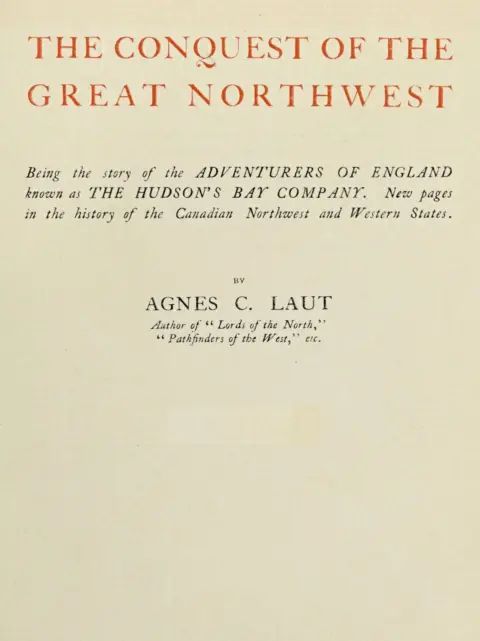
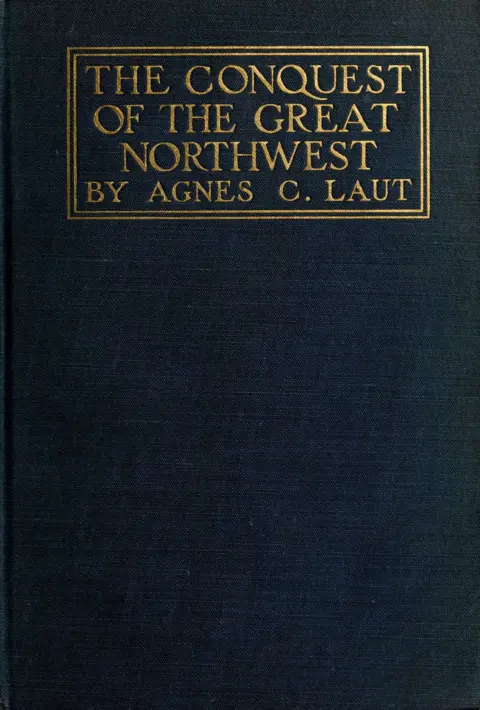
The conquest of the great Northwest, Volume 1 (of 2)
Agnes C. Laut
THE CLASSIC COLLECTION · 1908
"The Conquest of the Great Northwest, Volume 2" by Agnes C. Laut is a historical account written in the early 20th century. This volume continues the narrative of the adventurers of England associated with the Hudson's Bay Company, shedding light on the history of the Canadian Northwest and the Western States. It explores the complex interactions and rivalries between fur trading companies, their adventures, and the impact on indigenous populations and the burgeoning settlements in the region. The opening of the text provides insights into the recruitment process of the Nor’Westers, detailing how they sought new voyageurs to join their ranks. It vividly depicts the atmosphere as charismatic "sly wolves" of the North coax young men from their parishes with tales of adventure and luxury, contrasting the grueling reality of life as a fur trader. The narrative sets a colorful scene as brigades prepare to embark on their journeys, bringing to life the challenges of transportation, the camaraderie among voyageurs, and the fierce competition between the Hudson’s Bay Company and the Nor’Westers that drove their motivations and actions in the wilderness.
Introduction adapted from the source catalogue; source summaries may be automatically generated.
Free to read · English · 96,937 words · No account needed
MAKE TIME FOR A GOOD BOOK
On by default. Untick to stop anonymous reading totals. Each page counts after 10 seconds in view. How this works.
Anonymous counting is on unless you have switched it off.
At the mouth of the Columbia, all that remained of Astor’s Fort Astoria and Lewis and Clarke’s Fort Clatsop was a moldering pile of rain-rotted logs with a little square-timbered hut where one lone Scotchman kept watch for incoming ships and possible wrecks. Eastward, where the Columbia takes its first bend was Walla Walla, under trader Pambrum; northward, where it takes a second bend, Okanogan under Ross; west, where it turns up into the Arrow Lakes of British Columbia, Fort Colville under Firman MacDonell; and half way between these two posts southward, Spokane House, founded by that John Clarke, who was with Robertson in Athabasca. These were the strongholds from which the Company ruled its transmontane kingdom, five little fur posts, all except Spokane, close to the main river trail, the capitals and sub-capitals of an empire big as half Europe.
By right, the treaty of joint occupation had reference only to Washington and Oregon; but who was to prevent McLeod leading his brigade down the coast to California as far as Sacramento, or Ogden his brigade up the Snake as far as the Nevada deserts, or Ross his mountaineers through Washington and Idaho over the Bitter Root and Rocky Mountains to the buffalo plains of the Missouri in Montana? It was a no-man’s-land, where trappers might wander whither their beaver quest led, with no other law but what each man’s right arm was strong enough to enforce. Fish diet palled at Fort Vancouver. Buffalo meat was needed for the brigades. Up at Fort Okanogan was Alexander Ross, studying the language of the mountain Indians, leading a lonely existence “with no other company,” as he relates, “but my dog Weasel and the Bible.” A mid-winter express brought Ross orders to proceed over the mountains by way of Clarke’s Fork or Flathead River to the headwaters of the Missouri and Yellowstone and Big Horn. His hunting field was the very stamping ground of the most dangerous warriors among the Indians--the Blackfeet and Piegans and Crows. Yet if this express had ordered Ross to march down to Hell’s Gate and jump over the precipice into that cañon, he would have obeyed. A better man for the field could not have been chosen. Ross had come to the Pacific on John Jacob Astor’s first ship. He had been almost at once sent North to establish Fort Okanogan, where by studying the Indian languages during the long isolated winters, he soon became a proficient trader. He was both religious and scholarly, but either the intense loneliness of the life, or the danger of being among the Indians without a companion, drove him into marriage with a daughter of the Okanogans. This wife became one of the grand old ladies of the Red River Settlement, when Ross retired to Manitoba. Beaver must be sought as usual at the headwaters of the Missouri and the Yellowstone and the Big Horn; and to reach those headwaters for the spring hunt, Ross must do his buffalo hunting in mid-winter. The mountain passes must be traversed through bottomless depths of snow, for the climate was so mild no crust formed, and above the tree line in the cloud region was a fall--fall of snow almost continuous for the winter months till the precipices overhung with dangerous snow cornices of ponderous weight, and the cut-rocks were heaped into huge snow mushrooms. But Ross was no novice at snow work in the mountains. One of his first winters at Okanogan, he had become so desperately lonely that he decided to pay a three days’ visit to his next door neighbor at Spokane House, one hundred and fifty miles away. The country was rocky and the trail steep. Coming home the horses had fagged so completely climbing the last mountain that Ross and his Indian servants dismounted to beat the way up through the snow for the animals to follow. It was not easy work. Snow cornice broke under the weight, and down men and horses slithered in miniature avalanche. The soft crust of drift over rocks broke, plunging the path-makers in snow to their armpits, and all the while the way was zigzagging up till Ross and his Indians were blowing with heat like whales. First, pack straps came off, then gun cases, then coats and waistcoats to be hung on the saddle pommels. A sharp turn in the trail brought them suddenly on one of those high, bare Alpine meadows where Arctic storms sweep when flowers may be blooming in the valley. Before they could find their horses darkness and snow so completely hid everything Ross could only shout against the wind for the men to shift for themselves and let the horses run. Then he realized that he was without either coat or buffalo blanket. Luckily, a bewildered pack horse jammed against him in the whirl. Ross gripped the saddle straps, cut the pack ropes, threw off the load, and leaped astride the saddle trees with no other blanket than the patch of wool that served as saddle cloth. Certain that he was near Okanogan, he rode like mad through the howling darkness, but the floundering broncho fagged in the drifts, and Ross became so numb he could not keep his seat. Dismounting, he tried to keep himself warm by walking, but was soon so exhausted he could only cling to the warm body of the horse. Tying the saddle cloth round his neck, he tried to dig a hole of shelter in the snow, but there, his feet became so cold, he had to take off his boots to keep from freezing, and passed the night in a frantic effort against the frost-sleep. In the morning he was too stiff to mount his horse. He had no strength to beat the wind, and had almost determined to kill his horse and crawl inside the body, when the storm began to lessen. To his relief, Okanogan House was only a short distance away. When trappers went out to rescue the Indians of the party, they found one horse dead, torn to pieces by the wolves. Ross knew mountain travel.
Your reading position is saved on this browser. Take it to another device with a library code. Reading pages adapt to text, rather than matching a printed edition.
Agnes C. Laut
Agnes C. Laut
Agnes C. Laut
Agnes C. Laut
BEHIND THE BOOK
This eBook is for the use of anyone anywhere in the United States and most other parts of the world at no cost and with almost no restrictions whatsoever. You may copy it, give it away or re-use it under the terms of the Project Gutenberg License included with this eBook or online at www.gutenberg.org. If you are not located in the United States, you will have to check the laws of the country where you are located before using this eBook. Read the source licence.
The original source file, including credits and licence, is retained by this library. Request an original-format copy at no charge. Please include the book title and Project Gutenberg identifier #70122.
KEEP YOUR CURIOSITY GOING
Cécile Tormay

Moritz Busch
John L. Ransom
Frances Wright
Cécile Tormay

Mabel Potter Daggett