
The conquest of the great Northwest, Volume 2 (of 2)
Agnes C. Laut
THE CLASSIC COLLECTION · 1908
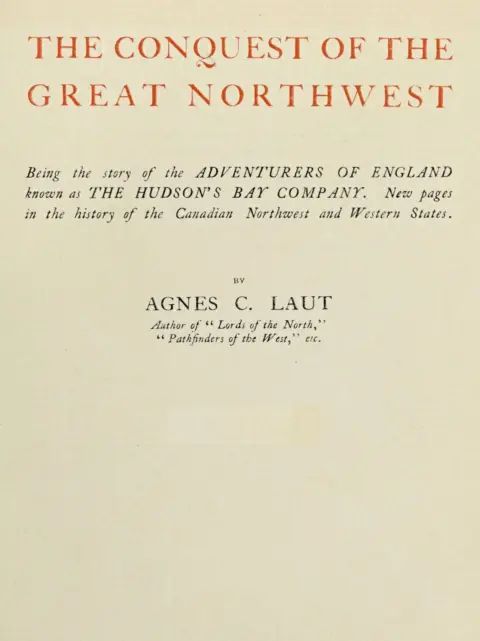
"The Conquest of the Great Northwest, Volume 1 (of 2)" by Agnes C. Laut is a historical account written in the early 20th century. This work chronicles the adventures of the Hudson's Bay Company, detailing the expansive fur trade and exploration of the Canadian Northwest and Western States. Laut’s narrative promises to uncover the tumultuous history of the adventurers who ventured into uncharted territories and navigated the complexities of early North American trade, showcasing the exploits of notable figures like Henry Hudson and Pierre le Moyne d'Iberville. At the start of the book, the author sets the stage for the voyages of Henry Hudson, recounting his obsession with discovering a passage across the Pole and the motivations behind his explorations. The narrative describes Hudson's crew and their perilous journey through uncharted waters, facing the harsh realities of ice-strewn seas and the unknown challenges of Arctic exploration. Throughout these early chapters, Laut captures the tension between dreamers and practical men, highlighting Hudson's indomitable spirit amid the struggles with nature and his ultimately flawed pursuit of glory in the harsh wilderness.
Introduction adapted from the source catalogue; source summaries may be automatically generated.
Free to read · English · 95,794 words · No account needed
MAKE TIME FOR A GOOD BOOK
On by default. Untick to stop anonymous reading totals. Each page counts after 10 seconds in view. How this works.
Anonymous counting is on unless you have switched it off.
How these pompous governors—little men in stature some of them—kept their own servants obedient and loyal in the loneliness of these wilderness wilds, can only be ascribed to their personal prowess. Of course, there were desertions, desertions to the wild life and to the French overland in Canada and to the Americans south of the boundary, but only once was payment withheld from the men of the far fur post on account of mutiny, though many a mutiny was quelled in its beginnings by the governor doffing his dignity and laying a sound drubbing on the back of the mutineer. The men were paid by bills drawn on the home office to the amount of two thirds of their wages, the other third being kept against their return as savings. Many devices were employed to keep the men loyal. Did a captain accomplish a good voyage? The home committee ordered him a bounty of £150. Hearne, for his explorations inland, over and above his wages was given a present of £200. Did a man suffer from rigorous climate? The committee solemnly indites: “£4, smart money, for a frozen toe.” Such luck as a French wood-runner deserting from Canada to the Hudson’s Bay was promptly recognized by the order: “To Jan Ba’tiste Larlée, £1-5, a periwig to keep him loyal.” No matter to what desperate straits war reduced the Company’s finances, it was never too poor to pension some wreck of the service, or present gold plate to some hero of the fight, or give a handsome funeral to some servant who died in harness—“funeral by torch light and linkmen, to St. Paul’s Churchyard, company and crew in attendance, £31.” Though Governor Semple had been little more than a year on the field when he was murdered, the Company pensioned both his sisters for life. The humblest servants in the ranks—men beginning on twenty shillings a month, like Kelsey, and Grimmington, and Hearne, and old Captain Knight—were urged and encouraged to rise to the highest positions in the Company. The one thing required was—absolute, implicit, unquestioning loyalty; the Company could do no wrong. Quite the funniest instance of the Company’s fatherly care for its servants was the matrimonial office. For years, especially in time of war, it was almost impossible to secure apprentices at all, though the agents paid £2 as bonus on signing the contract. At this period in the Company’s history, I came across a curious record in the minutes. A General Court was secretly called of which no entry was to be made in the minutes, to consider the proposals of one, Mr. Andrew Vallentine, for the good of the Company’s service. In addition to the shareholders’ general oath of secrecy, every one attending this meeting had to take solemn vows not to reveal the proceedings. What could it be about? I scanned the general minutes, the committee books, the sub-committee records of shippings and sailings and wars. It was not about France, for proceedings against France were in the open. It was not a “back-stairs” fund, for when the Company wanted favors it openly sent purses of gold or beaver stockings or cat-skin counterpanes. But farther on in the minutes, when the good secretary had forgotten all about secrecy, I found a cryptic entry about the cryptic gentleman, Mr. Andrew Vallentine—“that all entries about Mr. Andrew Vallentine’s office for the service of the Company be made in a Booke Aparte,” and that 10 per cent. of the regular yearly dividends go as dowries for the brides of the apprentices, the ceremonies to be performed—not by any unfrocked clergyman under the rose—but by the Honorable, the Very Reverend Doctor Sacheverell of renown. The business with the gentleman of matrimonial fame was not called “a marriage office.” No such clumsy herding of fair ones to the altar, as in Virginia and Quebec, where brides were sent in shiploads and exposed on the town square like slaves at the shambles. The Company’s matrimonial venture was kept in dignified reserve, that would send down no stigma to descendants. It was organized and designated as a separate company; certainly, a company of two. Later on, Mr. Vallentine’s office being too small for the rush of business, the secretary, “Mr. Potter is ordered to arrange a larger office for Mr. Vallentine in the Buttery of the Company’s store house.” But all the delightful possibilities hidden in Mr. Vallentine’s suggestive name and in the oleaginous place which he chose for his matrimonial mart—failed to make the course of true love run smooth. Mr. Vallentine entangled the Company in lawsuits and on his death in 1731, the office was closed.
Your reading position is saved on this browser. Take it to another device with a library code. Reading pages adapt to text, rather than matching a printed edition.
Agnes C. Laut

Agnes C. Laut
Agnes C. Laut
Agnes C. Laut
BEHIND THE BOOK
This eBook is for the use of anyone anywhere in the United States and most other parts of the world at no cost and with almost no restrictions whatsoever. You may copy it, give it away or re-use it under the terms of the Project Gutenberg License included with this eBook or online at www.gutenberg.org. If you are not located in the United States, you will have to check the laws of the country where you are located before using this eBook. Read the source licence.
The original source file, including credits and licence, is retained by this library. Request an original-format copy at no charge. Please include the book title and Project Gutenberg identifier #69591.
KEEP YOUR CURIOSITY GOING
Cécile Tormay

Moritz Busch
John L. Ransom
Frances Wright
Cécile Tormay

Mabel Potter Daggett