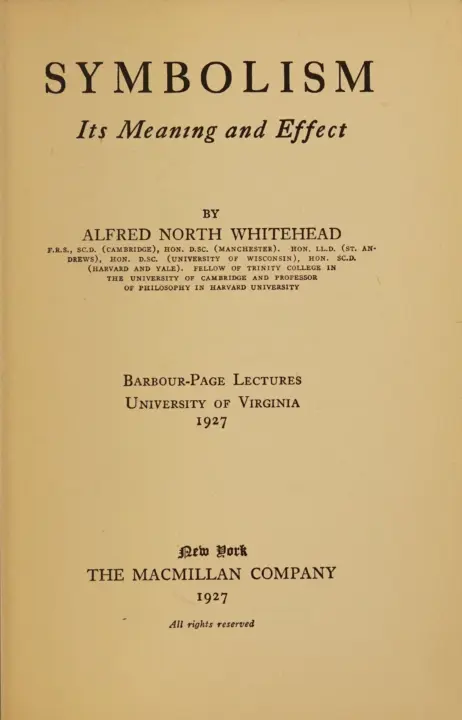
Symbolism, its meaning and effect
Alfred North Whitehead
THE CLASSIC COLLECTION · 1920
"The Concept of Nature" by Alfred North Whitehead is a philosophical treatise written in the early 20th century. This work embodies a series of lectures that explore the philosophy of the sciences and the interrelations between various branches of knowledge, particularly focusing on the natural sciences. Whitehead aims to redefine and clarify the nature of scientific inquiry, challenging prevailing notions of matter and substance that have dominated scientific discourse. The opening of the work outlines the intentions behind the Tarner lectures at Trinity College, establishing a framework for discussing the philosophy of the sciences. Whitehead emphasizes the importance of understanding nature as both a complex of entities and a process that unfolds through time, advocating for a view that avoids dualistic interpretations of reality. He introduces key concepts such as sense-perception, thought, and the distinctions between homogeneous and heterogeneous thinking. Through these foundational ideas, he begins to navigate the challenging terrain of natural philosophy, seeking to unite various scientific perspectives under a cohesive understanding of nature itself.
Introduction adapted from the source catalogue; source summaries may be automatically generated.
Free to read · English · 58,850 words · No account needed
MAKE TIME FOR A GOOD BOOK
On by default. Untick to stop anonymous reading totals. Each page counts after 10 seconds in view. How this works.
Anonymous counting is on unless you have switched it off.
The theory of significance has been expanded and made more definite in the present volume. It had already been introduced in the Principles of Natural Knowledge (cf. subarticles 3.3 to 3.8 and 16.1, 16.2, 19.4, and articles 20, 21). In reading over the proofs of the present volume, I come to the conclusion that in the light of this development my limitation of infinite events to durations is untenable. This limitation is stated in article 33 of the Principles and at the beginning of Chapter IV (p. 74) of this book. There is not only a significance of the discerned events embracing the whole present duration, but there is a significance of a cogredient event involving its extension through a whole time-system backwards and forwards. In other words the essential 'beyond' in nature is a definite beyond in time as well as in space [cf. pp. 53, 194]. This follows from my whole thesis as to the assimilation of time and space and their origin in extension. It also has the same basis in the analysis of the character of our knowledge of nature. It follows from this admission that it is possible to define point-tracks [i.e. the points of timeless spaces] as abstractive elements. This is a great improvement as restoring the balance between moments and points. I still hold however to the statement in subarticle 35.4 of the Principles that the intersection of a pair of non-parallel durations does not present itself to us as one event. This correction does not affect any of the subsequent reasoning in the two books.
I may take this opportunity of pointing out that the 'stationary events' of article 57 of the Principles are merely cogredient events got at from an abstract mathematical point of view.
In the case of terms of frequent occurrence, only those occurrences are indexed which are of peculiar importance for the elucidation of meaning.
A [or an], 11
Abraham, 105
Absolute position, 105, 106, 114, 188
Abstraction, 33, 37, 168, 171, 173;
extensive, 65, 79, 85
Abstractive element, 84;
set, 61, 79
Action at a distance, 159, 190
Action by transmission, 159, 190
Active conditions, 158
Activity, field of, 170, 181
Adjunction, 101
Aggregate, 23
Alexander, Prof., viii
Alexandria, 71
Alfred the Great, 137
Anticipation, 69
Anti-prime, 88
Apparent nature, 31, 39
Area, 99;
momental, 103;
vagrant, 103
Aristotelian logic, 150
Aristotle, 16, 17, 18, 24, 197
Associate-potential, 183
Atom, 17
Attribute, 21, 26, 150
Awareness, 3
Axiom, 36, 121
Axioms of congruence, 128 et seqq.
Bacon, Francis, 78
Behaviouristic, 185
Bergson, 54
Berkeley, 28
Between, 64
Beyond, 186, 198
Bifurcation, vi, 30, 185, 187
Boundary, 100;
moment, 63;
particle, 100
Broad, C. D., viii
Calculation, formula of, 45, 158
Cambridge, 97
Causal nature, 31, 39
Causation, 31, 146
Centrifugal force, 138
Change, uniformity of, 140
Character, extrinsic, 82, 89, 90, 113, 191;
intrinsic, 80, 82, 90, 113, 191
Charge, 160
Closure of nature, 4
Coefficient of drag, 133
Coefficients of impetus, 183
Cogredience, 110, 188
Coherence, 29
Comparison, 124, 125, 143, 189
Complex, 13
Conceptual nature, 45;
space, 96
Concrete facts, 167, 171, 189
Conditioning events, 152
Conditions, active, 158
Congruence, 65, 96, 118, 120, 127, 196
Continuity, 157;
Dedekindian, 102;
of events, 76;
of nature, 59, 76
Convention, 121
Convergence, 62, 79;
law of, 82
Conveyance, 154, 155
Co-present, 177
Covering, 83
Creative advance, 178
Critical velocity, 193, 195
Curvature of space-time, 182
Cyclone, 194
Dedekindian continuity, 102
Definite, 53, 194, 198
Delusions, 31, 38
Delusive perceptual object, 153
Demarcation of events, 144
Demonstrative phrase, 6
Descriptive phrase, 6, 10
Differential equations, 196
Your reading position is saved on this browser. Take it to another device with a library code. Reading pages adapt to text, rather than matching a printed edition.
Alfred North Whitehead

Alfred North Whitehead
Alfred North Whitehead
BEHIND THE BOOK
This eBook is for the use of anyone anywhere in the United States and most other parts of the world at no cost and with almost no restrictions whatsoever. You may copy it, give it away or re-use it under the terms of the Project Gutenberg License included with this eBook or online at www.gutenberg.org. If you are not located in the United States, you will have to check the laws of the country where you are located before using this eBook. Read the source licence.
The original source file, including credits and licence, is retained by this library. Request an original-format copy at no charge. Please include the book title and Project Gutenberg identifier #18835.
KEEP YOUR CURIOSITY GOING

David Patterson (Spirit) Hatch
Coulson Kernahan

Ralph Waldo Emerson
Frances Wright

Edwin Abbott Abbott

Joseph Droz