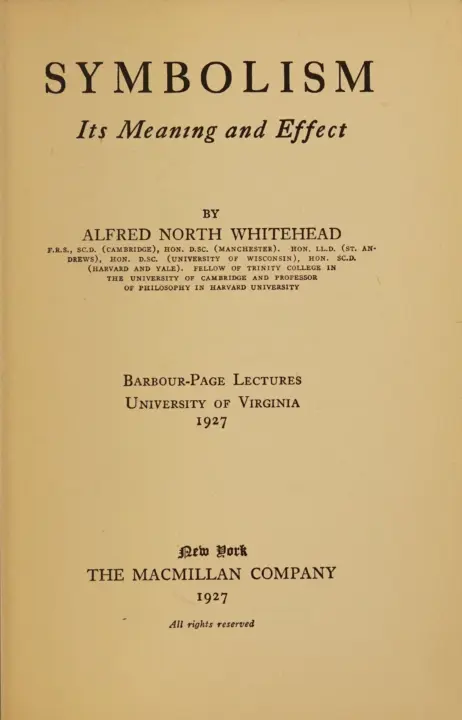
Symbolism, its meaning and effect
Alfred North Whitehead
THE CLASSIC COLLECTION · 1920
"The Concept of Nature" by Alfred North Whitehead is a philosophical treatise written in the early 20th century. This work embodies a series of lectures that explore the philosophy of the sciences and the interrelations between various branches of knowledge, particularly focusing on the natural sciences. Whitehead aims to redefine and clarify the nature of scientific inquiry, challenging prevailing notions of matter and substance that have dominated scientific discourse. The opening of the work outlines the intentions behind the Tarner lectures at Trinity College, establishing a framework for discussing the philosophy of the sciences. Whitehead emphasizes the importance of understanding nature as both a complex of entities and a process that unfolds through time, advocating for a view that avoids dualistic interpretations of reality. He introduces key concepts such as sense-perception, thought, and the distinctions between homogeneous and heterogeneous thinking. Through these foundational ideas, he begins to navigate the challenging terrain of natural philosophy, seeking to unite various scientific perspectives under a cohesive understanding of nature itself.
Introduction adapted from the source catalogue; source summaries may be automatically generated.
Free to read · English · 58,850 words · No account needed
MAKE TIME FOR A GOOD BOOK
On by default. Untick to stop anonymous reading totals. Each page counts after 10 seconds in view. How this works.
Anonymous counting is on unless you have switched it off.
Furthermore the inhabitant of Mars determines event-particles by another system of measurements. Call his system the q-system. According to him (q1, q2, q3, q4) determines an event-particle, and (q1, q2, q3) determines a point and q4 a time. But the collection of event-particles which he thinks of as a point is entirely different from any such collection which the man on earth thinks of as a point. Thus the q-space for the man on Mars is quite different from the p-space for the land-surveyor on earth.
So far in speaking of space we have been talking of the timeless space of physical science, namely, of our concept of eternal space in which the world adventures. But the space which we see as we look about is instantaneous space. Thus if our natural perceptions are adjustable to the p-system of measurements we see instantaneously all the event-particles at some definite time p_4, and observe a succession of such spaces as time moves on. The timeless space is achieved by stringing together all these instantaneous spaces. The points of an instantaneous space are event-particles, and the points of an eternal space are strings of event-particles occurring in succession. But the man on Mars will never perceive the same instantaneous spaces as the man on the earth. This system of instantaneous spaces will cut across the earth-man's system. For the earth-man there is one instantaneous space which is the instantaneous present, there are the past spaces and the future spaces. But the present space of the man on Mars cuts across the present space of the man on the earth. So that of the event-particles which the earth-man thinks of as happening now in the present, the man on Mars thinks that some are already past and are ancient history, that others are in the future, and others are in the immediate present. This break-down in the neat conception of a past, a present, and a future is a serious paradox. I call two event-particles which on some or other system of measurement are in the same instantaneous space 'co-present' event-particles. Then it is possible that A and B may be co-present, and that A and C may be co-present, but that B and C may not be co-present. For example, at some inconceivable distance from us there are events co-present with us now and also co-present with the birth of Queen Victoria. If A and B are co-present there will be some systems in which A precedes B and some in which B precedes A. Also there can be no velocity quick enough to carry a material particle from A to B or from B to A. These different measure-systems with their divergences of time-reckoning are puzzling, and to some extent affront our common sense. It is not the usual way in which we think of the Universe. We think of one necessary time-system and one necessary space. According to the new theory, there are an indefinite number of discordant time-series and an indefinite number of distinct spaces. Any correlated pair, a time-system and a space-system, will do in which to fit our description of the Universe. We find that under given conditions our measurements are necessarily made in some one pair which together form our natural measure-system. The difficulty as to discordant time-systems is partly solved by distinguishing between what I call the creative advance of nature, which is not properly serial at all, and any one time series. We habitually muddle together this creative advance, which we experience and know as the perpetual transition of nature into novelty, with the single-time series which we naturally employ for measurement. The various time-series each measure some aspect of the creative advance, and the whole bundle of them express all the properties of this advance which are measurable. The reason why we have not previously noted this difference of time-series is the very small difference of properties between any two such series. Any observable phenomena due to this cause depend on the square of the ratio of any velocity entering into the observation to the velocity of light. Now light takes about fifty minutes to get round the earth's orbit; and the earth takes rather more than 17,531 half-hours to do the same. Hence all the effects due to this motion are of the order of the ratio of one to the square of 10,000. Accordingly an earth-man and a sun-man have only neglected effects whose quantitative magnitudes all contain the factor 1/10^8. Evidently such effects can only be noted by means of the most refined observations. They have been observed however. Suppose we compare two observations on the velocity of light made with the same apparatus as we turn it through a right angle. The velocity of the earth relatively to the sun is in one direction, the velocity of light relatively to the ether should be the same in all directions. Hence if space when we take the ether as at rest means the same thing as space when we take the earth as at rest, we ought to find that the velocity of light relatively to the earth varies according to the direction from which it comes.
Your reading position is saved on this browser. Take it to another device with a library code. Reading pages adapt to text, rather than matching a printed edition.
Alfred North Whitehead
Alfred North Whitehead
Alfred North Whitehead
BEHIND THE BOOK
This eBook is for the use of anyone anywhere in the United States and most other parts of the world at no cost and with almost no restrictions whatsoever. You may copy it, give it away or re-use it under the terms of the Project Gutenberg License included with this eBook or online at www.gutenberg.org. If you are not located in the United States, you will have to check the laws of the country where you are located before using this eBook. Read the source licence.
The original source file, including credits and licence, is retained by this library. Request an original-format copy at no charge. Please include the book title and Project Gutenberg identifier #18835.
KEEP YOUR CURIOSITY GOING

David Patterson (Spirit) Hatch
Coulson Kernahan

Ralph Waldo Emerson
Frances Wright

Edwin Abbott Abbott

Joseph Droz