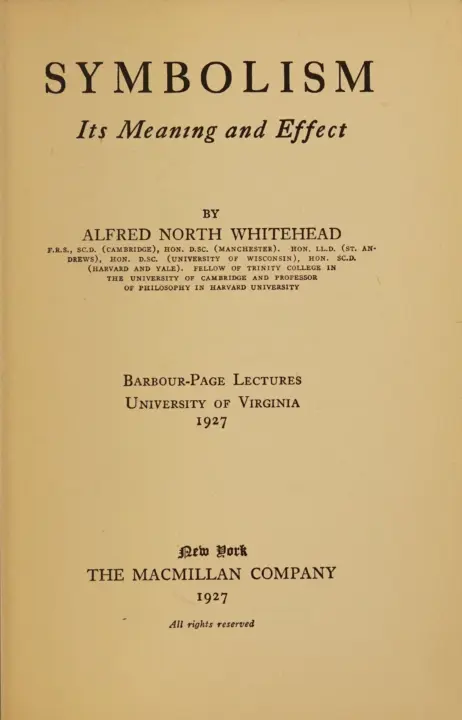
Symbolism, its meaning and effect
Alfred North Whitehead
THE CLASSIC COLLECTION · 1920
"The Concept of Nature" by Alfred North Whitehead is a philosophical treatise written in the early 20th century. This work embodies a series of lectures that explore the philosophy of the sciences and the interrelations between various branches of knowledge, particularly focusing on the natural sciences. Whitehead aims to redefine and clarify the nature of scientific inquiry, challenging prevailing notions of matter and substance that have dominated scientific discourse. The opening of the work outlines the intentions behind the Tarner lectures at Trinity College, establishing a framework for discussing the philosophy of the sciences. Whitehead emphasizes the importance of understanding nature as both a complex of entities and a process that unfolds through time, advocating for a view that avoids dualistic interpretations of reality. He introduces key concepts such as sense-perception, thought, and the distinctions between homogeneous and heterogeneous thinking. Through these foundational ideas, he begins to navigate the challenging terrain of natural philosophy, seeking to unite various scientific perspectives under a cohesive understanding of nature itself.
Introduction adapted from the source catalogue; source summaries may be automatically generated.
Free to read · English · 58,850 words · No account needed
MAKE TIME FOR A GOOD BOOK
On by default. Untick to stop anonymous reading totals. Each page counts after 10 seconds in view. How this works.
Anonymous counting is on unless you have switched it off.
I want now to recall your attention to Cleopatra's Needle, which I have not yet done with. As you are walking along the Embankment you suddenly look up and say, 'Hullo, there's the Needle.' In other words, you recognise it. You cannot recognise an event; because when it is gone, it is gone. You may observe another event of analogous character, but the actual chunk of the life of nature is inseparable from its unique occurrence. But a character of an event can be recognised. We all know that if we go to the Embankment near Charing Cross we shall observe an event having the character which we recognise as Cleopatra's Needle. Things which we thus recognise I call objects. An object is situated in those events or in that stream of events of which it expresses the character. There are many sorts of objects. For example, the colour green is an object according to the above definition. It is the purpose of science to trace the laws which govern the appearance of objects in the various events in which they are found to be situated. For this purpose we can mainly concentrate on two types of objects, which I will call material physical objects and scientific objects. A material physical object is an ordinary bit of matter, Cleopatra's Needle for example. This is a much more complicated type of object than a mere colour, such as the colour of the Needle. I call these simple objects, such as colours or sounds, sense-objects. An artist will train himself to attend more particularly to sense-objects where the ordinary person attends normally to material objects. Thus if you were walking with an artist, when you said 'There's Cleopatra's Needle,' perhaps he simultaneously exclaimed 'There's a nice bit of colour.' Yet you were both expressing your recognition of different component characters of the same event. But in science we have found out that when we know all about the adventures amid events of material physical objects and of scientific objects we have most of the relevant information which will enable us to predict the conditions under which we shall perceive sense-objects in specific situations. For example, when we know that there is a blazing fire (i.e. material and scientific objects undergoing various exciting adventures amid events) and opposite to it a mirror (which is another material object) and the positions of a man's face and eyes gazing into the mirror, we know that he can perceive the redness of the flame situated in an event behind the mirror--thus, to a large extent, the appearance of sense-objects is conditioned by the adventures of material objects. The analysis of these adventures makes us aware of another character of events, namely their characters as fields of activity which determine the subsequent events to which they will pass on the objects situated in them. We express these fields of activity in terms of gravitational, electromagnetic, or chemical forces and attractions. But the exact expression of the nature of these fields of activity forces us intellectually to acknowledge a less obvious type of objects as situated in events. I mean molecules and electrons. These objects are not recognised in isolation. We cannot well miss Cleopatra's Needle, if we are in its neighbourhood; but no one has seen a single molecule or a single electron, yet the characters of events are only explicable to us by expressing them in terms of these scientific objects. Undoubtedly molecules and electrons are abstractions. But then so is Cleopatra's Needle. The concrete facts are the events themselves--I have already explained to you that to be an abstraction does not mean that an entity is nothing. It merely means that its existence is only one factor of a more concrete element of nature. So an electron is abstract because you cannot wipe out the whole structure of events and yet retain the electron in existence. In the same way the grin on the cat is abstract; and the molecule is really in the event in the same sense as the grin is really on the cat's face. Now the more ultimate sciences such as Chemistry or Physics cannot express their ultimate laws in terms of such vague objects as the sun, the earth, Cleopatra's Needle, or a human body. Such objects more properly belong to Astronomy, to Geology, to Engineering, to Archaeology, or to Biology. Chemistry and Physics only deal with them as exhibiting statistical complexes of the effects of their more intimate laws. In a certain sense, they only enter into Physics and Chemistry as technological applications. The reason is that they are too vague. Where does Cleopatra's Needle begin and where does it end? Is the soot part of it? Is it a different object when it sheds a molecule or when its surface enters into chemical combination with the acid of a London fog? The definiteness and permanence of the Needle is nothing to the possible permanent definiteness of a molecule as conceived by science, and the permanent definiteness of a molecule in its turn yields to that of an electron. Thus science in its most ultimate formulation of law seeks objects with the most permanent definite simplicity of character and expresses its final laws in terms of them.
Your reading position is saved on this browser. Take it to another device with a library code. Reading pages adapt to text, rather than matching a printed edition.
Alfred North Whitehead
Alfred North Whitehead
Alfred North Whitehead
BEHIND THE BOOK
This eBook is for the use of anyone anywhere in the United States and most other parts of the world at no cost and with almost no restrictions whatsoever. You may copy it, give it away or re-use it under the terms of the Project Gutenberg License included with this eBook or online at www.gutenberg.org. If you are not located in the United States, you will have to check the laws of the country where you are located before using this eBook. Read the source licence.
The original source file, including credits and licence, is retained by this library. Request an original-format copy at no charge. Please include the book title and Project Gutenberg identifier #18835.
KEEP YOUR CURIOSITY GOING

David Patterson (Spirit) Hatch
Coulson Kernahan

Ralph Waldo Emerson
Frances Wright

Edwin Abbott Abbott

Joseph Droz