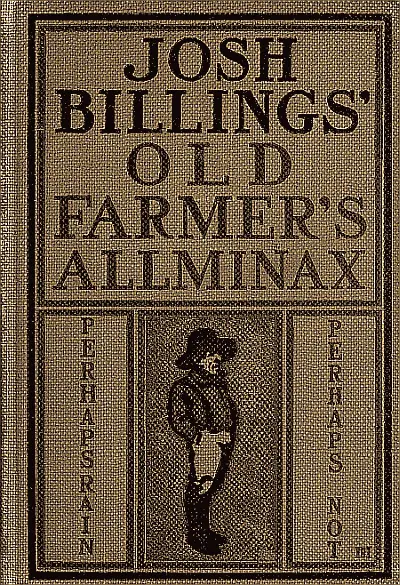
Josh Billings’ Farmer’s Allminax, 1870-1879
Josh Billings
THE CLASSIC COLLECTION · 1876
"The Complete Works of Josh Billings" by Josh Billings is a collection of comedic essays and writings written in the late 19th century. This compilation showcases the wit and humor of Billings, a well-known American humorist, as he tackles a range of topics through a uniquely quirky lens, often employing playful language and unconventional spellings. At the start of the work, the introduction emphasizes the widespread recognition and influence of Josh Billings, highlighting his ability to blend humor with wisdom. The Transcriber's Note explains the idiosyncratic spellings preserved from the original text. Billings' writing style is light-hearted, embodying a blend of satire and insightful commentary, as he begins to explore themes like contentment, marriage, and social behaviors with curves of cleverness and relatable observations, setting the tone for the entertaining essays that follow.
Introduction adapted from the source catalogue; source summaries may be automatically generated.
Free to read · English · 149,946 words · No account needed
MAKE TIME FOR A GOOD BOOK
On by default. Untick to stop anonymous reading totals. Each page counts after 10 seconds in view. How this works.
Anonymous counting is on unless you have switched it off.
When a limber man douz git tew going wrong, he iz like a blind mule, when he gits tew kicking, yu aint safe nowhare.
Limber men dont alwus lak kapacity, it would perhaps be better if they did, for a still phool iz one ov the safest people we hav.
Jolly men are most alwus good men.
It iz dredful eazy tew mistake spasmodik hilarity for good natur.
I have seen men who were called jolly good fellows who were az treacherous in their joy az a kat iz.
Yu will alwus notiss one thing, when a kat purrs the most, she haz just thought ov sum new kind ov deviltry.
I kno ov no vice in genuine jollity.
When a man iz jolly all over, he iz too happy and kareless tew be
vicious.
I hav seen people who could laff long and loud, but thare was no more good nature in it than thare iz grief in a hyena when they imitate the wail of an infant.
'Tis true we kant alwuss tell about theze things, but if we watch a man all summer, and hang around him all winter, when spring cums agin we ought tew be able tew guess whether the laff that iz in him iz the aroma ov hiz good natur, or iz only the aroma ov the hikkups.
The pewter man takes hiz name from the old-fashioned pewter spoon, made out ov cheap material, impossible tew keep bright long, eazy tew take impreshuns from almost enny thing, and no more ring tew it than thare iz tew a bogus haff dollar.
Puter men are mighty common here on earth, not only kommon bekauze they are plenty, but kommon bekauze they don't amount tew mutch.
They ain't exactly phools; if they was, we could deskribe them better.
They are like bass wood punkin seeds, and white oak whetstuns, in a
well-stocked kuntry store, kind ov necessary, tew keep up the
assortment.
They never do enny thing verry good or verry bad, and go thru life a good deal az a boy goes tew distrikt skool, in green-apple time, jist bekauze he haz got to.
The fiteing man iz a kind ov human bull tarrier, with a jaw on him like a wolf trap that haz just been sprung.
He haz a low, sour forehead, a beefy neck, a small eye, and an ugly pug
noze.
Hiz intelligence konsists in knowing how tew maul another human being, able tew take it in return, and not kno it.
Your reading position is saved on this browser. Take it to another device with a library code. Reading pages adapt to text, rather than matching a printed edition.
BEHIND THE BOOK
This eBook is for the use of anyone anywhere in the United States and most other parts of the world at no cost and with almost no restrictions whatsoever. You may copy it, give it away or re-use it under the terms of the Project Gutenberg License included with this eBook or online at www.gutenberg.org. If you are not located in the United States, you will have to check the laws of the country where you are located before using this eBook. Read the source licence.
The original source file, including credits and licence, is retained by this library. Request an original-format copy at no charge. Please include the book title and Project Gutenberg identifier #36556.
KEEP YOUR CURIOSITY GOING

David Patterson (Spirit) Hatch

David Patterson (Spirit) Hatch

David Patterson (Spirit) Hatch

Ralph Waldo Emerson

Maurice Baring

Oscar Wilde & James McNeill Whistler