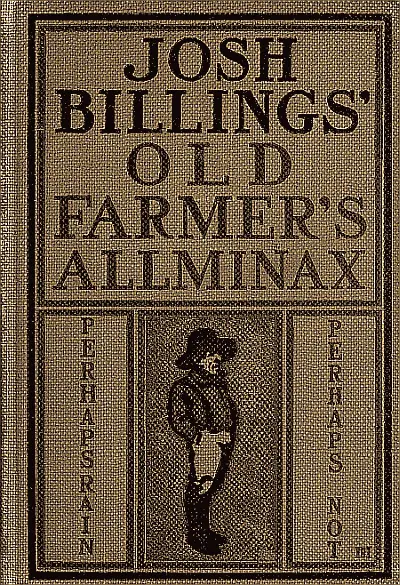
Josh Billings’ Farmer’s Allminax, 1870-1879
Josh Billings
THE CLASSIC COLLECTION · 1876
"The Complete Works of Josh Billings" by Josh Billings is a collection of comedic essays and writings written in the late 19th century. This compilation showcases the wit and humor of Billings, a well-known American humorist, as he tackles a range of topics through a uniquely quirky lens, often employing playful language and unconventional spellings. At the start of the work, the introduction emphasizes the widespread recognition and influence of Josh Billings, highlighting his ability to blend humor with wisdom. The Transcriber's Note explains the idiosyncratic spellings preserved from the original text. Billings' writing style is light-hearted, embodying a blend of satire and insightful commentary, as he begins to explore themes like contentment, marriage, and social behaviors with curves of cleverness and relatable observations, setting the tone for the entertaining essays that follow.
Introduction adapted from the source catalogue; source summaries may be automatically generated.
Free to read · English · 149,946 words · No account needed
MAKE TIME FOR A GOOD BOOK
On by default. Untick to stop anonymous reading totals. Each page counts after 10 seconds in view. How this works.
Anonymous counting is on unless you have switched it off.
Thare seems tew be a propriety in all things; late experiments in New York city, have proved, that religion in a rat pit iz a failure. Grate examples are no excuse for iniquity. Our Saviour thought so when he sed: "Git thee behind me, Satan."
Sin in the soul iz like a sliver in the flesh, mortification iz the natral way tew git rid ov it.
The man who dont praktiss what he preaches, iz no better than the rattlesnaik, who warns, and then strikes.
Fortune haz but little power over those who are not her suitors.
Man by natur luvs sosiety, and the more he luvs it, the more natral virtews he possesses--the most vicious amung the animals are thoze who liv the most sekluded.
Beware ov false friends,--yure dog wont desert yu when yure munny iz
gone.
One reazon whi friendships are so transhient, is bekauze we so often mistake a companyun for a friend.
To know how to think, iz one ov the sciences.
Poor human natur iz too full ov its own grievances tew hav enny pitty to spare,--if yu show a man a big bile on yure arm, he will tell yu he had one twice az big az that, on the same spot, last year.
The thinking men outliv the labouring men.
The owl iz remarkable for hiz gravity, and also for his stupidity.
Flattery iz like mollassis, a very little of it tastes sweet tew a wize man, and a good deal of it, tastes sweet tew a phool.
Politeness subsists upon politeness.
I like a hornet for one thing, they always attend tew their own bizzness, and wont let enny boddy else attend tew it.
Fools are alwus a looking ahead tew get wisdum, wize men look back.
It iz the eazyest thing in the world tew make a blunder, and the hardest
thing tew own it.
I deskribe a kiss, az the time, and spot, whare affeckshun cums tew the
surface.
Man waz kreated a little lower than the angels, but while an infant, he fell one day out ov hiz kradle, and hain't struk bottom yet.
If a man iz very anxious tew kultivate a good opinyun ov human natur, he mustn't know too mutch ov it.
A phool iz not necessarily a man without enny sense, but one without the
right kind ov sense.
When a man gits tew talking about himself, he seldum fails tew be eloquent, and often reaches the sublime.
Excellence in enny direction iz rare--even good clowns are skarse.
Love generally changes coquettry to sense, and prudery to sillyness.
Your reading position is saved on this browser. Take it to another device with a library code. Reading pages adapt to text, rather than matching a printed edition.
BEHIND THE BOOK
This eBook is for the use of anyone anywhere in the United States and most other parts of the world at no cost and with almost no restrictions whatsoever. You may copy it, give it away or re-use it under the terms of the Project Gutenberg License included with this eBook or online at www.gutenberg.org. If you are not located in the United States, you will have to check the laws of the country where you are located before using this eBook. Read the source licence.
The original source file, including credits and licence, is retained by this library. Request an original-format copy at no charge. Please include the book title and Project Gutenberg identifier #36556.
KEEP YOUR CURIOSITY GOING

David Patterson (Spirit) Hatch

David Patterson (Spirit) Hatch

David Patterson (Spirit) Hatch

Ralph Waldo Emerson

Maurice Baring

Oscar Wilde & James McNeill Whistler