THE CLASSIC COLLECTION✦How to Appreciate MusicCLASSIC FREE BOOKS
How to Appreciate Music
Gustav Kobbé
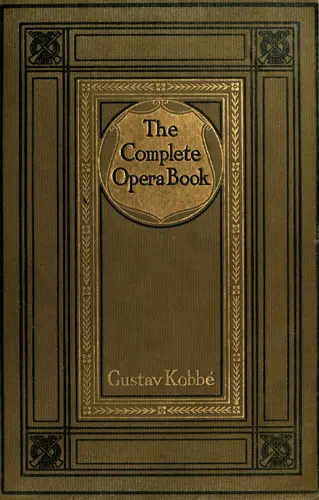
THE CLASSIC COLLECTION · 1919
"The Complete Opera Book" by Gustav Kobbé is a guide to operas first published posthumously in 1919. This comprehensive reference presents opera stories alongside musical notation of leading airs and motives. Covering works from Gluck to early twentieth-century composers, the book organizes operas by national schools and historical periods. Originally left unfinished at Kobbé's death, it was completed by editor Katharine Wright and expanded through numerous editions, becoming the definitive encyclopedic account of opera for generations of music lovers and record collectors.
Introduction adapted from the source catalogue; source summaries may be automatically generated.
Free to read · English · 250,916 words · No account needed
MAKE TIME FOR A GOOD BOOK
On by default. Untick to stop anonymous reading totals. Each page counts after 10 seconds in view. How this works.
Anonymous counting is on unless you have switched it off.
In fact, operas survive because the librettist has known how to create a character and the composer how to match it with his musical genius. Recall the dashing Don Giovanni; the resourceful Figaro, both in the Mozart and the Rossini opera; the real interpretive quality of a mild and gracious order in the heroine of "La Sonnambula"--innocence personified; the gloomy figure of Edgardo stalking through "Lucia di Lammermoor"; the hunchback and the titled gallant in "Rigoletto," and you can understand why these very old operas have lived so long. They are not make-believe; they are real.
Opera in three acts, by Verdi; words by Somma, based on Scribe's libretto for Auber's opera, "Gustave III., ou Le Bal Masqué" (Gustavus III., or the Masked Ball). Produced, Apollo Theatre, Rome, February 17, 1859. Paris, Théâtre des Italiens, January 13, 1861. London, June 15, 1861. New York, February 11, 1861. Revivals, Metropolitan Opera House, N.Y., with Jean de Reszke, 1903; with Caruso, Eames, Homer, Scotti, Plançon, and Journet, February 6, 1905; with Caruso, Destinn, Matzenauer, Hempel, and Amato, November 22, 1913.
RICHARD, Count of Warwick and Governor of Boston (or Riccardo, Duke of Olivares and Governor of Naples) Tenor AMELIA (Adelia) Soprano REINHART (Renato), secretary to the Governor and husband of Amelia Baritone SAMUEL } enemies of the Governor Bass TOM (Tommaso) } SILVAN, a sailor Soprano OSCAR (Edgardo), a page Soprano ULRICA, a negress astrologer Contralto
A judge, a servant of Amelia, populace, guards, etc., conspirators, maskers, and dancing couples.
Place--Boston, or Naples.
Time--Late seventeenth or middle eighteenth century.
The English libretto of "Un Ballo in Maschera," literally "A Masked
Ball," but always called by us "The Masked Ball," has the following
note:
"The scene of Verdi's 'Ballo in Maschera' was, by the author of the libretto, originally laid in one of the European cities. But the government censors objected to this, probably, because the plot contained the record of a successful conspiracy against an established prince or governor. By a change of scene to the distant, and, to the author, little-known, city of Boston, in America, this difficulty seems to have been obviated. The fact should be borne in mind by Bostonians and others, who may be somewhat astonished at the events which are supposed to have taken place in the old Puritan city."
Certainly the events in "The Masked Ball" are amazing for the Boston of Puritan or any other time, and it was only through necessity that the scene of the opera was laid there. Now that political reasons for this no longer exist, it is usually played with the scene laid in Naples.
Your reading position is saved on this browser. Take it to another device with a library code. Reading pages adapt to text, rather than matching a printed edition.
Gustav Kobbé
Gustav Kobbé
Gustav Kobbé
BEHIND THE BOOK
This eBook is for the use of anyone anywhere in the United States and most other parts of the world at no cost and with almost no restrictions whatsoever. You may copy it, give it away or re-use it under the terms of the Project Gutenberg License included with this eBook or online at www.gutenberg.org. If you are not located in the United States, you will have to check the laws of the country where you are located before using this eBook. Read the source licence.
The original source file, including credits and licence, is retained by this library. Request an original-format copy at no charge. Please include the book title and Project Gutenberg identifier #40540.
KEEP YOUR CURIOSITY GOING

Charles G. (Charles Griffith) Ross
Hannah Webster Foster

Emily Lawless
Edwin Hamlin Carr

Charles De Lano Hine
Andrew Ure