THE CLASSIC COLLECTION✦How to Appreciate MusicCLASSIC FREE BOOKS
How to Appreciate Music
Gustav Kobbé
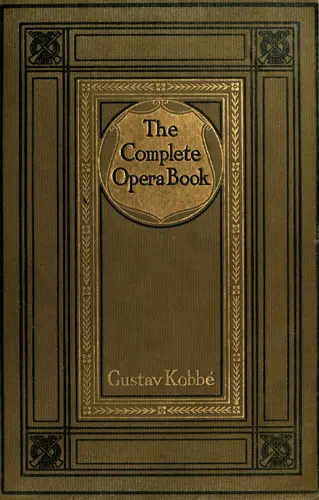
THE CLASSIC COLLECTION · 1919
"The Complete Opera Book" by Gustav Kobbé is a guide to operas first published posthumously in 1919. This comprehensive reference presents opera stories alongside musical notation of leading airs and motives. Covering works from Gluck to early twentieth-century composers, the book organizes operas by national schools and historical periods. Originally left unfinished at Kobbé's death, it was completed by editor Katharine Wright and expanded through numerous editions, becoming the definitive encyclopedic account of opera for generations of music lovers and record collectors.
Introduction adapted from the source catalogue; source summaries may be automatically generated.
Free to read · English · 250,916 words · No account needed
MAKE TIME FOR A GOOD BOOK
On by default. Untick to stop anonymous reading totals. Each page counts after 10 seconds in view. How this works.
Anonymous counting is on unless you have switched it off.
His first real success, "Anna Bolena," was brought out in Rome, in 1830. Even before that, however, thirty-one operas by him had been performed. Of his many works, the comparatively few still heard nowadays are, in the order of their production, "L'Elisire d'Amore," "Lucrezia Borgia," "Lucia di Lammermoor," "La Figlia del Reggimento," "La Favorita," "Linda di Chamounix," and "Don Pasquale." A clever little one-act comedy opera, "Il Campanello di Notte" (The Night Bell) was revived in New York in the spring of 1917.
With a gift for melody as facile as Bellini's, Donizetti is more dramatic, his harmonization less monotonous, and his orchestration more careful. This is shown by his choice of instruments for special effects, like the harp solo preceding the appearance of Lucia, the flute obligato in the mad scene in the opera of which she is the heroine, and the bassoons introducing "Una furtiva lagrima," in "L'Elisire d'Amore." He is a distinct factor in the evolution of Italian opera from Rossini to and including Verdi, from whom, in turn, the living Italian opera composers of note derive.
Donizetti's father was a weaver, who wished his son to become a lawyer. But he finally was permitted to enter the conservatory at Bergamo, where, among other teachers, he had J.H. Mayr in harmony. He studied further, on Mayr's recommendation, with Padre Martini.
As his father wanted him to teach so that he would be self-supporting, he enlisted in the army, and was ordered to Venice. There in his leisure moments he composed his first opera, "Enrico di Borgogna," produced, Venice, 1818. In 1845 he was stricken with paralysis. He died at Bergamo, April 8, 1848.
Opera, in two acts. Music by Donizetti; words by Felice Romani. Produced, Milan, May 12, 1832; London, December 10, 1836; New Orleans, March 30, 1842; New York, Academy of Music, 1883-84, with Gerster; Metropolitan Opera House, 1904, with Sembrich, Caruso, Scotti, and Rossi.
NEMORINO, a young peasant Tenor ADINA, wealthy, and owner of a farm Soprano BELCORE, a sergeant Baritone DULCAMARA, a quack doctor Bass GIANNETTA, a peasant girl Soprano
Time--Nineteenth Century.
Place--A small Italian village.
Act I. Beauty and riches have made the young peasant woman, Adina, exacting. She laughs at the embarrassed courting of the true-hearted peasant lad, Nemorino; she laughs at the story of "Tristan and Isolde," and rejoices that there are now no more elixirs to bring the merry heart of woman into slavish dependence on love. Yet she does not seem so much indifferent to Nemorino as piqued over his lack of courage to come to the point.
Your reading position is saved on this browser. Take it to another device with a library code. Reading pages adapt to text, rather than matching a printed edition.
Gustav Kobbé
Gustav Kobbé
Gustav Kobbé
BEHIND THE BOOK
This eBook is for the use of anyone anywhere in the United States and most other parts of the world at no cost and with almost no restrictions whatsoever. You may copy it, give it away or re-use it under the terms of the Project Gutenberg License included with this eBook or online at www.gutenberg.org. If you are not located in the United States, you will have to check the laws of the country where you are located before using this eBook. Read the source licence.
The original source file, including credits and licence, is retained by this library. Request an original-format copy at no charge. Please include the book title and Project Gutenberg identifier #40540.
KEEP YOUR CURIOSITY GOING

Charles G. (Charles Griffith) Ross
Hannah Webster Foster

Emily Lawless
Edwin Hamlin Carr

Charles De Lano Hine
Andrew Ure