Object: matrimony
Montague Glass
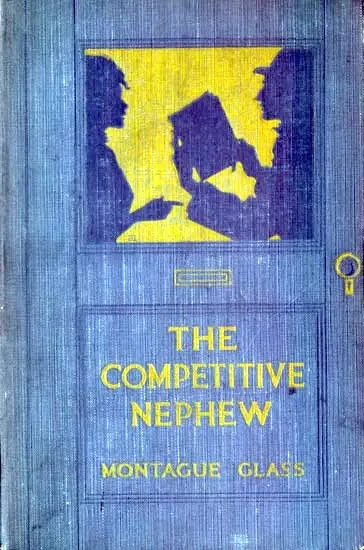
THE CLASSIC COLLECTION · 1915
"The Competitive Nephew" by Montague Glass is a humorous novel written in the early 20th century. The story revolves around the lives and interactions of various characters in the cloak and suit business, highlighting themes of nepotism, competition, and the complexities of human relationships. Central to the narrative are Aaron Pinsky, an asthmatic customer with a fondness for his ambitious nephew Fillup, and the business partners Sam Zaretsky and Max Fatkin, who navigate the challenges of the retail world while dealing with Aaron's interference and aspirations for his nephew. At the start of the novel, readers are introduced to Sam Zaretsky and Max Fatkin, who express their frustrations about competition and the challenges of hiring male employees who might eventually threaten their business. The conversation quickly turns to Aaron Pinsky, who boasts about his promising nephew Fillup, recently graduated from business college. After some comedic miscommunication and Aaron's insistence, Max and Sam reluctantly agree to bring Fillup into their business. As Aaron's character unfolds, with his asthmatic condition often taking center stage in humorous exchanges, the opening sets the stage for various intertwining narratives of ambition, loyalty, and the quirks of family dynamics within the context of the business world.
Introduction adapted from the source catalogue; source summaries may be automatically generated.
Free to read · English · 76,999 words · No account needed
MAKE TIME FOR A GOOD BOOK
On by default. Untick to stop anonymous reading totals. Each page counts after 10 seconds in view. How this works.
Anonymous counting is on unless you have switched it off.
Thus Sam drank a glass of buttermilk and ate some dry toast for his supper; and, in consequence, he slept so soundly that he did not waken until Dr. Sigmund Eichendorfer entered his room at eight o'clock the following morning. Under the bullying frown of his daughter Sam submitted to a physical examination that lasted for more than an hour; and when Doctor Eichendorfer departed he left behind him four varieties of tablets and a general interdiction against eating solid food, getting up, going downtown, or any of the other dozen things that Sam insisted upon doing.
It was only under the combined persuasion of Max, Babette, and Lester that he consented to stay in bed that forenoon; and when lunchtime arrived he was so weakened by a twenty-four-hour fast and Doctor Eichendorfer's tablets, that he was glad to remain undisturbed for the remainder of the day.
At length, after one bedridden week, accompanied by a liquid diet and more tablets, Sam was allowed to sit up in a chair and to partake of a slice of chicken.
"Well, popper, how do you feel to-day?" asked Max, who had just arrived
from the office.
"I feel pretty sick, Max," Sam replied; "but I guess I could get
downtown to-morrow, all right."
Babette sat nearby and nodded her head slowly.
"Guess some more, popper," she said. "Before you would go downtown yet, you are going to Lakewood."
"Lakewood!" Sam exclaimed. "What d'ye mean, Lakewood? If you want to go to Lakewood, go ahead. I am going downtown to-morrow. What, d'ye think a business could run itself?"
"So far as business is concerned," Max said, "you shouldn't trouble yourself at all. We are hustling like crazy downtown and we already sold over three thousand dollars' worth of them 1040's."
Sam sat up suddenly.
"I see my finish," he said, "with you boys selling goods left and right to a lot of fakers like the New Idea Store."
"New Idea Store nothing!" Max retorted. "We are selling over two thousand dollars to Falkstatter, Fein & Company--and I guess they're fakers--what!"
Sam leaned back in his chair.
"Falkstatter, Fein & Company is all right," he admitted.
"And, furthermore," Max continued, "we sold 'em fancy colours like wistaria, copenhagen, and champagne; and them navy blues and browns they wouldn't touch."
"No?" Sam said weakly.
"So you see, popper, if you would been downtown we wouldn't got that order at all," Max continued. "So what's the use worrying yourself?"
"He's right, popper," Babette added. "You're getting too old to be going downtown every day. The boys could look after the business. It's time you took a rest."
At this juncture Doctor Eichendorfer entered.
Your reading position is saved on this browser. Take it to another device with a library code. Reading pages adapt to text, rather than matching a printed edition.
Montague Glass
Montague Glass

Montague Glass
Montague Glass
BEHIND THE BOOK
This eBook is for the use of anyone anywhere in the United States and most other parts of the world at no cost and with almost no restrictions whatsoever. You may copy it, give it away or re-use it under the terms of the Project Gutenberg License included with this eBook or online at www.gutenberg.org. If you are not located in the United States, you will have to check the laws of the country where you are located before using this eBook. Read the source licence.
The original source file, including credits and licence, is retained by this library. Request an original-format copy at no charge. Please include the book title and Project Gutenberg identifier #32960.
KEEP YOUR CURIOSITY GOING
Coulson Kernahan

Maurice Baring
Frances Wright
Cécile Tormay

Frederic Jesup Stimson

W. H. P. (William Henry Pope) Jarvis