Object: matrimony
Montague Glass
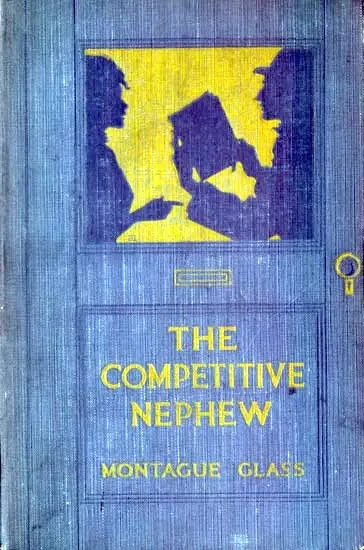
THE CLASSIC COLLECTION · 1915
"The Competitive Nephew" by Montague Glass is a humorous novel written in the early 20th century. The story revolves around the lives and interactions of various characters in the cloak and suit business, highlighting themes of nepotism, competition, and the complexities of human relationships. Central to the narrative are Aaron Pinsky, an asthmatic customer with a fondness for his ambitious nephew Fillup, and the business partners Sam Zaretsky and Max Fatkin, who navigate the challenges of the retail world while dealing with Aaron's interference and aspirations for his nephew. At the start of the novel, readers are introduced to Sam Zaretsky and Max Fatkin, who express their frustrations about competition and the challenges of hiring male employees who might eventually threaten their business. The conversation quickly turns to Aaron Pinsky, who boasts about his promising nephew Fillup, recently graduated from business college. After some comedic miscommunication and Aaron's insistence, Max and Sam reluctantly agree to bring Fillup into their business. As Aaron's character unfolds, with his asthmatic condition often taking center stage in humorous exchanges, the opening sets the stage for various intertwining narratives of ambition, loyalty, and the quirks of family dynamics within the context of the business world.
Introduction adapted from the source catalogue; source summaries may be automatically generated.
Free to read · English · 76,999 words · No account needed
MAKE TIME FOR A GOOD BOOK
On by default. Untick to stop anonymous reading totals. Each page counts after 10 seconds in view. How this works.
Anonymous counting is on unless you have switched it off.
"You ain't told me nothing about the safe," Wolfson answered. "The writing what I give you says the stock and fixtures."
Borrochson took out the paper which Wolfson had just signed, and
examined it carefully.
"You're wrong," Borrochson said. "I stuck it in the words 'without the safe' before you signed it."
Wolfson rose heavily to his feet.
"Let see it the writing," he said, making a grab for it.
"It's all right," Borrochson replied. "Here it is, black on white,
'without the safe.'"
"Then you done me out of it," Wolfson cried.
"I didn't done you out of nothing," Borrochson retorted. "You should of read it over before you signed it, and, anyhow, what difference does the safe make? It ain't worth fifty dollars if it was brand-new."
"Without a safe a jewellery stock is nothing," Wolfson said. "So if you told it me you wouldn't sell the safe I wouldn't of signed the paper. You cheated me."
He walked toward the door of the store and had about reached it when it burst open to admit a tall, slight man with haggard face and blazing eyes. He rushed past Wolfson, who turned and stared after him.
"Mr. Borrochson," the newcomer cried, "what's the use your fooling me any longer? Five hundred dollars I will give for the safe, and that's my last word."
"Sssh!" Borrochson hissed, and drew his visitor toward the end of the store. There a whispered conversation took place with frequent outbursts of sacred and profane exclamations from the tall, slender person, who finally smacked Borrochson's face with a resounding slap and ran out of the store.
"Bloodsucker!" he yelled as he slammed the door behind him. "You want
my life."
Wolfson stared first at the departing stranger and then at Borrochson, who was thoughtfully rubbing his red and smarting cheek.
"It goes too far!" Borrochson cried. "Twicet already he does that to me and makes also my nose bleed. The next time I make him arrested."
"What's the matter with him?" Wolfson asked. "Is he crazy?"
"He makes me crazy," Borrochson replied. "I wish I never seen the
safe."
"The safe!" Wolfson exclaimed. "What's he got to do with the safe?"
"Oh, nothing," Borrochson answered guardedly; "just a little business between him and me about it."
"But, Mr. Borrochson," Wolfson coaxed, "there can't be no harm in
telling me about it."
He handed a cigar to Borrochson, who examined it suspiciously and put
it in his pocket.
"Seed tobacco always makes me a stomachache," he said, "unless I smoke
it after a meal."
Your reading position is saved on this browser. Take it to another device with a library code. Reading pages adapt to text, rather than matching a printed edition.
Montague Glass
Montague Glass

Montague Glass
Montague Glass
BEHIND THE BOOK
This eBook is for the use of anyone anywhere in the United States and most other parts of the world at no cost and with almost no restrictions whatsoever. You may copy it, give it away or re-use it under the terms of the Project Gutenberg License included with this eBook or online at www.gutenberg.org. If you are not located in the United States, you will have to check the laws of the country where you are located before using this eBook. Read the source licence.
The original source file, including credits and licence, is retained by this library. Request an original-format copy at no charge. Please include the book title and Project Gutenberg identifier #32960.
KEEP YOUR CURIOSITY GOING
Coulson Kernahan

Maurice Baring
Frances Wright
Cécile Tormay

Frederic Jesup Stimson

W. H. P. (William Henry Pope) Jarvis