Object: matrimony
Montague Glass
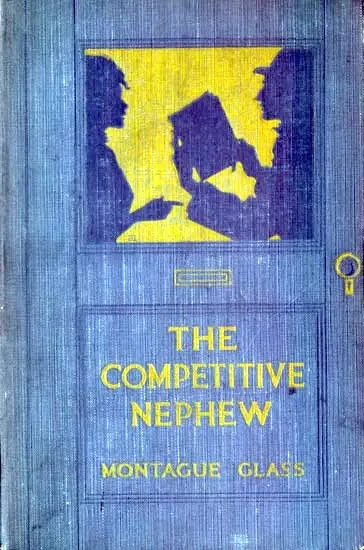
THE CLASSIC COLLECTION · 1915
"The Competitive Nephew" by Montague Glass is a humorous novel written in the early 20th century. The story revolves around the lives and interactions of various characters in the cloak and suit business, highlighting themes of nepotism, competition, and the complexities of human relationships. Central to the narrative are Aaron Pinsky, an asthmatic customer with a fondness for his ambitious nephew Fillup, and the business partners Sam Zaretsky and Max Fatkin, who navigate the challenges of the retail world while dealing with Aaron's interference and aspirations for his nephew. At the start of the novel, readers are introduced to Sam Zaretsky and Max Fatkin, who express their frustrations about competition and the challenges of hiring male employees who might eventually threaten their business. The conversation quickly turns to Aaron Pinsky, who boasts about his promising nephew Fillup, recently graduated from business college. After some comedic miscommunication and Aaron's insistence, Max and Sam reluctantly agree to bring Fillup into their business. As Aaron's character unfolds, with his asthmatic condition often taking center stage in humorous exchanges, the opening sets the stage for various intertwining narratives of ambition, loyalty, and the quirks of family dynamics within the context of the business world.
Introduction adapted from the source catalogue; source summaries may be automatically generated.
Free to read · English · 76,999 words · No account needed
MAKE TIME FOR A GOOD BOOK
On by default. Untick to stop anonymous reading totals. Each page counts after 10 seconds in view. How this works.
Anonymous counting is on unless you have switched it off.
"Well, I ain't surprised to hear that, Mr. Feinsilver," Trinkmann rejoined less viciously. "Because even if Maikafer is such a good friend of yours, the feller is so busy with other people's business, what he ain't got no business to butt in at all, that his own business he lets go to the devil. Am I right or wrong?"
Simon nodded and sat down at one of Louis' tables.
"Albert," Trinkmann cried, "wait on Mr. Feinsilver."
"That's all right," Feinsilver declared; "I got plenty time."
"Albert," Trinkmann repeated, "take Mr. Feinsilver's order."
Albert left his station on the opposite side of the room and approached Feinsilver with a conciliatory smile.
"What would you like to-day, Mr. Feinsilver?" he said.
"I would like Louis," Feinsilver replied; "so go ahead, Albert, and tell Louis when he gets through serving those two fellers over there to wait on me."
"What's the matter you ain't giving your order to Albert, Mr.
Feinsilver?" Trinkmann asked.
"Albert is all right," Feinsilver replied, "but Louis knows just how I want things, Trinkmann. You ain't got no objections to me waiting for Louis?"
"Why should I got objections, Mr. Feinsilver?" Trinkmann protested.
"I don't know why you should got objections, Trinkmann," Feinsilver said, "and if you did got 'em I would wait for Louis anyway."
He closed the discussion by spearing half a dill pickle with a fork and inserting it endwise in his mouth. Hardly had the metal tines touched his lips, however, than he hastily disgorged the pickle and uttered a resounding "T'phoo-ee!"
"What are you trying to do here to me, Trinkmann?" he demanded. "Poison
me?"
He dipped his napkin into the glass of water that stood on the table and performed an elaborate prophylaxis about his mouth and teeth.
"What d'ye mean, poison you?" Trinkmann cried.
"Why, there is something here on the fork," Simon declared.
"Let me see," Trinkmann said, advancing to the table; "might it be some Bismarck herring, maybe."
"Bismarck herring ain't poison," Feinsilver said, examining the fork closely. "Bismarck herring never harmed nobody, Trinkmann; but this here fork has got poison onto it."
He turned it over in his hand and sniffed at it suspiciously.
"Why, bless my soul," he roared. "Somebody has been cleaning it with
polishing powder."
"Well, suppose they did?" Trinkmann said calmly.
Your reading position is saved on this browser. Take it to another device with a library code. Reading pages adapt to text, rather than matching a printed edition.
Montague Glass
Montague Glass

Montague Glass
Montague Glass
BEHIND THE BOOK
This eBook is for the use of anyone anywhere in the United States and most other parts of the world at no cost and with almost no restrictions whatsoever. You may copy it, give it away or re-use it under the terms of the Project Gutenberg License included with this eBook or online at www.gutenberg.org. If you are not located in the United States, you will have to check the laws of the country where you are located before using this eBook. Read the source licence.
The original source file, including credits and licence, is retained by this library. Request an original-format copy at no charge. Please include the book title and Project Gutenberg identifier #32960.
KEEP YOUR CURIOSITY GOING
Coulson Kernahan

Maurice Baring
Frances Wright
Cécile Tormay

Frederic Jesup Stimson

W. H. P. (William Henry Pope) Jarvis