Object: matrimony
Montague Glass
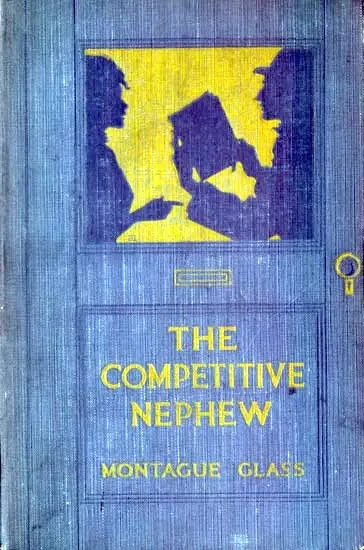
THE CLASSIC COLLECTION · 1915
"The Competitive Nephew" by Montague Glass is a humorous novel written in the early 20th century. The story revolves around the lives and interactions of various characters in the cloak and suit business, highlighting themes of nepotism, competition, and the complexities of human relationships. Central to the narrative are Aaron Pinsky, an asthmatic customer with a fondness for his ambitious nephew Fillup, and the business partners Sam Zaretsky and Max Fatkin, who navigate the challenges of the retail world while dealing with Aaron's interference and aspirations for his nephew. At the start of the novel, readers are introduced to Sam Zaretsky and Max Fatkin, who express their frustrations about competition and the challenges of hiring male employees who might eventually threaten their business. The conversation quickly turns to Aaron Pinsky, who boasts about his promising nephew Fillup, recently graduated from business college. After some comedic miscommunication and Aaron's insistence, Max and Sam reluctantly agree to bring Fillup into their business. As Aaron's character unfolds, with his asthmatic condition often taking center stage in humorous exchanges, the opening sets the stage for various intertwining narratives of ambition, loyalty, and the quirks of family dynamics within the context of the business world.
Introduction adapted from the source catalogue; source summaries may be automatically generated.
Free to read · English · 76,999 words · No account needed
MAKE TIME FOR A GOOD BOOK
On by default. Untick to stop anonymous reading totals. Each page counts after 10 seconds in view. How this works.
Anonymous counting is on unless you have switched it off.
"I belong in the Home," Miss Duckman replied, colouring slightly, and Rudnik felt himself being overcome by a wave of remorse for his bluntness. He therefore searched his mind for a sufficiently gruff rejoinder, and finding none he shrugged his shoulders.
"Well," he said at last, "there's worser places, lady."
Miss Duckman nodded.
"Maybe," she murmured; "and anyhow I ain't so bad off as some of them other ladies up there which they used to got husbands and homes of their own."
"Ain't you a widder, too?" Rudnik asked, his curiosity again getting
the upper hand.
"I ain't never been married," Miss Duckman answered as she drew her
shawl primly about her.
"Well, you ain't missed much," Rudnik declared, "so far as I could
see."
"Why," Miss Duckman exclaimed, "ain't you never been married, neither?"
Rudnik blinked solemnly before replying.
"You're just like a whole lot of ladies," he said; "you must got to find out everything." He turned away and stepped briskly on to the railroad track.
"But ain't you married?" Miss Duckman insisted.
"No," he growled as he started off. "Gott sei dank."
For a brief interval Miss Duckman stood and watched his progress along the ties, and then she gathered her parcels more firmly in her arms and began to negotiate the quagmire that led to the Home. She had not proceeded more than a hundred feet, however, when a locomotive whistle sounded in the distance.
"Hey, mister!" she shouted; but even if Rudnik heard the warning it served only to hasten his footsteps. Consequently the train was almost upon him before he became aware of it, and even as he leaped wildly to one side the edge of the cowcatcher struck him a glancing blow. Miss Duckman dropped her bundles and plunged through the mud to where Rudnik lay, while the train, which was composed of empty freight cars, slid to a grinding stop a short distance up the track.
She was kneeling recklessly in the mud supporting Rudnik with both her hands when the engineer and the fireman reached them.
"Is your husband hurted bad?" the engineer asked Miss Duckman.
The tears were rolling down Miss Duckman's worn cheeks, and her lips trembled so that she could not reply. Nevertheless, at the word "husband" her maidenly heart gave a tremendous bound, and when the engineer and the fireman lifted Rudnik gently into the caboose her confusion was such that without protest she permitted the conductor to assist her carefully up the car steps.
"Sit ye down on that stool there, lady," he said. "As far as I can see your man ain't got no bones broken."
"But----" Miss Duckman protested.
Your reading position is saved on this browser. Take it to another device with a library code. Reading pages adapt to text, rather than matching a printed edition.
Montague Glass
Montague Glass

Montague Glass
Montague Glass
BEHIND THE BOOK
This eBook is for the use of anyone anywhere in the United States and most other parts of the world at no cost and with almost no restrictions whatsoever. You may copy it, give it away or re-use it under the terms of the Project Gutenberg License included with this eBook or online at www.gutenberg.org. If you are not located in the United States, you will have to check the laws of the country where you are located before using this eBook. Read the source licence.
The original source file, including credits and licence, is retained by this library. Request an original-format copy at no charge. Please include the book title and Project Gutenberg identifier #32960.
KEEP YOUR CURIOSITY GOING
Coulson Kernahan

Maurice Baring
Frances Wright
Cécile Tormay

Frederic Jesup Stimson

W. H. P. (William Henry Pope) Jarvis