THE CLASSIC COLLECTION✦An outlaw’s diary: the CommuneCLASSIC FREE BOOKS
An outlaw’s diary: the Commune
Cécile Tormay
THE CLASSIC COLLECTION · 1850
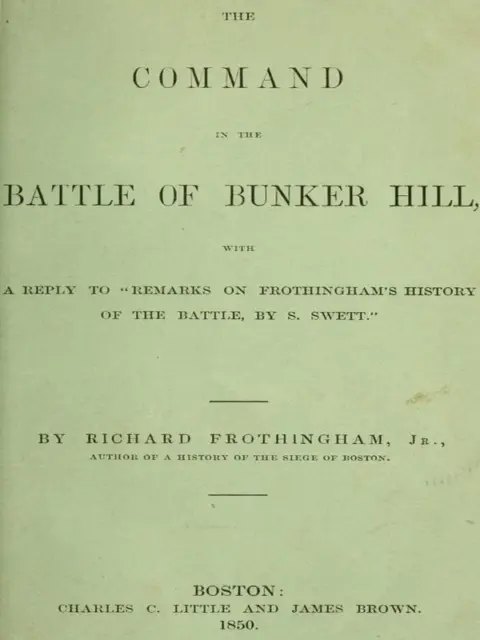
"The Command in the Battle of Bunker Hill" by Richard Frothingham is a historical account written in the mid-19th century. The work specifically delves into the controversial topic of command during the American Revolutionary War's pivotal Battle of Bunker Hill, reviewing varying accounts and claims about the roles of prominent figures such as Generals Putnam and Prescott. The author aims to clarify the conflicting narratives surrounding who commanded the American forces during the battle, thereby contributing to the ongoing discourse of military history. At the start of the book, Frothingham explains his motivation for writing this history, stemming from his previous work on the Siege of Boston. He notes the discrepancies in accounts regarding the command structure during the Bunker Hill battle, with claims made by different individuals about who led the troops. Frothingham emphasizes that much of the testimony regarding command is conflicted and colored by the perspectives of participants reflecting decades later, and he pledges to rely on more immediate historical documents to arrive at his conclusions. The opening sets the stage for a detailed examination of primary sources and various claims surrounding the roles of Putnam and Prescott, crafting an objective narrative rooted in historical evidence.
Introduction adapted from the source catalogue; source summaries may be automatically generated.
Free to read · English · 27,811 words · No account needed
MAKE TIME FOR A GOOD BOOK
On by default. Untick to stop anonymous reading totals. Each page counts after 10 seconds in view. How this works.
Anonymous counting is on unless you have switched it off.
But in spite of this endeavor to state things exactly, it would be strange indeed if the "Siege of Boston" did not contain errors, for what book is without them? As yet none of much importance have been pointed out, though I should thank any one who will inform me of such as there are and should be glad to correct them. Two may be here acknowledged: one on page 135 where "to a slough," should read "towards a slough." I regret to have met with no particular contemporary description of the entrenchments, and hence quoted Mr Swett's words, and this error was copied from his History! (This quotation is acknowledged on p. 135 of Siege of Boston as from p. 20 of his History.) Another error is on page 164, where "riding down the hill" should read "going down the hill," an error inadvertantly made in copying for the press. Long before Mr Swett printed his pamphlet he knew how these errors occurred, and also knew they were acknowledged and corrected for a subsequent edition of the Siege of Boston. What more could be done?
When this is considered let the reader judge the spirit or purpose or honor that could have dictated Mr Swett's comments on these two errors. 1. Of the breastwork error, he says--"By describing it as reaching down to the slough he has represented it as longer than it was, and has marred and obscured by this mistake one of the principal features of the battle," &c., &c., p. 5. Indeed! Is this so? Let both descriptions be examined and it will be seen who, in this, has "marred and obscured" this battle the most. The Siege says, page 135--"A breastwork beginning a short distance from the redoubt, and on a line with its eastern side, extended about one hundred yards north to a slough." The distance specified was taken by measure from Page's Plan--"to a slough" was taken from Mr Swett's History! The error is mostly corrected by the limitation. Now Mr Swett's description (History, p. 20, 1823 edition) reads--"A breastwork ran in a line with it north down to the slough." The error here has no corrective! My breastwork runs only "about one hundred yards north." Mr Swett's breastwork runs north down splash to the slough,--marring and obscuring (he says,) the principal features of the memorable Bunker Hill battle! But really he is altogether too severe on his mistake! 2. On the other error Mr Swett writes--"As if purposely to declare he did not think anything relative to Putnam deserving of ordinary care or attention, he says--'This report states Callender was riding down the hill, when there is not a syllable of the kind,'" p. 13. Now, 1st, the words put upon me between quotation marks are not mine. This is not what I say. The statement in the Siege, p. 164, is--"In the report (1775) made to the Massachusetts provincial congress it is stated that on Bunker Hill he (Putnam) ordered Capt. Callender, who was riding down the hill, 'to stop and go back.'" This statement, substituting going for riding, is correct. The exact statement of the report is that "an officer of the train was drawing his cannon down" Bunker Hill, when General Putnam met him and ordered him "to stop and go back." "He refused, until the General threatened him with immediate death, upon which he returned up the hill again, but soon deserted his post. Another officer, who had the direction of another cannon, conducted much in the same manner." And in another place Captains Gridley and Callender are named as being the officers. Now, by comparing this report with an article on Callender in the Centinel (1818), it will be seen that it was Callender "who was going down the hill." The sentence in the Siege is quoted simply to show that Gen. Putnam gave orders in the battle, and is concise, but it was written with "care and attention." I fearlessly appeal to the report to sustain this remark. Let Mr Swett look at it closely, calmly, and surely he cannot again write that "there is not a syllable of the kind there!" As though I had manufactured the whole statement! Here, then, an inexact quotation from the Siege, and a false statement as to fact, are prefaced by an illiberal, unjust and even wanton remark. Let the Siege of Boston, I had almost written everywhere, answer whether its author "did not think anything" "deserving of ordinary care and attention" relative to General Putnam. While Mr Swett is dealing out such rank injustice, accusing me of "sacrificing" Putnam's character, of "racking my fancy" to discover objections against "his claims," and I know not what else, it is peculiarly gratifying to me to be able to show the impression which the pages of this volume, as far as they relate to Putnam, made on a candid critic. An article on the Siege of Boston, in the Philadelphia Bulletin--understood to be from the pen of WILLIAM B. REED, Esq., the accomplished author of the Life of President Reed--after, I fear, too favorable a notice of my labors, reads:--
Your reading position is saved on this browser. Take it to another device with a library code. Reading pages adapt to text, rather than matching a printed edition.
BEHIND THE BOOK
This eBook is for the use of anyone anywhere in the United States and most other parts of the world at no cost and with almost no restrictions whatsoever. You may copy it, give it away or re-use it under the terms of the Project Gutenberg License included with this eBook or online at www.gutenberg.org. If you are not located in the United States, you will have to check the laws of the country where you are located before using this eBook. Read the source licence.
The original source file, including credits and licence, is retained by this library. Request an original-format copy at no charge. Please include the book title and Project Gutenberg identifier #48338.
KEEP YOUR CURIOSITY GOING
Cécile Tormay

Moritz Busch
John L. Ransom
Frances Wright
Cécile Tormay

Mabel Potter Daggett