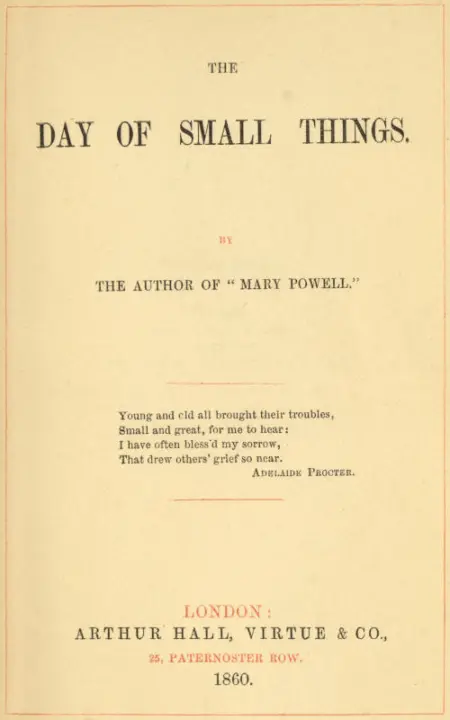
The Day of Small Things
Anne Manning
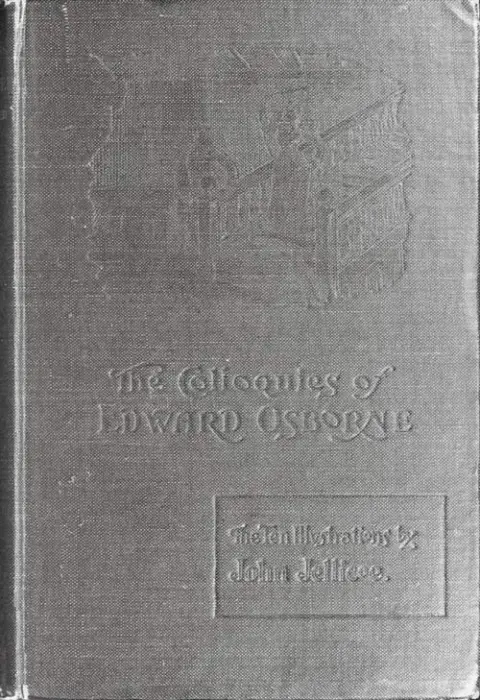
THE CLASSIC COLLECTION · 1852
"The Colloquies of Edward Osborne, Citizen and Clothworker of London" by Anne Manning is a historical novel written in the late 19th century. The narrative follows the experiences of Edward Osborne, a young lad from the countryside, as he arrives in London and embarks on his apprenticeship in clothworking. The story delves into themes of social dynamics, personal development, and the complexities of urban life during the time. At the start of the novel, Edward arrives in London with his mother, filled with wonder yet apprehension about the bustling city life. They traverse the lively streets, reaching the Clothworkers’ Hall, where Edward is to begin his apprenticeship. His introduction to the city highlights the stark contrast between his country upbringing and urban realities, punctuated by interactions with his master, Master Hewet, and other characters that foreshadow the challenges and adventures he will face. Edward's initial experiences are characterized by a mix of trepidation and excitement as he navigates this unfamiliar world, setting the stage for his growth and the unfolding drama around him.
Introduction adapted from the source catalogue; source summaries may be automatically generated.
Free to read · English · 39,033 words · No account needed
MAKE TIME FOR A GOOD BOOK
On by default. Untick to stop anonymous reading totals. Each page counts after 10 seconds in view. How this works.
Anonymous counting is on unless you have switched it off.
But all these little Clouds blew over during the three Weeks I spent with my Mother at Ashford. When I came back, I was the same Lad as ever, and took Things as I found them, and fell into my old Place.
In the October of this Year, Sir John Gresham, Mercer, being chosen Mayor, his Company resolved to get up their famous Pageant of the Maiden Chariot; and having vainly cast about among their own Fraternity for a young Damsel sufficiently comely to be the Admiration of all the City, and likewise able and willing to play the Part of Chariot Maiden, they at length offered it to the youngest Daughter of Master Soper the Barbitonsor who lived on the Bridge. Now Master Soper had two Daughters, good and pretty Girls enow as Times went, Tryphena and Tryphosa by Name, fresh-coloured, sprightly, and much admired by the Bridge 'Prentices. These two Sisters were seldom apart, inasmuch as both their Heads might commonly be seen out of one upper Lattice, looking after every Thing that passed in the Strete; and 'twas in their Favour that they always seemed on the best of Terms with one another. But whether by Reason of any Unguent of Master Soper's, or mere Liberality of Nature, I wot not, the younger, who in no other Wise excelled her Sister, was notorious for the excessive Length and Thickness of her glossy flaxen Hair. And this being an indispensable Requisite for the Chariot Maiden, the Mercers without more Ado offered her the Part, which she with great Glee accepted. Now hereupon, I lament to say, ensewed great Disruption between the twain hitherto so harmonious; for Public Admiration of Beauty is as true a Test of what is the Nature of a Woman's Heart, as the black Marble the Goldsmiths call Touchstone is of their precious Metals. If her Head be not turned by it, good: if she can bear it bestowed upon another and o'erlooked in herself, why, good also,—she can stand the Touchstone: howbeit, all have not this Virtue. And, whereas Tryphosa was now so elate with thinking of her white satin Gown, her golden Sandals, her jewelled Crown, and her Feast in the Hall, as to suppose the Ground scarce good enow for her to tread upon, Tryphena was ready to burst with Envy of her Sister, and could scarce speak peaceably unto her. However, she came to her common Sense and good Feeling at last, and found her Account in playing Second; many good Things being in Store for both. A notable Thing was, that Master Soper's Shop was now literally besieged with Customers who wanted to have a Glimpse of the Chariot Maiden, insomuch that he said he never had had such a Trafficking for Pennyworths in any given Year, as he had in this Month of October; only the worst was that every Customer gave as much Trouble for a Penny as he should have done for a Shilling, and would hang about, keeping away fresh Comers, when his Purchase was made. While Tryphosa, who had never to this Time shewn any Symptoms of Shyness, now turned coy and kept herself close; now and then letting Tryphena flit through the Shop and be mistaken for her, after which the two would shut themselves up and go into Fits of Laughter. The Women all along the Bridge were out of Patience with her for what they would have it was simulated Bashfulness in one who meant to be stared at from Morn to Night on Lord Mayor's Day. And they satisfied themselves that she was shutting herself up for Fear of freckling or sunburning. As for Miles, who always loved to do like the rest, he was evermore running over to Master Soper to have his Hair cut, till at last it was hardly longer than the Nap of his Gown; and I almost think he would have submitted one of his good white Teeth to the Barber's Pincers, if he could have gained Admittance on no cheaper Terms; just to boast of it afterwards. At last, when the grand Day came, he and every 'Prentice on the Bridge mobbed the Barbitonsor's Door till Tryphosa was fetched away in a close Litter. Then there was a Rush to the Mercers' Hall, where Master Gresham, in his Scarlet and Gold, met his Livery in their new Gowns furred with Foins and Budge; and accompanied them, mounted, to Guildhall, where the late Mayor, Sheriffs, and Aldermen, met them on Horseback. Then they all took Barge to Westminster and back, to the Sound of Trumpets, Sackbuts, and Shawlms, and the firing of small Guns, and exploding of Crackers. On re-landing at Three Cranes' Wharf, they re-mounted, and proceeded to Paul's Churchyard, where they met the Pageant, consisting of an exceeding magnifical Chariot, twenty-two Feet high, of the Roman Build, entirely covered with silver embossed Work, having Tryphosa therein, set on high, in Jewels and spangled Satin; her fair flaxen Tresses dishevelled, a Sceptre in one Hand, a Shield in the other, with all the Glory and Majesty possible to imagine:—Fame, blowing of a Trumpet right over her Head, Wisdom, Modesty, and all the rest, including the nine Muses, each in their proper Places; Triumph, driving nine white Flanders Horses, three abreast; Grooms, Lictors, and Pages marching alongside the Equipage; and a Score of Salvages and Jacks-i'-the-Green, making diverting Remarks to all; and keeping the Crowd off with Squibs and Crackers.
Your reading position is saved on this browser. Take it to another device with a library code. Reading pages adapt to text, rather than matching a printed edition.
Anne Manning
Anne Manning
Anne Manning
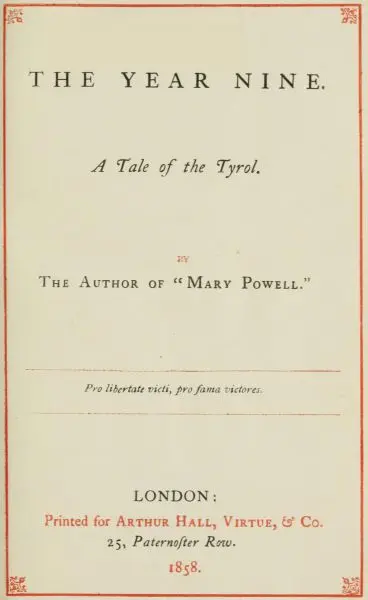
Anne Manning
BEHIND THE BOOK
This eBook is for the use of anyone anywhere in the United States and most other parts of the world at no cost and with almost no restrictions whatsoever. You may copy it, give it away or re-use it under the terms of the Project Gutenberg License included with this eBook or online at www.gutenberg.org. If you are not located in the United States, you will have to check the laws of the country where you are located before using this eBook. Read the source licence.
The original source file, including credits and licence, is retained by this library. Request an original-format copy at no charge. Please include the book title and Project Gutenberg identifier #51557.
KEEP YOUR CURIOSITY GOING
Cécile Tormay

Moritz Busch
Coulson Kernahan
John L. Ransom

Maurice Baring
Frances Wright