
The wild duck
Henrik Ibsen
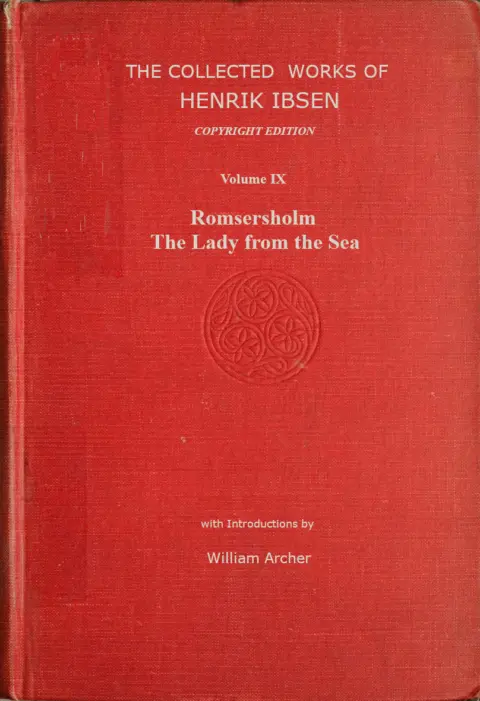
THE CLASSIC COLLECTION · 1910
"The Collected Works of Henrik Ibsen, Vol. 09" by Henrik Ibsen is a collection of plays, including "Rosmersholm" and "The Lady from the Sea," created during the late 19th century. This volume captures Ibsen's exploration of complex human relationships, societal norms, and psychological depths through its rich characters and intricate storylines. A significant theme revolves around individual emancipation and moral dilemmas within the context of a changing society. The opening portion of "Rosmersholm" introduces us to the titular character, Johannes Rosmer, a former clergyman living in his ancestral home, where past tragedies continue to haunt him. We meet Rebecca West, who manages Rosmer's household, and Rector Kroll, Rosmer's brother-in-law, who brings political tensions to the fore. A sense of foreboding is established as the characters reflect on the lingering impact of death on their lives and community. As discussions unfold, they touch on themes of loyalty, societal change, and the ghosts of their pasts, hinting at the conflicts to come as Rosmer grapples with his ideological awakening and the implications of his relationships with Rebecca and Kroll.
Introduction adapted from the source catalogue; source summaries may be automatically generated.
Free to read · English · 60,957 words · No account needed
MAKE TIME FOR A GOOD BOOK
On by default. Untick to stop anonymous reading totals. Each page counts after 10 seconds in view. How this works.
Anonymous counting is on unless you have switched it off.
Nowhere has The Lady from the Sea proved one of Ibsen’s most popular works. It was acted in all the Scandinavian capitals, and in several German cities, in February and March 1889. The poet himself was present at the first performance at the Royal Theatre, Berlin, on March 4, and afterwards (March 14) at a performance at Weimar, where he was called before the curtain after each act, and received a laurel wreath. In a letter to Hoffory, he expressed himself delighted with the actor who played the Stranger at Weimar; “I could not desire, and could scarcely conceive, a better embodiment of the part—a long gaunt figure, with hawk-like features, piercing black eyes, and a fine, deep, veiled voice.” The play holds the stage here and there in Germany, but is not very frequently acted.
In London, five performances of Mrs. Marx-Aveling’s translation were given, under the direction of Dr. Aveling, at Terry’s Theatre in May 1891—the year of the first performance in England of Ghosts, Rosmersholm and Hedda Gabler. This wholly inadequate production was followed, eleven years later, by a revival at the Royalty Theatre, by the Stage Society, in which Ellida was played by Miss Janet Achurch, and the Stranger by Mr. Laurence Irving. In Paris, an organisation calling itself “Les Escholiers,” produced La Dame de la Mer in 1892. It was afterwards played, both in Paris and on tour, by the Théâtre de l’Œuvre. I find no record of performances in other countries.
The discovery that The Lady from the Sea was planned so early as 1880 is particularly interesting in view of the fact that, in technical concentration, and even, one is inclined to say, in intellectual power, it falls notably below the level of its immediate predecessors, The Wild Duck and Rosmersholm, and its immediate successors, Hedda Gabler and The Master Builder. It would scarcely be going too far to call it the weakest thing Ibsen produced between A Doll’s House and John Gabriel Borkman, both inclusive. I well remember the sense of slackening dramatic fibre with which I read it on its first appearance; the fear that age was beginning to tell upon the poet; and the relief with which I found him, in Hedda Gabler, once more at the very height of his power. Some readers may take exception to this view, and declare that they prefer The Lady from the Sea to several of the plays which I would rank above it. In point of amenity and charm, it doubtless ranks high among Ibsen’s works; its poetic merits are great; but the comparative laxity of its technique seems to me quite unmistakable. The main interest—the Ellida-Wangel interest, let us call it—is constantly being interrupted by two subsidiary interests: the Arnholm-Boletta interest, and the Boletta-Hilda-Lyngstrand interest. These lines of interest touch each other, but are not effectually interwoven. In no other play of Ibsen’s, in fact, since The League of Youth, is there such a marked sub-plot, or, rather, two sub-plots; and, for my part, judging them by the high Ibsen standard, I find neither of these sub-plots particularly interesting. The main action, on the other hand, is not only interesting but full of psychological truth. Ellida is one of the most living of Ibsen’s women. There are few of his heroines whom one has not seen and recognised in real life; but Ellida in particular I happen to have known intimately, though Ibsen never heard of the lady in question. The character of Wangel, too, is not only very amiable, but very closely observed. Yet even in the working out of this main theme, there is, I think, a technical weakness. We feel that, in the decisive scene of the last act, Wangel’s mere statement that he sets Ellida free is an insufficient pivot for the revolution which takes place in her mind. Psychologically, no doubt, it is adequate, but dramatically it is ineffective. The poet ought, I suggest, to have devised some more convincing means of bringing home both to her and to us the fact of her manumission. In default of a practical proof, a symbolic indication might have served; but something we want beyond a mere verbal declaration. It may be taken as a technical principle, I believe, that a change of mind on which so much depends ought, for purposes of dramatic effect, to be demonstrated by some outward and visible sign sufficiently cogent to make the audience fully realise and believe in it.
Your reading position is saved on this browser. Take it to another device with a library code. Reading pages adapt to text, rather than matching a printed edition.
BEHIND THE BOOK
This eBook is for the use of anyone anywhere in the United States and most other parts of the world at no cost and with almost no restrictions whatsoever. You may copy it, give it away or re-use it under the terms of the Project Gutenberg License included with this eBook or online at www.gutenberg.org. If you are not located in the United States, you will have to check the laws of the country where you are located before using this eBook. Read the source licence.
The original source file, including credits and licence, is retained by this library. Request an original-format copy at no charge. Please include the book title and Project Gutenberg identifier #70684.
KEEP YOUR CURIOSITY GOING
Maurice Baring
W. B. (William Butler) Yeats
Edward Martyn

John Brougham & Charlotte Brontë
Marguerite Merington
Leonid Andreyev


