
The wild duck
Henrik Ibsen
THE CLASSIC COLLECTION · 1906
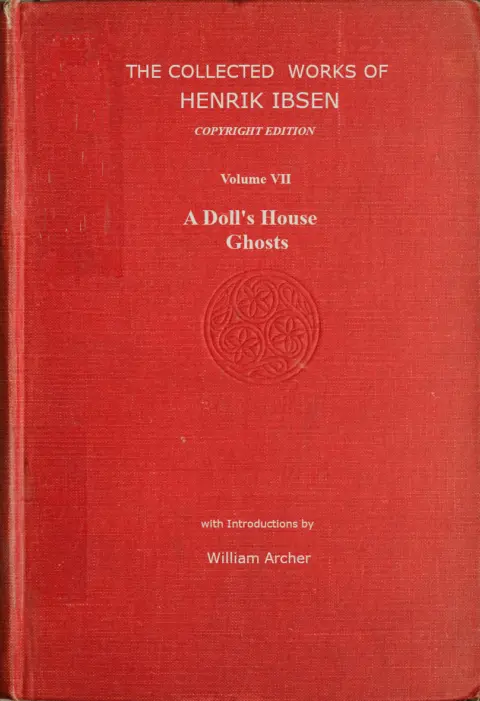
"The Collected Works of Henrik Ibsen, Vol. 07 (of 11)" by Henrik Ibsen is a collection of dramatic works from the late 19th century. This volume includes the renowned plays "A Doll’s House" and "Ghosts," both of which explore complex themes of morality, social norms, and the intricacies of human relationships. The main character in "A Doll’s House," Nora, is portrayed as a seemingly frivolous woman who undergoes a profound personal awakening, while "Ghosts" delves into familial legacy and societal hypocrisy. The opening of "A Doll’s House" introduces us to Nora Helmer, who is bustling about her home in the excitement of preparing for Christmas. She engages in playful banter with her husband, Torvald Helmer, showcasing their seemingly happy but complex relationship. As Nora remembers her past struggles, including the sacrifices she made for Torvald's health, we glimpse her inner turmoil and the weight of a secret that threatens to disrupt their domestic bliss. The scene sets up the tensions that will unravel as the plot progresses, hinting at Nora's journey of self-discovery and the challenging realities of her marriage.
Introduction adapted from the source catalogue; source summaries may be automatically generated.
Free to read · English · 53,383 words · No account needed
MAKE TIME FOR A GOOD BOOK
On by default. Untick to stop anonymous reading totals. Each page counts after 10 seconds in view. How this works.
Anonymous counting is on unless you have switched it off.
I could do no less for my father.
And I am to keep him so long! That is the best of all.
You are going to pass the winter at home, I hear.
My stay is indefinite, sir.—But, ah! it is good to be at home!
[Beaming.] Yes, isn’t it, dear?
[Looking sympathetically at him.] You went out into the world early,
my dear Oswald.
I did. I sometimes wonder whether it wasn’t too early.
Oh, not at all. A healthy lad is all the better for it; especially when he’s an only child. He oughtn’t to hang on at home with his mother and father, and get spoilt.
That is a very disputable point, Mrs. Alving. A child’s proper place is, and must be, the home of his fathers.
There I quite agree with you, Pastor Manders.
Only look at your own son—there is no reason why we should not say it in his presence—what has the consequence been for him? He is six or seven and twenty, and has never had the opportunity of learning what a well-ordered home really is.
I beg your pardon, Pastor; there you’re quite mistaken.
Indeed? I thought you had lived almost exclusively in artistic circles.
So I have.
And chiefly among the younger artists?
Yes, certainly.
But I thought few of those young fellows could afford to set up house
and support a family.
There are many who cannot afford to marry, sir.
Yes, that is just what I say.
But they may have a home for all that. And several of them have, as a matter of fact; and very pleasant, well-ordered homes they are, too.
[MRS. ALVING follows with breathless interest; nods, but says
nothing.
But I’m not talking of bachelors’ quarters. By a “home” I understand the home of a family, where a man lives with his wife and children.
Yes; or with his children and his children’s mother.
[Starts; clasps his hands.] But, good heavens——
Well?
Lives with—his children’s mother!
Yes. Would you have him turn his children’s mother out of doors?
Then it is illicit relations you are talking of! Irregular marriages, as
people call them!
I have never noticed anything particularly irregular about the life
these people lead.
But how is it possible that a—a young man or young woman with any decency of feeling can endure to live in that way?—in the eyes of all the world!
Your reading position is saved on this browser. Take it to another device with a library code. Reading pages adapt to text, rather than matching a printed edition.
BEHIND THE BOOK
This eBook is for the use of anyone anywhere in the United States and most other parts of the world at no cost and with almost no restrictions whatsoever. You may copy it, give it away or re-use it under the terms of the Project Gutenberg License included with this eBook or online at www.gutenberg.org. If you are not located in the United States, you will have to check the laws of the country where you are located before using this eBook. Read the source licence.
The original source file, including credits and licence, is retained by this library. Request an original-format copy at no charge. Please include the book title and Project Gutenberg identifier #70566.
KEEP YOUR CURIOSITY GOING
Maurice Baring
W. B. (William Butler) Yeats
Edward Martyn

John Brougham & Charlotte Brontë
Marguerite Merington
Leonid Andreyev


