
The wild duck
Henrik Ibsen
THE CLASSIC COLLECTION · 1906
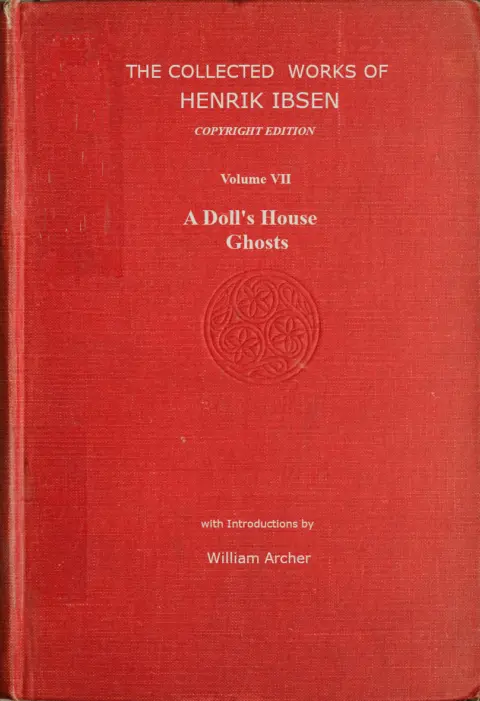
"The Collected Works of Henrik Ibsen, Vol. 07 (of 11)" by Henrik Ibsen is a collection of dramatic works from the late 19th century. This volume includes the renowned plays "A Doll’s House" and "Ghosts," both of which explore complex themes of morality, social norms, and the intricacies of human relationships. The main character in "A Doll’s House," Nora, is portrayed as a seemingly frivolous woman who undergoes a profound personal awakening, while "Ghosts" delves into familial legacy and societal hypocrisy. The opening of "A Doll’s House" introduces us to Nora Helmer, who is bustling about her home in the excitement of preparing for Christmas. She engages in playful banter with her husband, Torvald Helmer, showcasing their seemingly happy but complex relationship. As Nora remembers her past struggles, including the sacrifices she made for Torvald's health, we glimpse her inner turmoil and the weight of a secret that threatens to disrupt their domestic bliss. The scene sets up the tensions that will unravel as the plot progresses, hinting at Nora's journey of self-discovery and the challenging realities of her marriage.
Introduction adapted from the source catalogue; source summaries may be automatically generated.
Free to read · English · 53,383 words · No account needed
MAKE TIME FOR A GOOD BOOK
On by default. Untick to stop anonymous reading totals. Each page counts after 10 seconds in view. How this works.
Anonymous counting is on unless you have switched it off.
In the United States, the first performance of the play in English took place at the Berkeley Lyceum, New York City, on January 5, 1894. The production was described by Mr. W. D. Howells as “a great theatrical event—the very greatest I have ever known.” Other leading men of letters were equally impressed by it. Five years later, a second production took place at the Carnegie Lyceum; and an adventurous manager has even taken the play on tour in the United States. The Italian version of the tragedy, Gli Spettri, has ever since 1892 taken a prominent place in the repertory of the great actors Zaccone and Novelli, who have acted it, not only throughout Italy, but in Austria, Germany, Russia, Spain, and South America.
In an interview, published immediately after Ibsen’s death, Björnstjerne Björnson, questioned as to what he held to be his brother-poet’s greatest work, replied, without a moment’s hesitation, Gengangere. This dictum can scarcely, I think, be accepted without some qualification. Even confining our attention to the modern plays, and leaving out of comparison The Pretenders, Brand, and Peer Gynt, we can scarcely call Ghosts Ibsen’s richest or most human play, and certainly not his profoundest or most poetical. If some omnipotent Censorship decreed the annihilation of all his works save one, few people, I imagine, would vote that that one should be Ghosts. Even if half a dozen works were to be saved from the wreck, I doubt whether I, for my part, would include Ghosts in the list. It is, in my judgment, a little bare, hard, austere. It is the first work in which Ibsen applies his new technical method—evolved, as I have suggested, during the composition of A Doll’s House—and he applies it with something of fanaticism. He is under the sway of a prosaic ideal—confessed in the phrase, “My object was to make the reader feel that he was going through a piece of real experience”—and he is putting some constraint upon the poet within him. The action moves a little stiffly, and all in one rhythm. It lacks variety and suppleness. Moreover, the play affords some slight excuse for the criticism which persists in regarding Ibsen as a preacher rather than as a creator—an author who cares more for ideas and doctrines than for human beings. Though Mrs. Alving, Engstrand and Regina are rounded and breathing characters, it cannot be denied that Manders strikes one as a clerical type rather than an individual, while even Oswald might not quite unfairly be described as simply and solely his father’s son, an object-lesson in heredity. We cannot be said to know him, individually and intimately, as we know Helmer or Stockmann, Hialmar Ekdal or Gregers Werle. Then, again, there are one or two curious flaws in the play. The question whether Oswald’s “case” is one which actually presents itself in the medical books seems to me of very trifling moment. It is typically true, even if it be not true in detail. The suddenness of the catastrophe may possibly be exaggerated, its premonitions and even its essential nature may be misdescribed. On the other hand, I conceive it probable that the poet had documents to found upon, which may be unknown to his critics. I have never taken any pains to satisfy myself upon the point, which seems to me quite immaterial. There is not the slightest doubt that the life-history of a Captain Alving may, and often does, entail upon posterity consequences quite as tragic as those which ensue in Oswald’s case, and far more wide-spreading. That being so, the artistic justification of the poets presentment of the case is certainly not dependent on its absolute scientific accuracy. The flaws above alluded to are of another nature. One of them is the prominence given to the fact that the Asylum is uninsured. No doubt there is some symbolical purport in the circumstance; but I cannot think that it is either sufficiently clear or sufficiently important to justify the emphasis thrown upon it at the end of the second act. Another dubious point is Oswald’s argument in the first act as to the expensiveness of marriage as compared with free union. Since the parties to free union, as he describes it, accept all the responsibilities of marriage, and only pretermit the ceremony, the difference of expense, one would suppose, must be neither more nor less than the actual marriage fee. I have never seen this remark of Oswald’s adequately explained, either as a matter of economic fact, or as a trait of character. Another blemish, of somewhat greater moment, is the inconceivable facility with which, in the third act, Manders suffers himself to be victimised by Engstrand. All these little things, taken together, detract, as it seems to me, from the artistic completeness of the play, and impair its claim to rank as the poet’s masterpiece. Even in prose drama, his greatest and most consummate achievements were yet to come.
Your reading position is saved on this browser. Take it to another device with a library code. Reading pages adapt to text, rather than matching a printed edition.
BEHIND THE BOOK
This eBook is for the use of anyone anywhere in the United States and most other parts of the world at no cost and with almost no restrictions whatsoever. You may copy it, give it away or re-use it under the terms of the Project Gutenberg License included with this eBook or online at www.gutenberg.org. If you are not located in the United States, you will have to check the laws of the country where you are located before using this eBook. Read the source licence.
The original source file, including credits and licence, is retained by this library. Request an original-format copy at no charge. Please include the book title and Project Gutenberg identifier #70566.
KEEP YOUR CURIOSITY GOING
Maurice Baring
W. B. (William Butler) Yeats
Edward Martyn

John Brougham & Charlotte Brontë
Marguerite Merington
Leonid Andreyev


