
The wild duck
Henrik Ibsen
THE CLASSIC COLLECTION · 1894
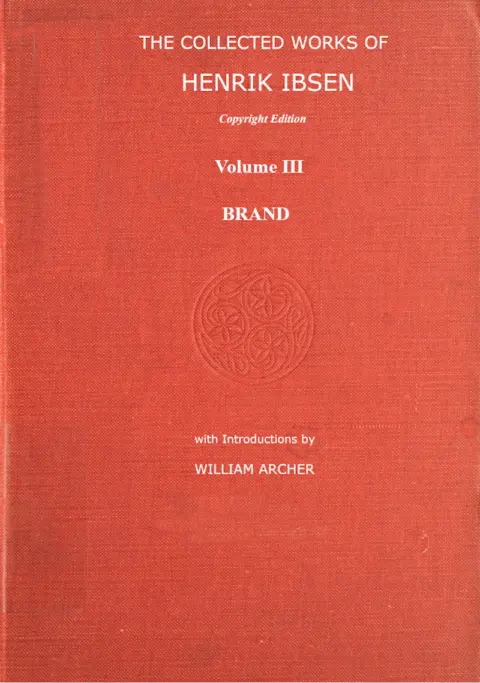
"The Collected Works of Henrik Ibsen, Vol. 03" by Henrik Ibsen is a collection of dramatic works, specifically focusing on the play "Brand," which was written in the mid-19th century. This volume not only includes the text of the play but also features an introduction that discusses its significance in Scandinavian literature and Ibsen's exploration of existential themes. The central character, Brand, is portrayed as a priest grappling with profound moral questions and the struggle between individual will and societal norms. The opening of "Brand" introduces the titular character as he navigates a treacherous mountain landscape, accompanied by a peasant and his son. The setting conveys a sense of isolation and impending danger as Brand remains steadfast in his mission, seemingly driven by divine purpose, refusing to turn back despite warnings. This initial encounter sets the stage for Brand’s uncompromising worldview, emphasizing themes of faith, sacrifice, and the human condition. Through these interactions, Ibsen introduces the audience to the complex moral fabric that will define the rest of the play, showcasing Brand's determination to confront life’s challenges, no matter the cost.
Introduction adapted from the source catalogue; source summaries may be automatically generated.
Free to read · English · 42,647 words · No account needed
MAKE TIME FOR A GOOD BOOK
On by default. Untick to stop anonymous reading totals. Each page counts after 10 seconds in view. How this works.
Anonymous counting is on unless you have switched it off.
From the vale they follow’d thronging,
Never one has reached the height.
Through all bosoms thrill’d the longing
For a greater Day’s dawn-light;
Through all souls subduing strode
The alarum-call of God.
But the sacrifice they dread!
Will, the weakling, hides his head;—
One man died for them of yore,—
Cowardice is crime no more!
[Sinks down on a stone, and looks with
shrinking gaze around.]
Oft I shudder’d at their doom;
And I walk’d, with horror quivering,
As a little child walks shivering
Amid shrieking shapes that loom
In a dim and haunted room.
But I check’d my bosom’s quaking,
And bethought me, and consoled it:
Out of doors the day is breaking,
Not of night it is, this gloom,
But the shutters barr’d enfold it;
And I thought, the day inwelling,
Rich with summer’s golden bloom,
Shall anon prevail, expelling
All the darkness that is dwelling
In the dim and haunted room.
O how bitter my dismay!
Pitchy darkness on me broke,—
And, without, a nerveless folk
Sat forlorn by fjord and bay,
Dim traditions treasuring
While their sotted souls decay.
Even as, year by year, the king
Treasured up his Snefrid dead,
Loosed the linen shroud o’erspread
By her mute heart listening low,
Still upon hope’s fragments fed,
Thinking, “Now the roses red
In her pallid ashes blow!”
None, like him, arose, and gave
The grave’s debt unto the grave;
None among them wise to know:
“Dreaming cannot kindle dust,
Down into the earth it must,
Dust is only made to breed
Nurture for the new-sown seed.”
Night, black night,—and night again
Over children, women, men!
O could I with levin-flame
Save them from the straw-death’s shame!
[Leaps up.]
Gloomy visions I see sweep
Like the Wild Hunt through the night.
Lo, the Time is Tempest-dight,
Calls for heroes, death to dare,
Calls for naked steel to leap,
And for scabbards to hang bare;—
Kinsfolk, lo, to battle riding,
While their gentle brothers, hiding,
From the hat of darkness peep.
And yet more I do divine—
All the horror of their shame,—
Men that shriek and wives that whine,
Deaf to every cry and claim,
See them on their brows imprinting
“Poor folks sea-bound” for their name,
“Humble farthings of God’s minting!”
Pale they listen to the fray,—
Willing-weakness for their shield.—
Rainbow o’er the mead of May,
Flag, where fliest thou now afield?
Where’s that tricolor to-day,—
Which the wind of myriad song,
Beat and bellied from the mast
Till a zealot king at last
Split it into teeth and tongue?
But you used the tongue to brag;
And what boots the toothed flag
If the dragon dares not bite?
Would the folk had spared those cheers,
And the zealot king those shears!
Four-square flag of peace suffices,
When a stranded craft capsizes,
To give warning of her plight!
Direr visions, worse foreboding,
Glare upon me through the gloom!
Britain’s smoke-cloud sinks corroding
On the land in noisome fume;
Smirches all its tender bloom,
All its gracious verdure dashes,
Sweeping low with breath of bane,
Stealing sunlight from the plain,
Showering down like rain of ashes
On the city of God’s doom.—
Fouler featured men are grown;—
Dropping water’s humming drone
Echoes through the mine’s recesses:
Bustling, smug, a pigmy pack
Plucks its prey from ore’s embraces,
Walks with crooked soul and back,
Glares like dwarfs with greedy eyes
For the golden glittering lies;
Speechless souls with lips unsmiling,
Hearts that fall of brothers rends not,
Nor their own to fury frets,
Hammer-wielding, coining, filing;
Light’s last gleam forlornly flies;
For this bastard folk forgets
That the need of willing ends not
When the power of willing dies!
Direr visions, direr doom,
Glare upon me through the gloom.
Craft, the wolf, with howl and yell,
Bays at Wisdom, sun of earth;
Cries of ruin ring to North,
Call to arms by fjord and fell;
And the pigmy, quaking, grim,
Hisses: “What is that to him?”
Let the other nations glow,
Let the mighty meet the foe,
We can ill afford to bleed,—
We are weak, may fairly plead
From a giants’ war exemption,
Need not offer All as meed
For our fraction of Redemption.
Not for us the cup He drank,
Not for us the thorny wreath
In His temples drove its teeth,
Not for us the spear-shaft sank
In the Side whose life was still.
Not for us the burning thrill
Of the nails that clove and tore.
We, the weak, the least accounted,
Battle-summons may ignore!
Not for us the Cross He mounted!
Just the stirrup-slash’s stain,
Just the gash the cobbler scored
In the shoulder of the Lord,
Is our portion of His pain!
[Throws himself down in the snow and covers
his face; presently he looks up.]
Was I dreaming! Dream I still?
Mist-enshrouded is the hill.
Were those visions but the vain
Phantoms of a fever’d brain?
Is the image clean outworn
Whereunto Man’s soul was born?
Is the Maker’s spirit fled——
[Listening.]
Ha, what song breaks overhead?
Your reading position is saved on this browser. Take it to another device with a library code. Reading pages adapt to text, rather than matching a printed edition.
BEHIND THE BOOK
This eBook is for the use of anyone anywhere in the United States and most other parts of the world at no cost and with almost no restrictions whatsoever. You may copy it, give it away or re-use it under the terms of the Project Gutenberg License included with this eBook or online at www.gutenberg.org. If you are not located in the United States, you will have to check the laws of the country where you are located before using this eBook. Read the source licence.
The original source file, including credits and licence, is retained by this library. Request an original-format copy at no charge. Please include the book title and Project Gutenberg identifier #66238.
KEEP YOUR CURIOSITY GOING
Maurice Baring
W. B. (William Butler) Yeats
Edward Martyn

John Brougham & Charlotte Brontë
Marguerite Merington
Leonid Andreyev


