
The wild duck
Henrik Ibsen
THE CLASSIC COLLECTION · 1894
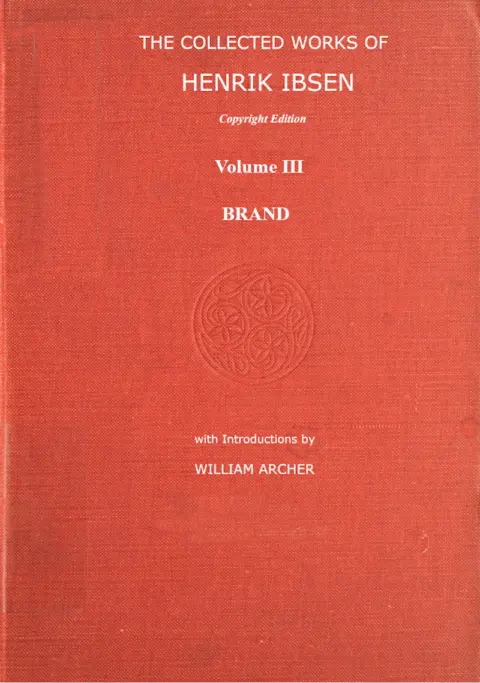
"The Collected Works of Henrik Ibsen, Vol. 03" by Henrik Ibsen is a collection of dramatic works, specifically focusing on the play "Brand," which was written in the mid-19th century. This volume not only includes the text of the play but also features an introduction that discusses its significance in Scandinavian literature and Ibsen's exploration of existential themes. The central character, Brand, is portrayed as a priest grappling with profound moral questions and the struggle between individual will and societal norms. The opening of "Brand" introduces the titular character as he navigates a treacherous mountain landscape, accompanied by a peasant and his son. The setting conveys a sense of isolation and impending danger as Brand remains steadfast in his mission, seemingly driven by divine purpose, refusing to turn back despite warnings. This initial encounter sets the stage for Brand’s uncompromising worldview, emphasizing themes of faith, sacrifice, and the human condition. Through these interactions, Ibsen introduces the audience to the complex moral fabric that will define the rest of the play, showcasing Brand's determination to confront life’s challenges, no matter the cost.
Introduction adapted from the source catalogue; source summaries may be automatically generated.
Free to read · English · 42,647 words · No account needed
MAKE TIME FOR A GOOD BOOK
On by default. Untick to stop anonymous reading totals. Each page counts after 10 seconds in view. How this works.
Anonymous counting is on unless you have switched it off.
And Mercy’s is——
BRAND.
[Peremptorily.]
Beset with crosses.
AGNES.
[Gazes before her; then, trembling.]
Now manifest and open lies,
Abysmal as the depths of space,
That mystic Word.
What word?
He dies
Who sees Jehovah face to face.
BRAND.
[Throws his arms about her and clasps her close.]
O look not on Him! Close thine eyes!
Hide thee, O hide thee!
Must I?
BRAND.
[Lets her go.]
No.
Thou sufferest, Brand.
Thou art so dear.
Thou lov’st me, but thy love I fear.
’Tis stern.
Too stern?
Ask not; whereso
Thou goest, I will also go!
Think’st thou without design I won thee
Out of thy gladsome gay content,
Or, half in earnest, laid upon thee
The call to self-abandonment?
Woe to us both; too dear we paid,
Too vast a sacrifice we made;
Thou art my wife: I crave thee all
To live according to our call.
Crave; only leave me not.
Indeed
I must; for rest and peace I need.
Soon shall the great new Church arise!
My little Church a ruin lies.
It was a blessed wind that blew
And thy heart’s idol overthrew!
[Clasps her as if in dread.]
Peace be upon thee—and, through thee,
Peace also upon mine and me!
[Goes towards the side-door.
Brand, may I softly set ajar
One hateful window-barrier,—so?
Only a little? May I?
BRAND.
[In the doorway.]
No.
[Goes into his room.
Closed, all closed with bolt and bar!
Seals on every passion set!
Seal’d to sorrow and to sigh,
Seal’d the grave and seal’d the sky,
Seal’d to feel—and to forget!
I will out! I gasp for breath
In this lonely house of death.
Out? Oh, whither? Angry eyes
Glare upon me from the skies!
Can I, flying, high or low,
Bear my treasure where I go?
Can I from my breast unsphere
The mute vacancy of fear?—
[Listens at BRAND’S door.]
Loud he reads, he cannot hear.
There’s no comfort! There’s no way
God is busy; lists to-day
But to song and praise and blessing
Of the happy, child-possessing,
Richly-gifted of the earth.
Christmas is the feast of mirth.
Me He sees not, nor takes heed
Of a lonely mother’s need.—
[Goes cautiously to the window.]
Shall I draw the curtain back,
Till the clear and kindly ray
Chase the horror of night away
From his chamber bare and black?
Nay, he is not there at all.
Yule’s the children’s festival,
He hath got him leave to rise,
Haply now he stands, and cries,
Stretches little arms in vain
To his mother’s darken’d pane.
Was not that a baby’s voice?
Alf, I’ve neither will nor choice!
All is barr’d and bolted here.
’Tis thy father’s bidding, dear!
Alf, I may not open now!
An obedient child art thou!
We ne’er grieved him, thou and I.
Oh, fly home then to the sky,
There is gladness, there is light,
There thy merry comrades stay
Till thou come to join their play.
Oh, but weep not in their sight,
Nor to any soul betray
That thy father bade me lock,
When thy little hand did knock.
Years bring sterner, sadder stress
Than a little child may guess.
Say, he sorrow’d, say, he sigh’d;
Say, he wove the garden’s pride
All into a wreath for thee.
’Tis his doing! Canst thou see?
[Listens, starts, and shakes her head.]
Oh, I dream! Not bar and wall
Only from my love divide me.
When the purging fire hath tried me
In its anguish, then alone
Shall the parting barriers fall
And the mighty bolts be batter’d,
And the vaulted dungeons shatter’d,
And the prison hinges groan!
Much, oh, much is to be done
Ere we parted twain be one.
I with silent, toiling hands
Still will labour on, to fill
The abyss of his commands;
I shall nerve me, I shall will.
But it is the Feast this eve—
Last year’s how unlike! And wait
We will honour it in state.
I will fetch my treasures forth,
Whereof the uncounted worth
Best a mother can conceive,
To whose spirit they express
All her life-lost happiness.
Your reading position is saved on this browser. Take it to another device with a library code. Reading pages adapt to text, rather than matching a printed edition.
BEHIND THE BOOK
This eBook is for the use of anyone anywhere in the United States and most other parts of the world at no cost and with almost no restrictions whatsoever. You may copy it, give it away or re-use it under the terms of the Project Gutenberg License included with this eBook or online at www.gutenberg.org. If you are not located in the United States, you will have to check the laws of the country where you are located before using this eBook. Read the source licence.
The original source file, including credits and licence, is retained by this library. Request an original-format copy at no charge. Please include the book title and Project Gutenberg identifier #66238.
KEEP YOUR CURIOSITY GOING
Maurice Baring
W. B. (William Butler) Yeats
Edward Martyn

John Brougham & Charlotte Brontë
Marguerite Merington
Leonid Andreyev


