
The wild duck
Henrik Ibsen
THE CLASSIC COLLECTION · 1894
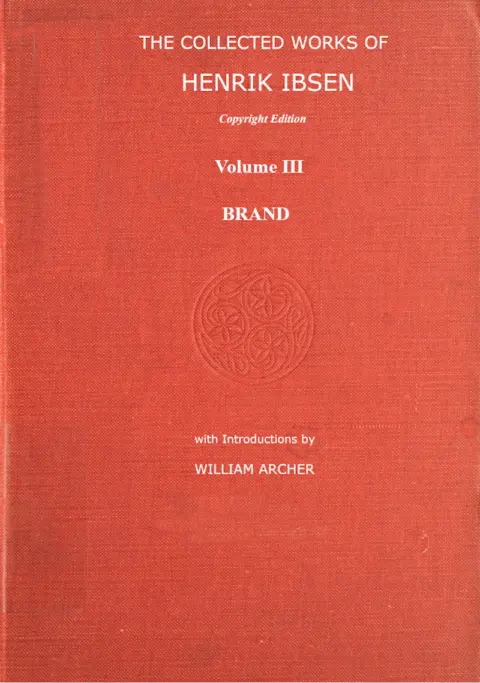
"The Collected Works of Henrik Ibsen, Vol. 03" by Henrik Ibsen is a collection of dramatic works, specifically focusing on the play "Brand," which was written in the mid-19th century. This volume not only includes the text of the play but also features an introduction that discusses its significance in Scandinavian literature and Ibsen's exploration of existential themes. The central character, Brand, is portrayed as a priest grappling with profound moral questions and the struggle between individual will and societal norms. The opening of "Brand" introduces the titular character as he navigates a treacherous mountain landscape, accompanied by a peasant and his son. The setting conveys a sense of isolation and impending danger as Brand remains steadfast in his mission, seemingly driven by divine purpose, refusing to turn back despite warnings. This initial encounter sets the stage for Brand’s uncompromising worldview, emphasizing themes of faith, sacrifice, and the human condition. Through these interactions, Ibsen introduces the audience to the complex moral fabric that will define the rest of the play, showcasing Brand's determination to confront life’s challenges, no matter the cost.
Introduction adapted from the source catalogue; source summaries may be automatically generated.
Free to read · English · 42,647 words · No account needed
MAKE TIME FOR A GOOD BOOK
On by default. Untick to stop anonymous reading totals. Each page counts after 10 seconds in view. How this works.
Anonymous counting is on unless you have switched it off.
But if he might? What “Isaac’s Fear”
Once ventured, He may venture here.
[Shakes off the thought.]
No, no, my sacrifice is made,
The calling of my life gainsaid—
Like the Lord’s thunder to go forth
And rouse the sleepers of the earth.
Sacrifice! Liar! there was none!
I miss’d it when my Dream was done,
When Agnes woke me—and follow’d free
To labour in the gloom with me.
[Looks along the road.]
Why tarries still the dying call,
Her word, that she will offer all,
That she has won that which uproots
Sin’s deepest fibres, rankest shoots!
See there——! No, it is but the Mayor,
Well-meaning, brisk, and debonnaire,
Both hands in pockets, round, remiss,
A bracketed parenthesis.
Enter MAYOR.
THE MAYOR.
[Through the garden gate.]
Good-day! Our meetings are but rare,
Perhaps my time is chosen amiss——
BRAND.
[Pointing to house.]
Come in.
Thanks; here I’m quite content.
Should my proposal meet assent,
I’m very sure the upshot of it
Would issue in our common profit.
Name your desire.
Your mother’s state,
I understand, is desperate.
I’m sorry.
That I do not doubt.
I’m very sorry.
Pray, speak out.
She’s old, however. Welladay,
We are all bound the selfsame way—
And, as I just drove by, occurr’d
The thought that, after all, “to leap
Is just as easy as to creep”:
Moreover, many have averr’d,
That she and you have been imbrued
For years in a domestic feud——
Domestic feud?
She’s out and out
Close-fisted, so they say, you know.
You think it goes too far, no doubt.
A man’s own claims he can’t forego.
She keeps exclusive occupation
Of all that was bequeath’d to you.
Exclusive occupation, true.
A ready cause of irritation
In families. Surmising thence
That you await with resignation
The moment of her going hence,
I hope I may without offence
Speak out, although I quite admit
The time I’ve chosen is unfit.
Or now or later, nought I care.
Well, to the point then, fair and square.
When once your mother’s dead and blest,
In the earth’s bosom laid to rest,
You’re rich!
You think so?
Think? Nay, man,
That’s sure. She’s land in every port,
Far as a telescope can scan.
You’re rich!
’Spite the Succession Court?
THE MAYOR.
[Smiling.]
What of it? That cuts matters short
When many fight for pelf and debt.
Here no man’s interest suffers let.
Your reading position is saved on this browser. Take it to another device with a library code. Reading pages adapt to text, rather than matching a printed edition.
BEHIND THE BOOK
This eBook is for the use of anyone anywhere in the United States and most other parts of the world at no cost and with almost no restrictions whatsoever. You may copy it, give it away or re-use it under the terms of the Project Gutenberg License included with this eBook or online at www.gutenberg.org. If you are not located in the United States, you will have to check the laws of the country where you are located before using this eBook. Read the source licence.
The original source file, including credits and licence, is retained by this library. Request an original-format copy at no charge. Please include the book title and Project Gutenberg identifier #66238.
KEEP YOUR CURIOSITY GOING
Maurice Baring
W. B. (William Butler) Yeats
Edward Martyn

John Brougham & Charlotte Brontë
Marguerite Merington
Leonid Andreyev


