
The wild duck
Henrik Ibsen
THE CLASSIC COLLECTION · 1894
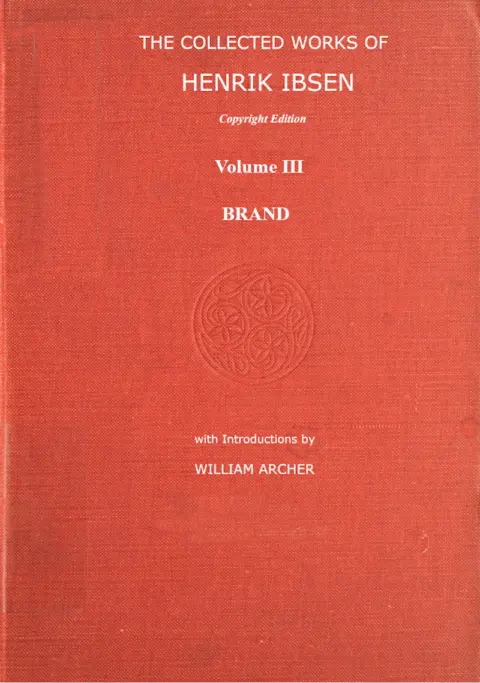
"The Collected Works of Henrik Ibsen, Vol. 03" by Henrik Ibsen is a collection of dramatic works, specifically focusing on the play "Brand," which was written in the mid-19th century. This volume not only includes the text of the play but also features an introduction that discusses its significance in Scandinavian literature and Ibsen's exploration of existential themes. The central character, Brand, is portrayed as a priest grappling with profound moral questions and the struggle between individual will and societal norms. The opening of "Brand" introduces the titular character as he navigates a treacherous mountain landscape, accompanied by a peasant and his son. The setting conveys a sense of isolation and impending danger as Brand remains steadfast in his mission, seemingly driven by divine purpose, refusing to turn back despite warnings. This initial encounter sets the stage for Brand’s uncompromising worldview, emphasizing themes of faith, sacrifice, and the human condition. Through these interactions, Ibsen introduces the audience to the complex moral fabric that will define the rest of the play, showcasing Brand's determination to confront life’s challenges, no matter the cost.
Introduction adapted from the source catalogue; source summaries may be automatically generated.
Free to read · English · 42,647 words · No account needed
MAKE TIME FOR A GOOD BOOK
On by default. Untick to stop anonymous reading totals. Each page counts after 10 seconds in view. How this works.
Anonymous counting is on unless you have switched it off.
And indeed
I’m weary too, to tell the truth,—
And here our footing asks more heed
Than on yon upland broad and smooth.
But once we’re on the level plain
We’ll dance defiantly once more,
Ay, in a tenfold wilder vein
And tenfold swifter than before.
See Agnes, yon blue line that sparkles,
Fresh from the young sun’s morning kiss,
And now it dimples and now darkles,
Silver one moment, amber this;
It is the ocean glad and free
That in the distance thou dost see.
And seest thou the smoky track
In endless line to leeward spread?
And seest thou the point of black
Just rounding now the furthest head?
It is the steamer—thine and mine—
And now it speeds into the fjord,
Then out into the foaming brine
To-night with thee and me on board!—
The mists have veil’d the mountain brow—
Saw’st thou how vividly, but now,
Heaven’s image in the water woke!
AGNES.
[Looking absently about her.]
Oh, yes. But tell me—sawest thou——?
What?
AGNES.
[In a hushed voice, without looking at him.]
How he tower’d as he spoke?
[She goes down over the pass, EINAR follows.
[A path along the crags, with a wild valley beyond to the right. Above, and beyond the mountain, are glimpses of greater heights, with peaks and snow.]
BRAND.
[Comes up along the path, descends, stops half-way upon a
jutting crag, and gazes into the valley.]
Yes, I know myself once more!
Every boat-house by the shore,
Every home; the landslip-fall,
And the inlet’s fringe of birch,
And the ancient moulder’d church,
And the river alders, all
From my boyhood I recall.
But methinks it all has grown
Grayer, smaller than I knew;
Yon snow-cornice hangs more prone
Than of old it used to do,
From that scanty heaven encloses
Yet another strip of blue,
Beetles, looms, immures, imposes—
Steals of light a larger due.
[Sits down and gazes into the distance.]
And the fjord too. Crouch’d it then
In so drear and deep a den?
’Tis a squall. A square-rigg’d skiff
Scuds before it to the land.
Southward, shadow’d by the cliff,
I descry a wharf, a shed,
Then, a farm house, painted red.—
’Tis the farm beside the strand!
’Tis the widow’s farm. The home
Of my childhood. Thronging come
Memories born of memories dead.
I, where yonder breakers roll,
Grew, a lonely infant-soul.
Like a nightmare on my heart
Weighs the burden of my birth,
Knit to one, who walks apart
With her spirit set to earth.
All the high emprise that stirr’d
In me, now is veil’d and blurr’d.
Force and valour from me fail,
Heart and soul grow faint and frail
As I near my home, I change,
To my very self grow strange—
Wake, as baffled Samson woke,
Shorn and fetter’d, tamed and broke.
[Looks again down into the valley.]
What is stirring down below?
Out of every garth they flow,
Troops of children, wives and men,
And in long lines meet and mingle,
Now among the rocks and shingle
Vanish, now emerge again;—
To the ancient Church they go.
[Rises.]
Oh, I know you, through and through!
Sluggard spirits, souls of lead!
All the Lord’s Prayer, said by you,
Is not with such anguish sped,
By such passion borne on high,
That one tittle thrills the sky
As a ringing human cry,
Save the prayer for daily bread!
That’s this people’s battle-call,
That’s the blazon of them all!
From its context pluck’d apart,
Branded deep in every heart—
There it lies, the tempest-tost
Wreckage of the Faith you’ve lost.
Forth! out of this stifling pit!
Vault-like is the air of it!
Not a Flag may float unfurl’d
In this dead and windless world!
Your reading position is saved on this browser. Take it to another device with a library code. Reading pages adapt to text, rather than matching a printed edition.
BEHIND THE BOOK
This eBook is for the use of anyone anywhere in the United States and most other parts of the world at no cost and with almost no restrictions whatsoever. You may copy it, give it away or re-use it under the terms of the Project Gutenberg License included with this eBook or online at www.gutenberg.org. If you are not located in the United States, you will have to check the laws of the country where you are located before using this eBook. Read the source licence.
The original source file, including credits and licence, is retained by this library. Request an original-format copy at no charge. Please include the book title and Project Gutenberg identifier #66238.
KEEP YOUR CURIOSITY GOING
Maurice Baring
W. B. (William Butler) Yeats
Edward Martyn

John Brougham & Charlotte Brontë
Marguerite Merington
Leonid Andreyev


