
The wild duck
Henrik Ibsen
THE CLASSIC COLLECTION · 1906
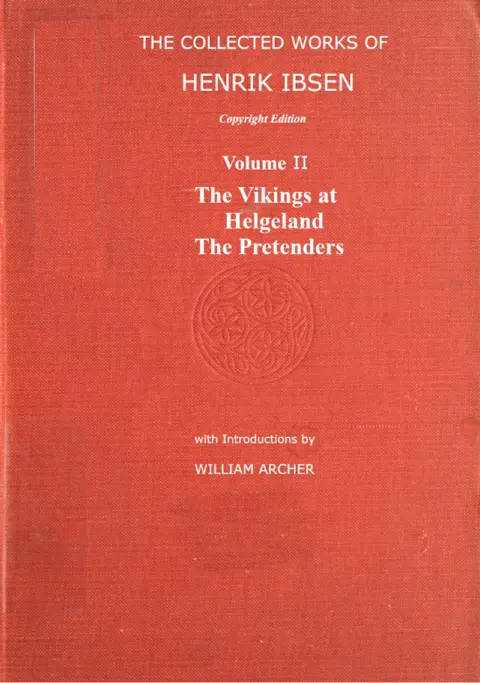
"The Collected Works of Henrik Ibsen, Vol. 02 (of 11)" by Henrik Ibsen is a collection of plays written in the mid-19th century. This volume includes the two dramatic works "The Vikings at Helgeland" and "The Pretenders." The themes explore complex character dynamics, societal roles, and the interplay between personal ambition and moral responsibility against the backdrop of Norse tradition and mythology. At the start of "The Vikings at Helgeland," the characters are introduced amidst a tense encounter between the Viking Sigurd and the Icelandic chieftain Örnulf. The scene sets a dramatic tone with promises of peace contrasting the potential for conflict over past grievances. Sigurd's fierce loyalty to his foster-brother Gunnar and his wife Dagny weaves a complex web of relationships that hint at future tensions, especially with the strong-willed Hiördis, Örnulf's foster-daughter. The opening also hints at underlying themes of vengeance, honor, and the consequences of past actions as characters navigate personal and familial bonds in a harsh, mythic landscape.
Introduction adapted from the source catalogue; source summaries may be automatically generated.
Free to read · English · 65,938 words · No account needed
MAKE TIME FOR A GOOD BOOK
On by default. Untick to stop anonymous reading totals. Each page counts after 10 seconds in view. How this works.
Anonymous counting is on unless you have switched it off.
[In quiet sorrow.] Now is Hiördis surely dead.
So it must be, Gunnar;—and my vengeance was rather against her than thee. Dear has this meeting been to both of us;—there is my hand; be there peace between us!
Thanks, Örnulf! And now aboard; I sail with thee to Iceland.
Ay, to Iceland! Long will it be ere our forthfaring is forgotten.
Weapon-wielding warriors’ meeting,
woful, by the norland seaboard,
still shall live in song and saga
while our stem endures in Iceland.
Footnote 7:
Failing to find a better equivalent for the Norwegian “Herse,” I have used the word “Headman” wherever it seemed necessary to give Gunnar a title or designation. He is generally spoken of as “Gunnar Herse” in the Norwegian text; but where it could be done without inconvenience, the designation has here been omitted.
Footnote 8:
“I ærlig holmgang.” The established form of duel in the viking times was to land the combatants on one of the rocky islets or “holms” that stud the Norwegian coast, and there let them fight it out. Hence “holmgang”=duel.
Footnote 9:
“At knæsætte” = to knee-set a child, to take it on one’s knee, an irrevocable form of adoption.
Footnote 10:
The giants or Titans of Scandinavian mythology.
Footnote 11:
Breastplate.
Footnote 12:
“Draugen,” a vague and horrible sea-monster.
Footnote 13:
Literally the “blood-night.”
Footnote 14:
The “Nornir” were the Fates of northern mythology.
Footnote 15:
The Valkyries.
Footnote 16:
Holmgang—see note, p. 19.
Footnote 17:
Bragi, the god of poetry and eloquence.
Footnote 18:
See note, p. 72.
Footnote 19:
Suttung was a giant who kept guard over the magic mead of poetical
inspiration.
Footnote 20:
The word “wraith” is here used in an obviously inexact sense; but the wraith seemed to be the nearest equivalent in English mythology to the Scandinavian “fylgie,” an attendant spirit, often regarded as a sort of emanation from the person it accompanied, and sometimes (as in this case) typifying that person’s moral attributes.
HÅKON HÅKONSSON, the King elected by the Birchlegs.
INGA OF VARTEIG, his mother.
EARL SKULE.
LADY RAGNHILD, his wife.
SIGRID, his sister.
MARGRETE, his daughter.
GUTHORM INGESSON.
SIGURD RIBBUNG.
NICHOLAS ARNESSON, Bishop of Oslo.
DAGFINN THE PEASANT, Håkon’s marshal.
IVAR BODDE, his chaplain.
VEGARD VÆRADAL, one of his guard.
GREGORIUS JONSSON, a nobleman.
PAUL FLIDA, a nobleman.
INGEBORG, Andres Skialdarband’s wife.
PETER, her son, a young priest.
SIRA VILIAM, Bishop Nicholas’s chaplain.
MASTER SIGARD OF BRABANT, a physician.
JATGEIR SKALD, an Icelander.
BÅRD BRATTE, a chieftain from the Trondhiem district.
Populace and Citizens of Bergen, Oslo, and Nidaros.
Priests, Monks, and Nuns.
Guests, Guards, and Ladies.
Men-at-Arms, etc. etc.
Your reading position is saved on this browser. Take it to another device with a library code. Reading pages adapt to text, rather than matching a printed edition.
BEHIND THE BOOK
This eBook is for the use of anyone anywhere in the United States and most other parts of the world at no cost and with almost no restrictions whatsoever. You may copy it, give it away or re-use it under the terms of the Project Gutenberg License included with this eBook or online at www.gutenberg.org. If you are not located in the United States, you will have to check the laws of the country where you are located before using this eBook. Read the source licence.
The original source file, including credits and licence, is retained by this library. Request an original-format copy at no charge. Please include the book title and Project Gutenberg identifier #66186.
KEEP YOUR CURIOSITY GOING

Maurice Baring
Francis Greenleaf Allinson & Anne C. E. (Anne Crosby Emery) Allinson
Maurice Baring
Stuart Dodgson Collingwood
Percy Keese Fitzhugh
W. B. (William Butler) Yeats


