
The wild duck
Henrik Ibsen
THE CLASSIC COLLECTION · 1906
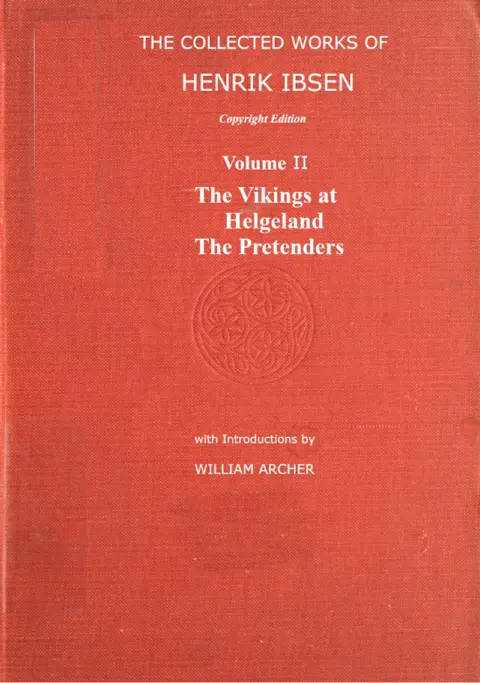
"The Collected Works of Henrik Ibsen, Vol. 02 (of 11)" by Henrik Ibsen is a collection of plays written in the mid-19th century. This volume includes the two dramatic works "The Vikings at Helgeland" and "The Pretenders." The themes explore complex character dynamics, societal roles, and the interplay between personal ambition and moral responsibility against the backdrop of Norse tradition and mythology. At the start of "The Vikings at Helgeland," the characters are introduced amidst a tense encounter between the Viking Sigurd and the Icelandic chieftain Örnulf. The scene sets a dramatic tone with promises of peace contrasting the potential for conflict over past grievances. Sigurd's fierce loyalty to his foster-brother Gunnar and his wife Dagny weaves a complex web of relationships that hint at future tensions, especially with the strong-willed Hiördis, Örnulf's foster-daughter. The opening also hints at underlying themes of vengeance, honor, and the consequences of past actions as characters navigate personal and familial bonds in a harsh, mythic landscape.
Introduction adapted from the source catalogue; source summaries may be automatically generated.
Free to read · English · 65,938 words · No account needed
MAKE TIME FOR A GOOD BOOK
On by default. Untick to stop anonymous reading totals. Each page counts after 10 seconds in view. How this works.
Anonymous counting is on unless you have switched it off.
In the meantime, almost simultaneously with the rejection of the play by the Christiania Theatre, it was rejected by the Royal Theatre in Copenhagen. The director, J. L. Heiberg, was then regarded as an autocrat in the æsthetic world; and his report on The Vikings is now a curiosity of literature. He declared that nothing was so “monotonous, tiresome and devoid of all poetry” as the Icelandic family-sagas; he could not endure their “wildness and rawness” on the stage; the saga style, as reproduced by Ibsen, seemed to him “mannered and affected”; and he concluded his judgment in these terms: “A Norwegian theatre will scarcely take its rise from such experiments, and the Danish theatre has fortunately no need for them.”
The play was published in April 1858 as a supplement to a Christiania illustrated paper, the author receiving an “honorarium” of something less than £7. On November 24, 1858, it was produced at the little “Norwegian Theatre” in Christiania, of which the poet was then director. At the Bergen Theatre it was produced in 1859, at the Christiania Theatre (by that time pretty well Norwegianised) in 1861. It did not make its way to Copenhagen and Stockholm until 1875. In 1876 it was acted at the Court Theatres of Munich and Dresden, and at the Vienna Burgtheater. Thenceforward it was pretty frequently seen on the German stage; but it does not seem to have reached Berlin (Deutsches Theater) until 1890. In 1892 it was produced in Moscow. The only production in the English language of which any account has reached me took place in 1903 at the Imperial Theatre, London, when Miss Ellen Terry appeared as Hiördis and Mr. Oscar Asche as Sigurd. The scenery and dresses were designed by Miss Terry’s son, Mr. Gordon Craig.
It would need not merely an essay, but a volume, to discuss the relation of The Vikings to its mythic material, and to other modern treatments of that material—Friedrich Hebbel’s Die Nibelungen, Richard Wagner’s Ring der Nibelungen, &c. The poet’s actual indebtedness to the Volsung-Saga is well summarised by Henrik Jæger in his “Life of Ibsen”: “Like Sigurd Fafnir’s-bane,” he says, “Sigurd Viking has achieved the deed which Hiördis (Brynhild) demands of the man who shall wed her; and, again like his heroic namesake, he has renounced her in favour of his foster-brother, Gunnar, himself taking another to wife. This other woman reveals the secret in the course of an altercation with Hiördis (Brynhild), who, in consequence of this discovery, brings about Sigurd’s death and her own. The reader will observe that we must keep to very general terms if they are to fit both the saga and the drama. Are there any further coincidences? Yes, one. After Gudrun has betrayed the secret, there comes a scene in which she seeks to appease Brynhild, and begs her to think no more of it; then follows a scene in which Sigurd explains to Brynhild how it all happened; and finally a scene in which Brynhild goads Gunnar to kill Sigurd. All these scenes have their parallels in the third act of The Vikings; but their order is different, and none of their wording has been adopted.” From the family-sagas, again, not only the stature of the characters, so to speak, but several details of incident and dialogue are borrowed. The boasting-match at Gunnar’s feast, which, as we have seen, was one of the first elements of the story to present itself to Ibsen’s mind, has many analogies in Icelandic lore. Örnulf’s questions as to how Thorolf fell are borrowed from Egils Saga, and so is the idea of his “drapa,” or funeral chant over his dead sons. Sigurd and Hiördis are, perhaps, almost as closely related to Kiartan and Gudrun in the Laxdæla Saga as to Sigurd Fafnir’s bane and Brynhild. Indeed, Ibsen seems to have reckoned too confidently on the unfamiliarity of his public with the stores of material upon which he drew. Not, of course, that there could be any question of plagiarism. The sagas were as legitimately at Ibsen’s service as were Plutarch and Holinshed at Shakespeare’s. But having been himself, as he tells us, almost ignorant of the existence of these sagas until he came across N. M. Petersen’s translation of them he forgot that people who had long known and loved them might resent the removal of this trait and that from its original setting, and might hold it to be, in its new context, degraded and sentimentalised. “It may be,” writes H. H. Boyesen, in his generally depreciatory remarks on the play, “that my fondness for these sagas themselves prevents me from relishing the modification and remoulding to which Ibsen has subjected them.” Dr. Brandes, too, points to a particular instance in which the sense of degradation could not but be felt. The day-dream as to the hair-woven bowstring which Hiördis relates to Sigurd in the third act (p. 84) is in itself effective enough; but any one who knows the splendid passage in Nials Saga, on which it is founded, cannot but feel that the actual (or at any rate legendary) event is impoverished by being dragged in under the guise of a mere morbid fantasy.
Your reading position is saved on this browser. Take it to another device with a library code. Reading pages adapt to text, rather than matching a printed edition.
BEHIND THE BOOK
This eBook is for the use of anyone anywhere in the United States and most other parts of the world at no cost and with almost no restrictions whatsoever. You may copy it, give it away or re-use it under the terms of the Project Gutenberg License included with this eBook or online at www.gutenberg.org. If you are not located in the United States, you will have to check the laws of the country where you are located before using this eBook. Read the source licence.
The original source file, including credits and licence, is retained by this library. Request an original-format copy at no charge. Please include the book title and Project Gutenberg identifier #66186.
KEEP YOUR CURIOSITY GOING

Maurice Baring
Francis Greenleaf Allinson & Anne C. E. (Anne Crosby Emery) Allinson
Maurice Baring
Stuart Dodgson Collingwood
Percy Keese Fitzhugh
W. B. (William Butler) Yeats


