
The wild duck
Henrik Ibsen
THE CLASSIC COLLECTION · 1908
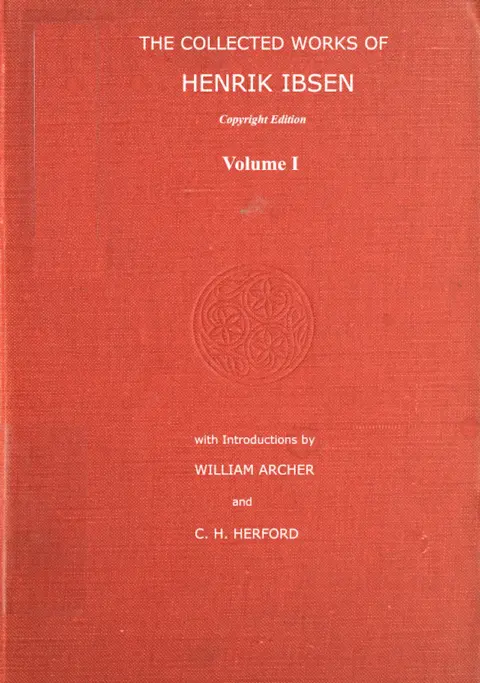
"The Collected Works of Henrik Ibsen, Vol. 01 (of 11)" by Henrik Ibsen is a collection of dramatic works written in the late 19th century. This volume includes three plays: "Lady Inger of Östråt," "The Feast at Solhoug," and "Love's Comedy." These works explore intricate themes of power dynamics, societal norms, and personal struggles, with characters that navigate the complexities of love, ambition, and familial duty. At the start of "Lady Inger of Östråt," the stage is set in the dramatic backdrop of Norway in 1528, where Lady Inger is at the center of an impending conflict. We find her receiving guests and grappling with a sense of national degradation under Danish rule, exemplified through the discussions among her servants and peasants about rising against their oppressors. The opening introduces tensions surrounding Lady Inger’s ambitions for her family and her struggles with the looming threats posed by the political landscape. The scene is charged with emotions as Elina, her daughter, reflects on the weight of their heritage and the sacrifices made for power, setting the foundation for the intricate relationships and moral dilemmas that will unfold throughout the play.
Introduction adapted from the source catalogue; source summaries may be automatically generated.
Free to read · English · 81,990 words · No account needed
MAKE TIME FOR A GOOD BOOK
On by default. Untick to stop anonymous reading totals. Each page counts after 10 seconds in view. How this works.
Anonymous counting is on unless you have switched it off.
Aha, we’ve put a bridle on you there!
The tea is good, one knows by the bouquet.
Well, let us keep the simile you chose. Love is a flower; for if heaven’s blessed rain Fall short, it all but pines to death— [Pauses.
What then?
FALK [with a gallant bow].
Then come the aunts with the reviving hose.—
But poets have this simile employed,
And men for scores of centuries enjoyed,—
Yet hardly one its secret sense has hit;
For flowers are manifold and infinite.
Say, then, what flower is love? Name me, who knows,
The flower most like it?
Why, it is the rose;
Good gracious, that’s exceedingly well known;—
Love, all agree, lends life a rosy tone.
It is the snowdrop; growing, snow enfurled; Till it peer forth, undreamt of by the world.
It is the dandelion,—made robust
By dint of human heel and horse hoof thrust;
Nay, shooting forth afresh when it is smitten,
As Pedersen so charmingly has written.
It is the bluebell,—ringing in for all
Young hearts life’s joyous Whitsun festival.
No, ’tis an evergreen,—as fresh and gay
In desolate December as in May.
No, Iceland moss, dry gathered,—far the best Cure for young ladies with a wounded breast.
No, the wild chestnut tree,—in high repute For household fuel, but with a bitter fruit.
No, a camellia; at our balls, ’tis said,
The chief adornment of a lady’s head.
No, it is like a flower, O such a bright one;— Stay now—a blue one, no, it was a white one— What is its name—? Dear me—the one I met—; Well it is singular how I forget!
None of these flower similitudes will run. The flowerpot is a likelier candidate. There’s only room in it, at once, for one; But by progressive stages it holds eight.
STRAWMAN [with his little girls round him].
No, love’s a pear tree; in the spring like snow With myriad blossoms, which in summer grow To pearlets; in the parent’s sap each shares;— And with God’s help they’ll all alike prove pears.
So many heads, so many sentences! No, you all grope and blunder off the line. Each simile’s at fault; I’ll tell you mine;— You’re free to turn and wrest it as you please.
[Rises as if to make a speech.
In the remotest east there grows a plant; And the sun’s cousin’s garden is its haunt—
Ah, it’s the tea-plant!
Your reading position is saved on this browser. Take it to another device with a library code. Reading pages adapt to text, rather than matching a printed edition.
BEHIND THE BOOK
This eBook is for the use of anyone anywhere in the United States and most other parts of the world at no cost and with almost no restrictions whatsoever. You may copy it, give it away or re-use it under the terms of the Project Gutenberg License included with this eBook or online at www.gutenberg.org. If you are not located in the United States, you will have to check the laws of the country where you are located before using this eBook. Read the source licence.
The original source file, including credits and licence, is retained by this library. Request an original-format copy at no charge. Please include the book title and Project Gutenberg identifier #66060.
KEEP YOUR CURIOSITY GOING
Maurice Baring
W. B. (William Butler) Yeats
Edward Martyn

John Brougham & Charlotte Brontë
Marguerite Merington
Leonid Andreyev


